
Free Weights vs. Machines for Building Strength: Understanding the Trade-Offs

Key Takeaways
Option A
Free Weights
The versatile, stability-demanding classic.
Best for: Lifters who want to build functional strength, coordination, and muscle across multiple planes of movement.
Option B
Resistance Machines
The guided, joint-friendly alternative.
Best for: Beginners learning movement patterns, or experienced lifters targeting specific muscles with reduced injury risk.
If you are new to strength training and learning foundational movement patterns
Resistance Machines
Machines guide your range of motion, reducing technique errors and acute injury risk while you build basic strength and body awareness.
If you want to build functional, transferable strength for everyday activities or sport
Free Weights
Free weights demand stabilizer muscle activation and multi-plane coordination, qualities that carry over more directly to real-world movement.
If you are returning from an injury or have a joint condition requiring controlled loading
Resistance Machines
Machines allow isolated loading of a target muscle with a fixed movement path, reducing unintended stress on vulnerable joints — always consult a healthcare provider first.
If you want to maximize muscle hypertrophy across your entire body efficiently
Free Weights
Compound free-weight movements like squats and rows engage large amounts of muscle mass simultaneously, making them highly efficient for overall muscle growth.
If you train alone and need to lift near your maximum without a spotter
Resistance Machines
Most machines feature built-in safety stops or weight stacks that eliminate the risk of being pinned under a failed lift, making solo heavy training safer.
The Core Difference: Stability Demands
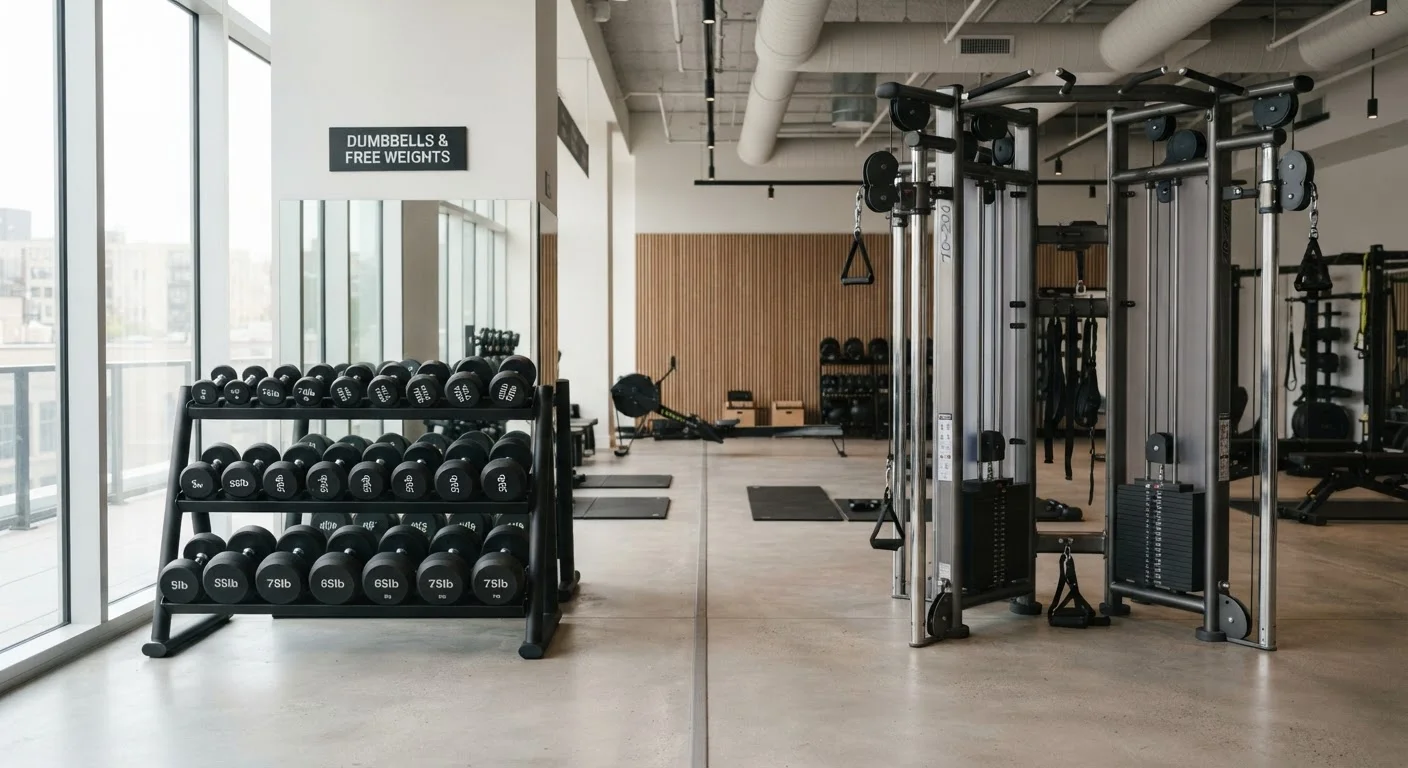
The most meaningful distinction between free weights and machines is not about which builds more muscle in the abstract — it is about who controls the path of movement. With free weights (dumbbells, barbells, kettlebells), your body must stabilize the load through its full range of motion. That responsibility falls on dozens of smaller stabilizer muscles working alongside the primary movers.
Resistance machines, by contrast, fix the movement path mechanically. The cable, lever, or guided rail removes much of the stability demand, allowing you to load the target muscle more directly. This is not a flaw — it is a deliberate design choice that serves real purposes.
Research in exercise science consistently shows that free-weight exercises produce greater activation in muscles surrounding joints compared to machine equivalents. A squat, for example, demands far more from hip abductors, spinal erectors, and ankle stabilizers than a leg press does for the same quadriceps load. For building broad, transferable strength, that added recruitment matters. For isolating a single muscle group for hypertrophy or rehabilitation, it may be an unwanted complication.
| Criterion | Free Weights | Resistance Machines |
|---|---|---|
| Stability demand | High — recruits stabilizer muscles throughout | Low — guided movement path handles stability |
| Learning curve | Steeper — technique must be learned before loading | Gentler — setup is simpler for beginners |
| Muscle isolation | Difficult — compound activation is the norm | Easier — fixed path targets specific muscles |
| Functional carryover | Higher — multi-plane, real-world movement patterns | Lower — single-plane, fixed-axis movement |
| Solo training safety | Lower at heavy loads without a spotter | Higher — built-in stops reduce failure risk |
| Equipment cost and space | Moderate — versatile but requires storage | High — machines are large and expensive |
| Exercise variety | Very high — one set of dumbbells, dozens of moves | Limited by the number of machines available |
Learning Curve and Injury Risk
Free weights carry a steeper learning curve. Exercises like the barbell deadlift or overhead press require deliberate practice of technique before meaningful loads can be added safely. Poor form under heavy free weights — a rounded lower back in a deadlift, for instance — can cause acute injury. This is not a reason to avoid them, but it is a reason to treat technique as non-negotiable from the start.
Machines compress that learning curve significantly. Because the movement path is fixed, a beginner on a chest press machine can load a challenging weight and feel the target muscle working without the technical overhead of a barbell bench press. This makes machines genuinely valuable early in a training career, and for older adults or those returning after a layoff who need to rebuild strength without high technique demands.
That said, machines are not entirely risk-free. Sitting in a poorly adjusted machine — seat height, pad position, or axis alignment set incorrectly — can place joints under abnormal stress. Proper machine setup is worth learning just as technique is for free weights.
~43%
Greater stabilizer muscle activation with free weights
A study published in the Journal of Human Kinetics found substantially higher EMG activity in stabilizer muscles during free-weight exercises compared to machine equivalents at matched loads.
2–3x
Faster technique acquisition on machines vs. free weights
Exercise science literature generally suggests beginners can reach safe working loads on machines considerably faster than on complex free-weight movements, due to the reduced motor learning requirement.
Comparing the Two Approaches Side by Side
When deciding which tool to prioritize, it helps to map each one against the dimensions that matter most for your program. The comparison above covers the most relevant factors for adults building a sustainable strength routine. Neither column dominates across every row — which is precisely why most well-designed programs borrow from both.
For example, a program might use a barbell squat or Romanian deadlift as the primary compound movement, then add machine leg curls or a cable pull-down as accessory work. The compound free-weight movement builds systemic strength and coordination; the machine work allows higher volume on a specific muscle without accumulating excessive joint fatigue.
If you train primarily at home, free weights tend to offer more exercise variety per dollar of equipment, though they require more floor space and attentiveness to form. For a broader look at training without a facility, see the honest trade-offs of home training. If you are exploring options beyond equipment entirely, bodyweight strength training has real capabilities worth understanding.
Building a Program That Uses Both
The most practical takeaway is that free weights and machines are complementary, not competing. A common and evidence-informed structure is to anchor sessions around one or two compound free-weight movements — where multi-joint coordination and overall load capacity matter — and supplement with machine or cable exercises for targeted muscle development and volume management.
Progressive overload, the principle of gradually increasing the challenge placed on muscle over time, applies equally to both tools. You can add weight, reps, sets, or reduce rest periods whether you are using a barbell or a cable stack. For ideas on progressing challenge without equipment, the principles in progressive overload at home translate well to any setting.
Strength training also works best as part of a complete fitness program. If you are weighing how to balance resistance work with aerobic training, understanding why strength training and cardio complement each other is a useful next step.
This article is for general informational and educational purposes only and is not a substitute for professional medical or fitness advice. If you have any health conditions, injuries, or concerns, consult a qualified healthcare provider or certified fitness professional before beginning or modifying a strength training program.