

Key Takeaways
Our Verdict
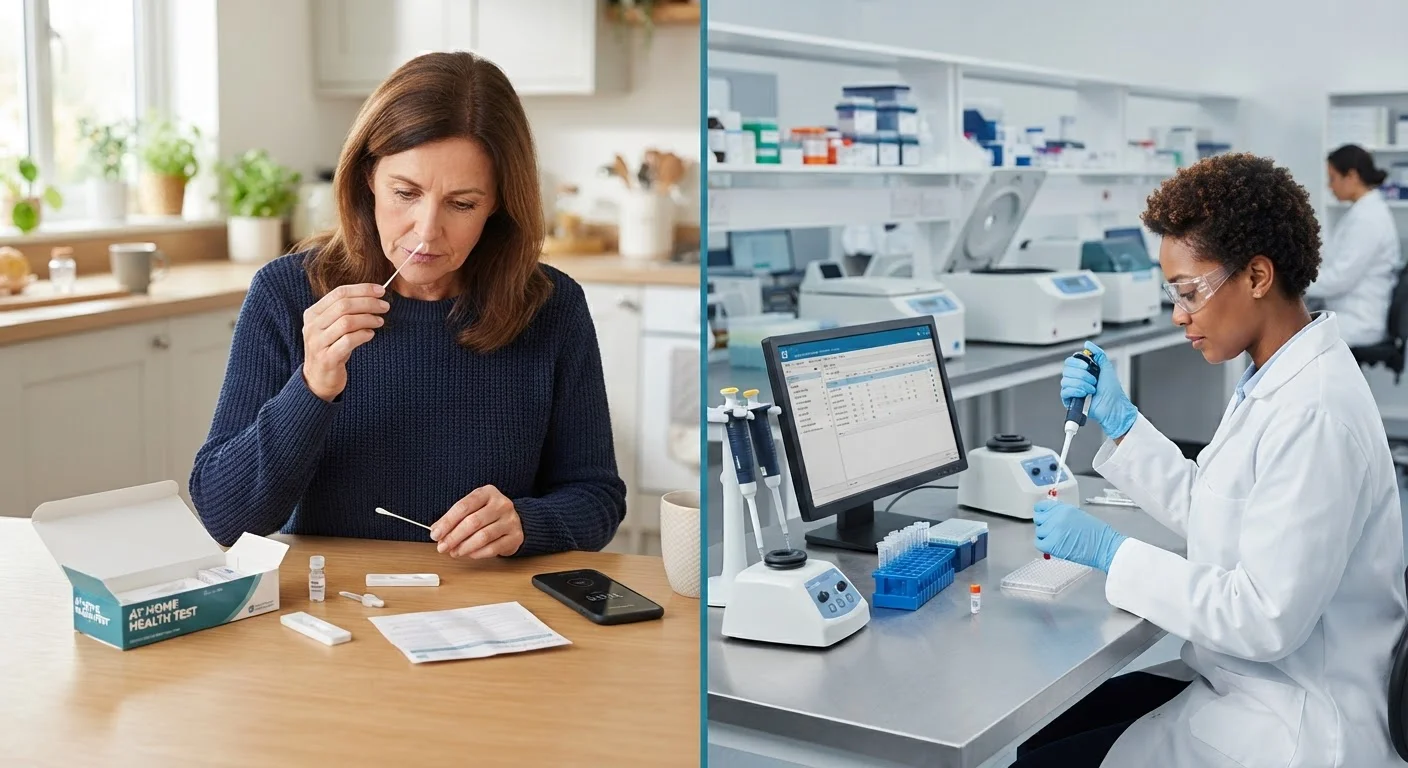
At-home screening tools expand access and encourage more frequent health monitoring, but they are not a substitute for clinical-grade testing. Clinical tests provide greater accuracy, context, and professional interpretation that at-home kits cannot fully replicate. The most effective approach combines the convenience of at-home tools with the diagnostic rigor of clinical care.
| Best for | Recommended |
|---|---|
| Those seeking routine self-monitoring between clinical visits | At-Home Screening Tools |
| Those requiring confirmed diagnosis or follow-up after an abnormal result | Clinical Tests |
| Individuals with limited access to in-person care | At-Home Screening Tools (with clinician follow-up) |
| Populations with elevated risk requiring high-accuracy results | Clinical Tests |
What Sets These Two Approaches Apart
The rise of consumer health technology has made it easier than ever to check blood glucose, detect colorectal blood markers, or assess cholesterol levels without leaving home. But convenience and clinical equivalence are not the same thing. Understanding the structural differences between at-home screening tools and clinical tests is essential for interpreting results accurately.
Clinical tests are administered in controlled environments — laboratories, clinics, or hospitals — using standardized equipment calibrated to meet regulatory standards. Trained professionals collect and analyze samples, reducing variability and human error. Results are interpreted within the context of a patient's full medical history.
At-home tools, by contrast, are designed for ease of use by non-clinicians. They typically use simplified detection methods that are accurate enough to provide meaningful signals, but they are generally validated for screening purposes rather than definitive diagnosis. For a broader look at how screenings differ from diagnostic tests, see our guide to preventive health screenings.
Accuracy, Sensitivity, and Specificity Explained
Two technical concepts matter here: sensitivity (a test's ability to correctly identify people who have a condition) and specificity (its ability to correctly identify people who do not). Clinical tests are typically validated in large, diverse populations and often achieve higher performance on both measures.
At-home tests vary considerably. Some — such as certain HIV self-tests — have been rigorously validated and perform close to clinical standards. Others, particularly general wellness panels sold directly to consumers, may have less robust evidence behind them. A false negative from an at-home kit can provide false reassurance; a false positive can cause unnecessary anxiety.
~60%
Increase in colorectal screening uptake
Research published in peer-reviewed gastroenterology journals has found that offering at-home stool tests can significantly increase the proportion of eligible adults who complete colorectal cancer screening compared to colonoscopy alone.
99%+
Sensitivity of FDA-approved HIV self-tests
The FDA notes that certain approved HIV self-tests have demonstrated sensitivity above 99% in clinical validation studies when used correctly, approaching laboratory standards.
This does not mean at-home tools are unreliable — it means their results require appropriate context. Abnormal findings should always prompt a conversation with a clinician, regardless of the source.
Where At-Home Tools Add Genuine Value
At-home screening tools have meaningfully expanded access to early health signals for populations who face barriers to in-person care — whether due to geography, cost, stigma, or scheduling constraints. For conditions such as colorectal cancer, studies have found that offering at-home stool-based tests increases overall screening uptake compared to colonoscopy alone, because the barrier to participation is lower.
Ongoing self-monitoring is another legitimate use case. People managing chronic conditions such as hypertension or diabetes may use at-home blood pressure cuffs or glucose monitors to track trends between clinical appointments. These readings, shared with a provider, enrich the clinical picture rather than replace it.
Share At-Home Results With Your Provider
Keep a log of any at-home test results — including dates, readings, and the specific product used — and bring this record to your next clinical appointment. Providers can incorporate trends from home monitoring into a more complete picture of your health. This is especially valuable for blood pressure and blood glucose tracking over time.
For a broader view of how daily habits work alongside preventive care, explore our article on proactive health habits that complement routine screenings.
How to Interpret and Act on Results
The most important principle: no single test result — at-home or clinical — should be treated as a final verdict in isolation. Clinical context, personal risk factors, and test performance characteristics all shape what a result actually means.
If an at-home test returns a positive result, the appropriate next step is clinical confirmation, not immediate alarm. If it returns a negative result, that does not necessarily rule out a condition, particularly if you have symptoms or significant risk factors. The misconceptions that lead people to skip screenings often include over-reliance on a single normal result.
For clinical tests, ask your provider what specific condition the test screens for, what the result thresholds mean, and what follow-up is recommended. Cancer screenings, for example, follow structured guidelines based on age, sex, and family history — context our article on recommended cancer screenings covers in depth.
This article is for general informational and educational purposes only and does not constitute medical advice. Always consult a qualified healthcare professional regarding any health concerns, symptoms, or before making decisions about screening or testing.