

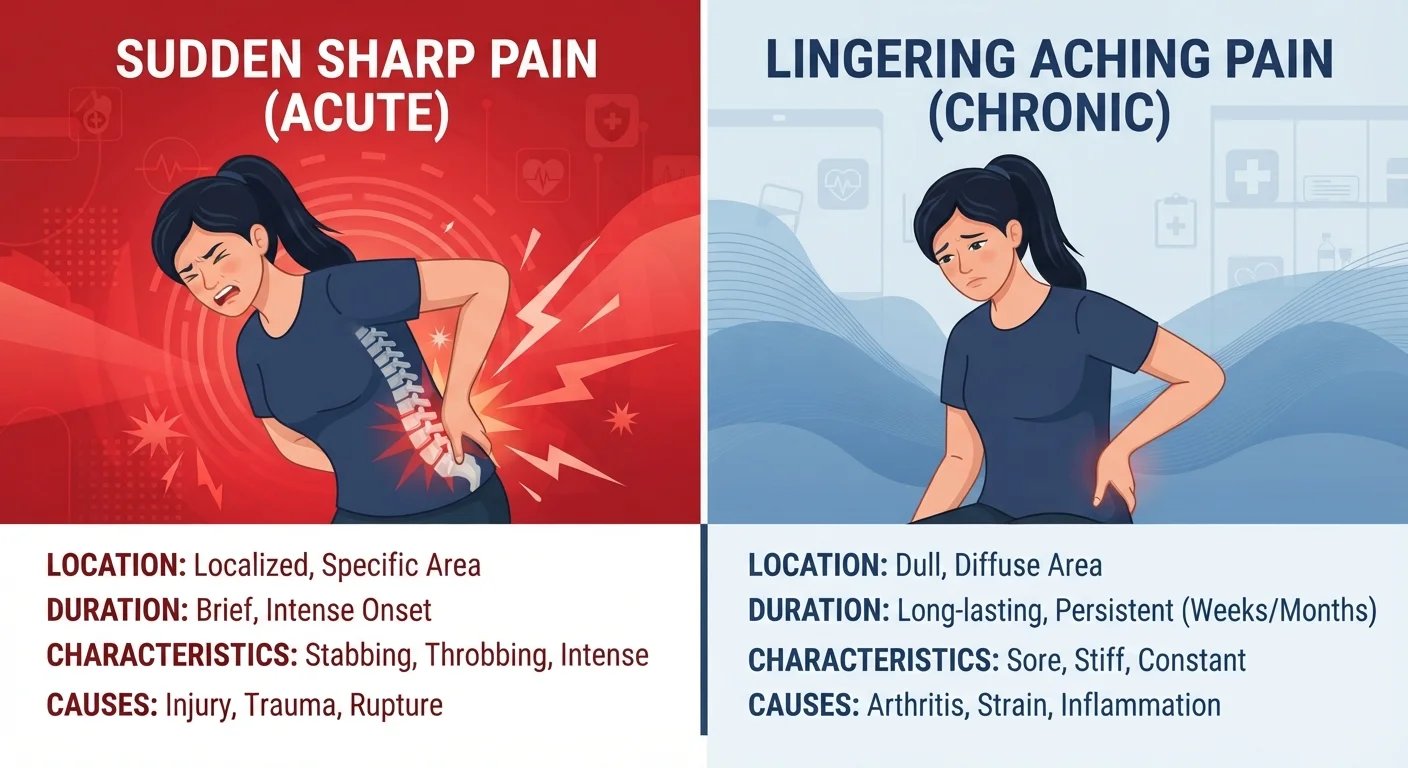
Key Takeaways
Option A
Acute Symptoms
The sudden, short-lived signal demanding immediate attention.
Best for: Identifying rapid-onset health events that typically resolve with prompt, targeted treatment.
Option B
Chronic Symptoms
The persistent, recurring pattern that requires long-term management.
Best for: Recognizing ongoing conditions that benefit from sustained medical oversight and lifestyle strategies.
If you experience a sudden, intense symptom you haven't had before
Acute Symptoms
Acute symptoms demand prompt evaluation to rule out serious or time-sensitive causes. Seek care quickly rather than waiting to see if it passes.
If a symptom has persisted for months despite basic self-care
Chronic Symptoms
Persistent symptoms warrant a structured conversation with your provider about diagnosis, monitoring, and a long-term management plan.
If you're unsure whether your symptoms are acute or chronic
Acute Symptoms
When in doubt, treat uncertainty as urgency. A healthcare professional can determine the pattern and appropriate next steps far better than self-assessment alone.
What Defines an Acute Symptom?
An acute symptom is one that comes on suddenly and is typically short in duration. The word "acute" in clinical contexts refers to timing and onset — not necessarily severity, although acute symptoms can range from mild to life-threatening. A sprained ankle, a sudden fever, or the sharp chest tightness of a panic attack are all examples of acute presentations.
Acute symptoms usually signal that the body is mounting a response to a specific trigger — infection, injury, or a discrete physiological event. They generally resolve within days to a few weeks, either on their own or with targeted treatment. That said, an untreated acute problem can sometimes transition into a chronic one, which is why early evaluation matters.
Key characteristics of acute symptoms include: rapid onset, a relatively clear triggering event, and a trajectory toward resolution. When symptoms appear suddenly and feel unfamiliar, that novelty itself is clinically meaningful information.
What Defines a Chronic Symptom?
A chronic symptom is one that persists over an extended period — conventionally defined in clinical medicine as three months or longer, though some guidelines vary by condition. Chronic symptoms may be continuous or intermittent, but their defining feature is that they recur or linger rather than resolving on their own.
Conditions such as arthritis, irritable bowel syndrome, migraines, and type 2 diabetes all produce chronic symptom patterns. Crucially, a chronic symptom isn't always intense; it may be low-grade but persistent. Many people learn to accommodate chronic symptoms — sometimes so effectively that they delay seeking care, assuming the problem is simply part of their normal life.
Distinguishing persistent fatigue from ordinary tiredness is a useful example of how this distinction plays out in everyday experience. Symptoms that don't improve with rest or standard self-care measures deserve professional attention, not adaptation.
When Chronic Symptoms Become an Emergency
A person with a chronic condition can also experience acute episodes that require urgent care — for example, a sudden severe headache in someone with a history of migraines may still warrant emergency evaluation to rule out a more serious cause. Chronic status does not make a new or dramatically worsening symptom less urgent. If you are ever uncertain, err on the side of seeking prompt medical attention.
Side-by-Side: How They Compare
Understanding the structural differences between acute and chronic symptoms helps frame conversations with healthcare providers and guides decisions about when and how urgently to seek care.
| Criterion | Acute Symptoms | Chronic Symptoms |
|---|---|---|
| Onset | Sudden, rapid | Gradual or recurring |
| Duration | Days to a few weeks | Three months or longer |
| Typical trigger | Injury, infection, discrete event | Ongoing condition or unknown |
| Resolution pattern | Usually resolves with treatment | Managed, not always cured |
| Care approach | Prompt evaluation and intervention | Ongoing monitoring and management |
| Example conditions | Flu, sprain, appendicitis | Arthritis, diabetes, migraines |
It's worth noting that the same underlying sensation can be either acute or chronic. Back pain that flares after lifting something heavy is acute; back pain that has been present most days for six months is chronic. The symptom itself doesn't change — the pattern does. That pattern is what clinicians use to guide diagnosis and treatment planning.
Why the Distinction Shapes the Care You Need
Acute and chronic symptoms call for fundamentally different clinical responses. Acute care focuses on rapid assessment and resolution — identifying the cause quickly and interrupting it before it causes lasting harm. Chronic care focuses on management, monitoring, and preventing progression or complications over time.
Misclassifying a symptom can lead to under- or over-treatment. Treating a chronic condition with only acute-care urgency can exhaust resources without addressing root causes. Conversely, dismissing an acute symptom as something to "wait out" can allow a treatable condition to worsen.
Building the habit of observing your own symptom patterns — noting when something started, how long it lasts, what makes it better or worse — gives your provider critical context. Developing a symptom-tracking practice before your next appointment is one of the most practical steps you can take to improve the quality of that clinical conversation.
Symptom patterns also shift across life stages. How the body's signals change over time is worth understanding, since what's typical at 30 may differ from what warrants attention at 60. For a parallel look at how this acute-versus-chronic framework applies to stress, see how acute and chronic stress differ in their effects.
This article is for general health information and educational purposes only. It is not a substitute for professional medical advice, diagnosis, or treatment. Always consult a qualified healthcare provider about any symptoms or health concerns you may have.