

Key Takeaways
Our Verdict
Time-blocking and task batching solve different problems: blocking protects your time and creates accountability; batching reduces cognitive friction and preserves mental energy. For most people, the most effective approach combines both — using batching to cluster similar work and time-blocking to assign those batches to the right windows in your day.
| Best for | Recommended |
|---|---|
| Those with meeting-heavy or highly structured workdays | Time-Blocking |
| Those doing creative, deep-focus, or project-based work | Task Batching |
| Those seeking maximum flexibility with minimal rigidity | Task Batching |
| Those wanting a fully integrated, sustainable daily system | Combined Approach |
What Each Method Actually Does
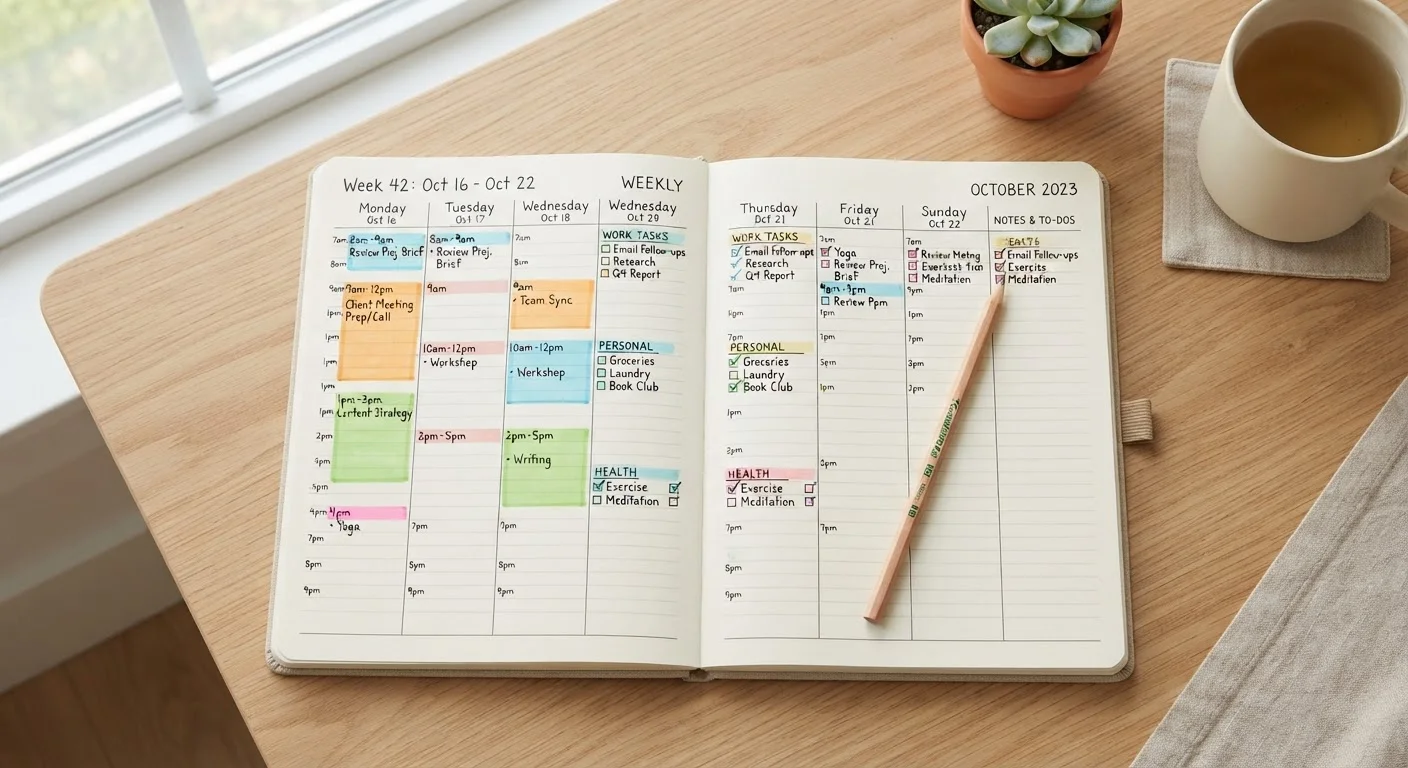
Time-blocking means dividing your calendar into dedicated slots and assigning specific work to each. Rather than a to-do list you pick from throughout the day, you pre-decide what happens at 9 a.m., 11 a.m., and 2 p.m. Each block has a defined purpose and a hard stop. For a deeper look at how the method differs from a conventional schedule, see what time-blocking really means.
Task batching takes a different angle. Instead of anchoring tasks to clock time, it groups cognitively similar activities — all your emails, all your calls, all your writing — and processes them together. The logic is straightforward: every time your brain switches task type, it incurs a small but real switching cost. Batching minimises those transitions. How batching works in practice goes into detail on where it helps most and where it falls short.
The Core Trade-offs
| Time-Blocking | Task Batching | |
|---|---|---|
| Core principle | Assign tasks to fixed calendar slots | Group similar tasks together |
| Primary benefit | Protects time, creates visibility | Reduces mental context-switching |
| Flexibility | Low — disruptions cascade | Higher — timing can shift |
| Best work type | Structured, meeting-heavy roles | Creative, project, or deep-focus work |
| Planning overhead | Higher — requires daily scheduling | Lower — group once, execute flexibly |
| Works with energy peaks | Yes, when blocks are intentionally placed | Yes, when batches are sequenced wisely |
Time-blocking's biggest strength is visibility: you can look at a day and immediately know where your attention is going. This makes it easier to protect time for deep work and to spot over-commitment before it happens. Its weakness is rigidity — an unexpected meeting or a task that runs long can cascade through the rest of the day and create stress rather than relieve it.
Task batching is more resilient to disruption because it doesn't depend on the clock. You can process your administrative batch at 10 a.m. or 2 p.m. and still get the cognitive benefit. The trade-off is that without a structural anchor, batches can drift — or expand to fill whatever time is available.
Start With a Weekly Audit
Before choosing a method, track how you actually spend your time for three to five days. Most people discover their day contains more reactive work than they assumed. That gap between intended and actual time use is precisely where time-blocking and task batching offer the most leverage — but only if the system is built around real patterns, not an idealised version of your workday.
How to Choose Based on Your Work Type
The right fit depends on what your day actually looks like, not on which method sounds more appealing in theory.
- High-meeting schedules: Time-blocking tends to work well here because it forces you to claim the gaps explicitly. If you don't block time for focused work, meetings will colonise it.
- Project-based or creative work: Batching is often more natural. Grouping all research, all writing, or all client communication into dedicated stretches preserves the mental momentum those tasks need.
- Unpredictable or interruption-prone roles: Neither method works perfectly, but batching tends to be more forgiving. Consider fixed vs. flexible scheduling as a related framing for high-variability workloads.
Your energy pattern also matters. If you know your peak focus hours, you can use time-blocking to protect them and batching to cluster lower-stakes tasks in your lower-energy windows. Structuring your day around natural energy peaks explains how to map tasks to your ultradian rhythms.
Combining Both for a Practical System
In practice, the two methods aren't competitors — they operate at different levels. Batching answers the question what kind of work am I doing? Blocking answers when am I doing it? Using both together gives you the cognitive efficiency of grouping with the structural discipline of scheduling.
A simple starting framework:
- Identify your recurring task types (deep work, communication, admin, learning).
- Create named batches for each category.
- Time-block each batch into your calendar at an appropriate point in your day — matched, where possible, to your energy curve.
- Review and adjust weekly rather than trying to lock in a perfect daily template from day one.
For guidance on protecting boundaries between work and personal time once your system is in place, the setting boundaries hub offers practical strategies worth bookmarking.