

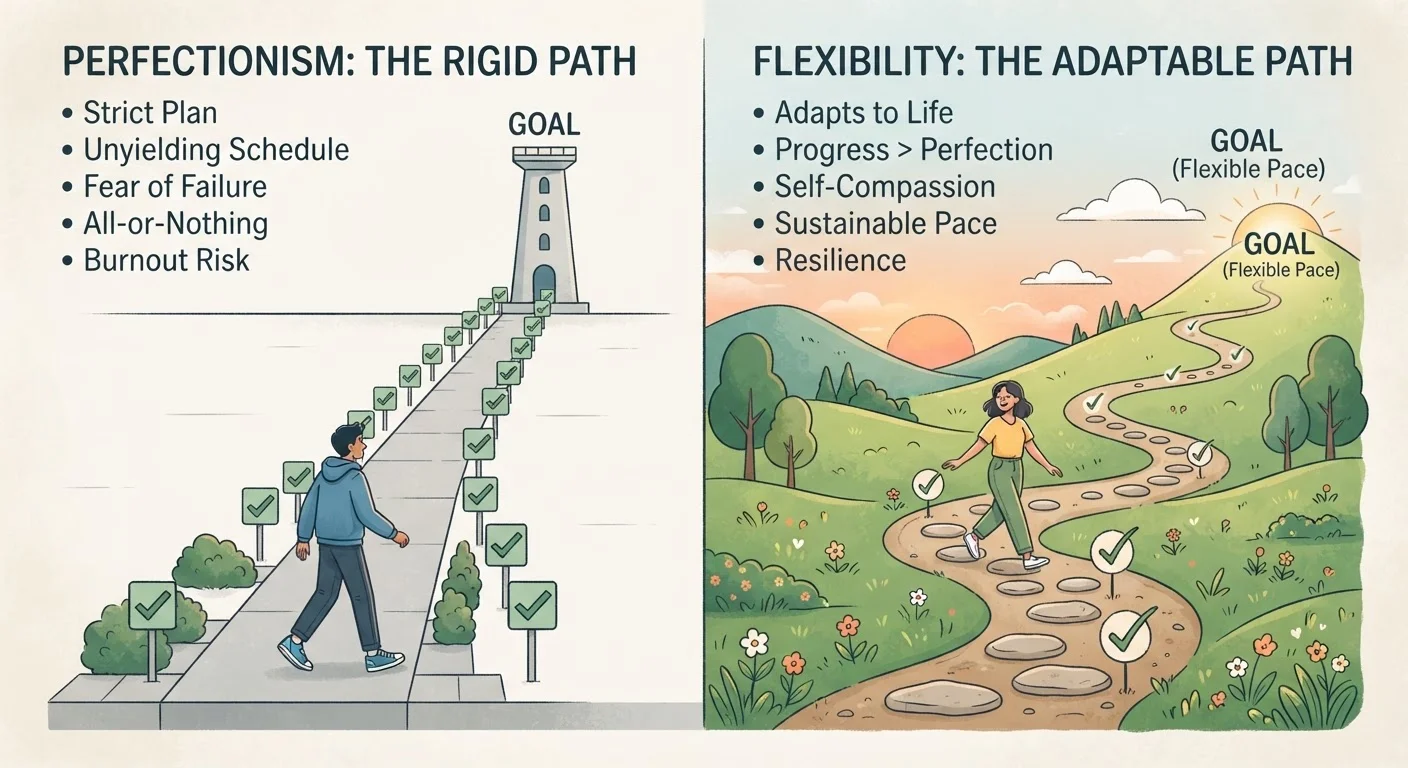
Key Takeaways
Reduces psychological cost of inevitable slip-ups
Flexible consistency frames missed days as expected events rather than failures, preventing the guilt spiral that often leads to full habit abandonment.
More durable across life disruptions
A consistency-based approach bends without breaking — illness, travel, or high-stress periods don't reset the entire system, so resumption is far easier.
Maintains neural habit pathways on low-effort days
Even a minimum viable version of a habit — a short walk, a single journal sentence — keeps the cue-routine-reward loop active and prevents behavioral decay.
Builds sustainable identity over time
Showing up imperfectly but repeatedly reinforces a self-image as "someone who does this," which research links to stronger long-term adherence than goal-based motivation alone.
Can become a permission slip for chronic under-effort
Without clearly defined minimum standards, "flexibility" can drift into sporadic behavior that never crosses the threshold needed for genuine habit formation.
Lacks the motivational pull of a visible streak
Streak mechanics are psychologically compelling for many people; abandoning them removes a concrete, gamified incentive that some individuals genuinely rely on.
Requires honest self-monitoring to avoid rationalisation
Flexible systems demand more self-awareness — it's easy to convince yourself an exception is justified when the real issue is avoidance or low motivation.
May slow initial habit formation in some contexts
Daily repetition in the early weeks appears to accelerate automaticity; a more permissive schedule could extend the window before the behavior feels truly effortless.
Our Verdict
For most adults navigating unpredictable schedules, flexible consistency outperforms the pursuit of a perfect streak. Aiming for perfection raises the psychological stakes of every missed day, making full abandonment more likely. That said, a structured, streak-based approach can be genuinely useful for people building habits in highly controlled environments or during short-term formation windows.
Flexible consistency is best for busy adults who want lasting behavioral change without the fragility of an all-or-nothing mindset.
Why the Perfect Streak Feels Appealing — But Often Backfires
There's an intuitive logic to perfect streaks: if you never miss, the habit becomes unbreakable. Habit-tracking apps are built on this premise, and for short bursts it can work. But research on self-regulation suggests that framing any single miss as a failure activates what psychologists call the "what-the-hell effect" — a collapse in restraint following a perceived lapse. In plain terms: one skipped workout becomes two, then a week, then the habit is quietly abandoned.
The problem isn't ambition. It's that perfection creates a brittle system. Real life — illness, travel, deadlines — isn't compatible with zero-miss streaks over months or years. When the system cracks, it often cracks entirely. This is explored further in our piece on why eating pattern changes fall apart early, which applies directly to behavioral habits beyond diet.
Reduces psychological cost of inevitable slip-ups
Flexible consistency frames missed days as expected events rather than failures, preventing the guilt spiral that often leads to full habit abandonment.
More durable across life disruptions
A consistency-based approach bends without breaking — illness, travel, or high-stress periods don't reset the entire system, so resumption is far easier.
Maintains neural habit pathways on low-effort days
Even a minimum viable version of a habit — a short walk, a single journal sentence — keeps the cue-routine-reward loop active and prevents behavioral decay.
Builds sustainable identity over time
Showing up imperfectly but repeatedly reinforces a self-image as "someone who does this," which research links to stronger long-term adherence than goal-based motivation alone.
The Case for Flexible Consistency
Flexible consistency means showing up most of the time — with an explicit, pre-decided allowance for imperfect days. Research published in the European Journal of Social Psychology found that missing one behavior did not meaningfully affect long-term habit formation, provided the person returned quickly. The key variable wasn't perfection; it was recovery speed.
Practically, this might mean defining your habit as "five out of seven days" rather than "every day," or keeping a minimum viable version ready — a five-minute walk instead of a 45-minute run. This preserves the neural cue-routine-reward loop that makes habits automatic over time. For strategies on embedding exactly this kind of low-friction behavior into your day, see habit design for consistent daily movement.
Can become a permission slip for chronic under-effort
Without clearly defined minimum standards, "flexibility" can drift into sporadic behavior that never crosses the threshold needed for genuine habit formation.
Lacks the motivational pull of a visible streak
Streak mechanics are psychologically compelling for many people; abandoning them removes a concrete, gamified incentive that some individuals genuinely rely on.
Requires honest self-monitoring to avoid rationalisation
Flexible systems demand more self-awareness — it's easy to convince yourself an exception is justified when the real issue is avoidance or low motivation.
May slow initial habit formation in some contexts
Daily repetition in the early weeks appears to accelerate automaticity; a more permissive schedule could extend the window before the behavior feels truly effortless.
When Structure and Streaks Actually Help
Perfectionism in habits isn't universally harmful. During the initial formation window — roughly the first two to four weeks — a consistent daily trigger helps wire the habit loop more quickly. Streaks can also be motivating for people with high conscientiousness or those working in stable, predictable environments. The key distinction is using streaks as a scaffold rather than the structure itself.
Pairing a new habit with an already-established behavior — a technique known as habit stacking — can provide the regularity of a streak without its fragility. Our guide to anchoring new behaviors to existing routines explains how this works in practice. Similarly, how you define your identity around the habit matters: people who think of themselves as "someone who exercises" rather than "someone trying to exercise" show more durable behavior over time. See the comparison in identity-based vs. outcome-based habit building for a deeper look at this distinction.
66 days
Average time for a habit to become automatic
A study published in the European Journal of Social Psychology found habit automaticity took an average of 66 days, with wide individual variation from 18 to 254 days.
~1 missed day
Impact of a single lapse on habit formation
The same research indicated that missing one day did not significantly derail the overall habit formation trajectory, provided the person resumed promptly.
Building a Consistency-First Habit System
A practical consistency-first approach has three elements. First, define your floor — the minimum version of the habit you'll do on hard days (two minutes of journaling instead of twenty, for instance). Second, establish a recovery rule: never miss twice in a row. This single heuristic prevents one lapse from compounding. Third, decouple your self-assessment from your streak count. Progress isn't a number; it's the overall pattern across weeks.
These same principles apply beyond fitness and diet. Adults working to maintain professional or personal boundaries — another domain where "all or nothing" thinking undermines long-term results — can find similar frameworks in what consistent boundary-keepers do differently. For a broader lens on intentional daily living, the daily routines hub offers structured approaches to morning, evening, and midday habits that complement a consistency-first mindset.
The "Never Miss Twice" Rule in Practice
This simple heuristic — regardless of what happened yesterday, do the habit today — functions as a circuit breaker for the what-the-hell effect. It works because it reframes recovery as part of the system rather than an exception to it. Set it as a standing personal policy before disruptions occur, not in response to them.
This article is for informational purposes only and is not a substitute for professional medical or psychological advice.