
Key Takeaways
The Habit Loop
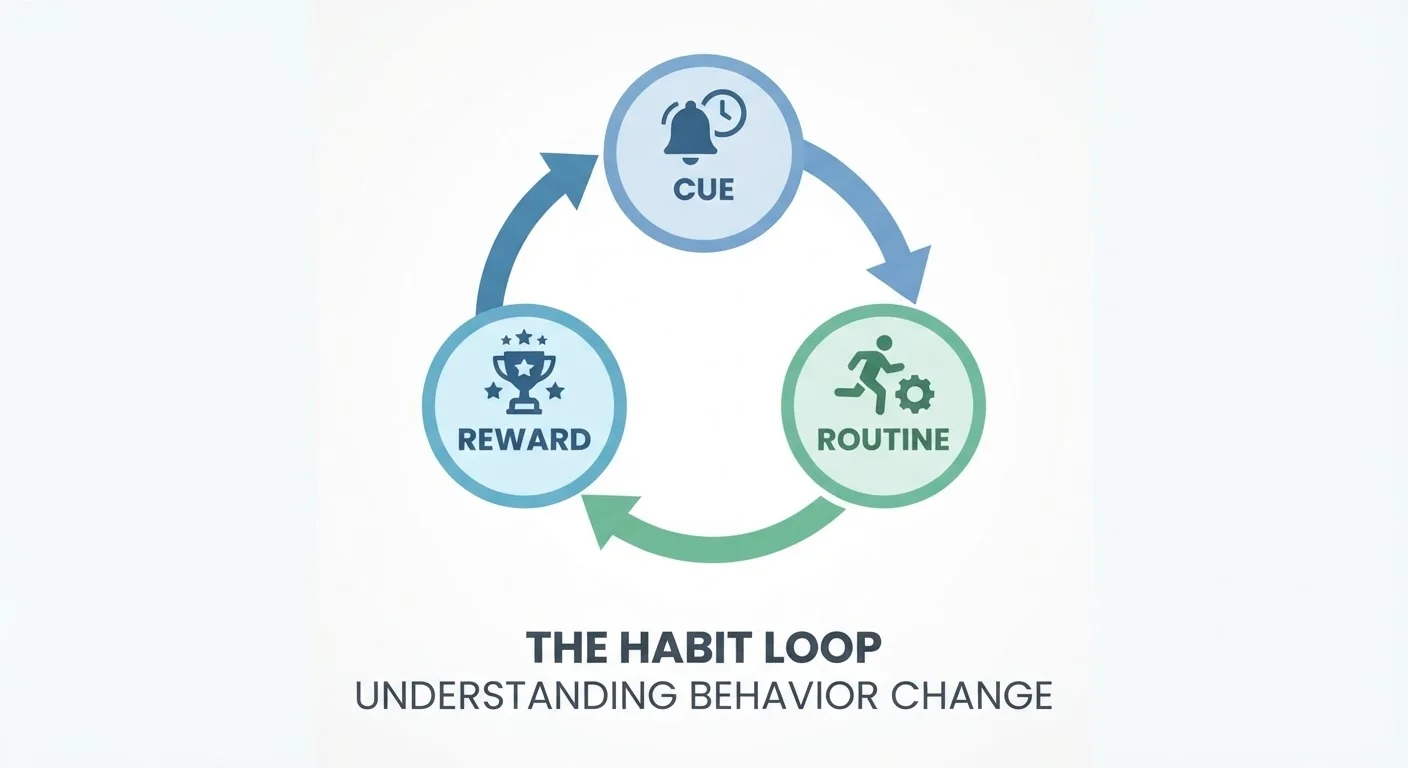
The habit loop is a three-part neurological pattern that drives all habitual behavior: a cue that triggers the behavior, a routine that is the behavior itself, and a reward that reinforces it. First described in research on basal ganglia function, the loop explains how the brain automates repeated actions to conserve cognitive effort. Over time, the loop becomes self-reinforcing — the brain begins anticipating the reward as soon as it detects the cue.
Neuroimaging studies show that as behaviors become habitual, control shifts from the prefrontal cortex (deliberate decision-making) to the basal ganglia, which handles procedural memory and automatic execution.
Why the Brain Automates Behavior
Your brain is relentlessly efficient. Every repeated behavior it can offload to autopilot frees up cognitive resources for novel problems. This automation happens through a process neuroscientists call chunking — the brain packages a sequence of actions into a single mental unit stored in the basal ganglia, a region deep in the brain associated with procedural memory and reward processing.
The habit loop is the mechanism through which chunking occurs. MIT researchers studying rats navigating mazes in the 1990s observed that as behavior became automatic, basal ganglia activity surged at the start and end of the sequence — at the cue and the reward — while mid-routine brain activity quieted. The loop, once formed, runs with minimal conscious input. This is why you can drive a familiar route while your mind wanders: the routine has been fully automated.
For a deeper look at the neuroscience, see what neuroscience actually shows about habit formation.
Breaking Down the Three Components
The Cue
A cue is any signal that tells your brain to initiate a habitual routine. Cues generally fall into five categories: time of day, location, emotional state, preceding action, or the presence of other people. The alarm that prompts your morning run, the stress of an inbox that prompts a snack, the sight of the coffee maker that triggers reaching for a mug — these are all cues. Identifying yours requires deliberate observation, not guesswork.
The Routine
The routine is the behavior itself — physical, mental, or emotional. It's what most people mean when they say "the habit." But because the brain encodes the entire loop as a unit, targeting only the routine without understanding its surrounding context rarely leads to lasting change. The routine exists in service of the reward.
The Reward
The reward is what the brain learns to crave. It can be sensory (the taste of food), emotional (the calm that follows exercise), or social (approval from peers). Critically, the reward must be genuinely satisfying to strengthen the loop — the brain will not reliably encode a behavior it doesn't associate with a positive outcome. Over time, the brain begins releasing dopamine in anticipation of the reward the moment it detects the cue, creating a craving that sustains the loop independently.
“The key to understanding habits is to understand that they never truly disappear. They are encoded in the structures of the brain. The problem is that the brain can't tell the difference between bad and good habits — so if you have one, it's always lurking there, waiting for the right cues and rewards.”
— Charles Duhigg, Author, 'The Power of Habit'
Using the Loop to Change Behavior
The practical power of the habit loop framework lies in what it implies about change: you don't need to eliminate a habit — you need to reroute it. Because the cue-reward connection is neurologically durable, trying to simply stop a behavior often fails. A more effective strategy, supported by behavioral research, is to preserve the cue and reward while substituting a new routine.
Someone who habitually checks social media when bored (cue: boredom; reward: stimulation) might replace the scroll with a two-minute breathing exercise or a brief walk — keeping the cue intact and seeking a comparable reward through a different routine. The brain has an existing track to run on; you're just redirecting it.
Map Before You Modify
Before trying to change any habit, spend one week simply observing it. Note the exact time, place, emotional state, and preceding action each time the routine occurs. Patterns in your cues become visible quickly — and you can't redesign a loop you haven't clearly identified. A habit journal or even a notes-app entry takes less than 30 seconds per instance.
For a practical walkthrough of designing your own loop from scratch, see Building a New Habit From Scratch. And if you want to layer multiple habits efficiently, habit stacking — linking new behaviors to existing cues — is one of the most effective methods available.
Putting the Loop to Work in Daily Life
Understanding the loop is necessary but not sufficient — awareness has to translate into deliberate design. Start by auditing one existing habit: write down the routine, then work backward to identify the cue and the actual reward (which is often not what you expect). People who think they snack because they're hungry often find the real reward is a break from mental effort, not calories.
Once you've mapped the loop, you can apply frameworks like habit stacking to anchor new behaviors to existing cues, or explore the broader architecture of routine design at the Daily Routines hub. For definitions of the key terms used across habit science, the reference guide to daily routine concepts is a useful companion. This article is part of a broader resource: Habit Formation: An End-to-End Guide.
This article is for informational and educational purposes only. It does not constitute medical or psychological advice. If you are dealing with compulsive behaviors or mental health concerns, please consult a qualified healthcare professional.