

Key Takeaways
Why a Desk-Based Body Scan Actually Works
The body scan is one of the most researched mindfulness techniques in clinical psychology, originating from Jon Kabat-Zinn's Mindfulness-Based Stress Reduction (MBSR) program developed in the late 1970s. The core mechanism is straightforward: by deliberately moving focused attention through different regions of the body, you interrupt automatic, worry-driven thought patterns and redirect the nervous system away from a stress-activated state.
You don't need a yoga mat, an app, or twenty minutes. Research suggests that even brief mindfulness moments — those lasting just a few minutes — can reduce perceived stress and improve attentional focus compared to no practice. The desk version described here asks only that you remain seated and willing to observe. For a broader look at techniques that fit similarly tight windows, see strategies for managing stress when you're pressed for time.
If you're curious how this compares to other tension-relief approaches, progressive muscle relaxation and body scan meditation each have distinct strengths — understanding the difference can help you choose the right tool for a given moment.
Mindfulness Is Not a Crisis Tool
A desk body scan is a general wellbeing practice suited to everyday stress management. If you're experiencing symptoms of anxiety, depression, trauma, or another mental health concern, please reach out to a qualified mental health professional. Mindfulness can complement professional care but is not a replacement for it.
What You'll Need Before You Begin
The beauty of this practice is its simplicity. There is no equipment required, and no prior experience with meditation is necessary.
What you will need
A supportive chair
Provides stable, upright posture so the body can relax without slouching or strain.
Gentle timer or alarm
Lets you fully commit to the practice without watching the clock.
Headphones or earplugs
Reduce distracting noise in a busy office environment if needed.
If you'd like a short settling ritual before diving in, the pre-meditation grounding checklist offers a quick way to clear mental clutter before you start.
The Five-Minute Body Scan: Step by Step
Work through each step below at whatever pace feels natural. The timestamps are guides, not rules — if one area holds your attention longer, that's fine. The goal is gentle awareness, not performance.
Settle into your seat
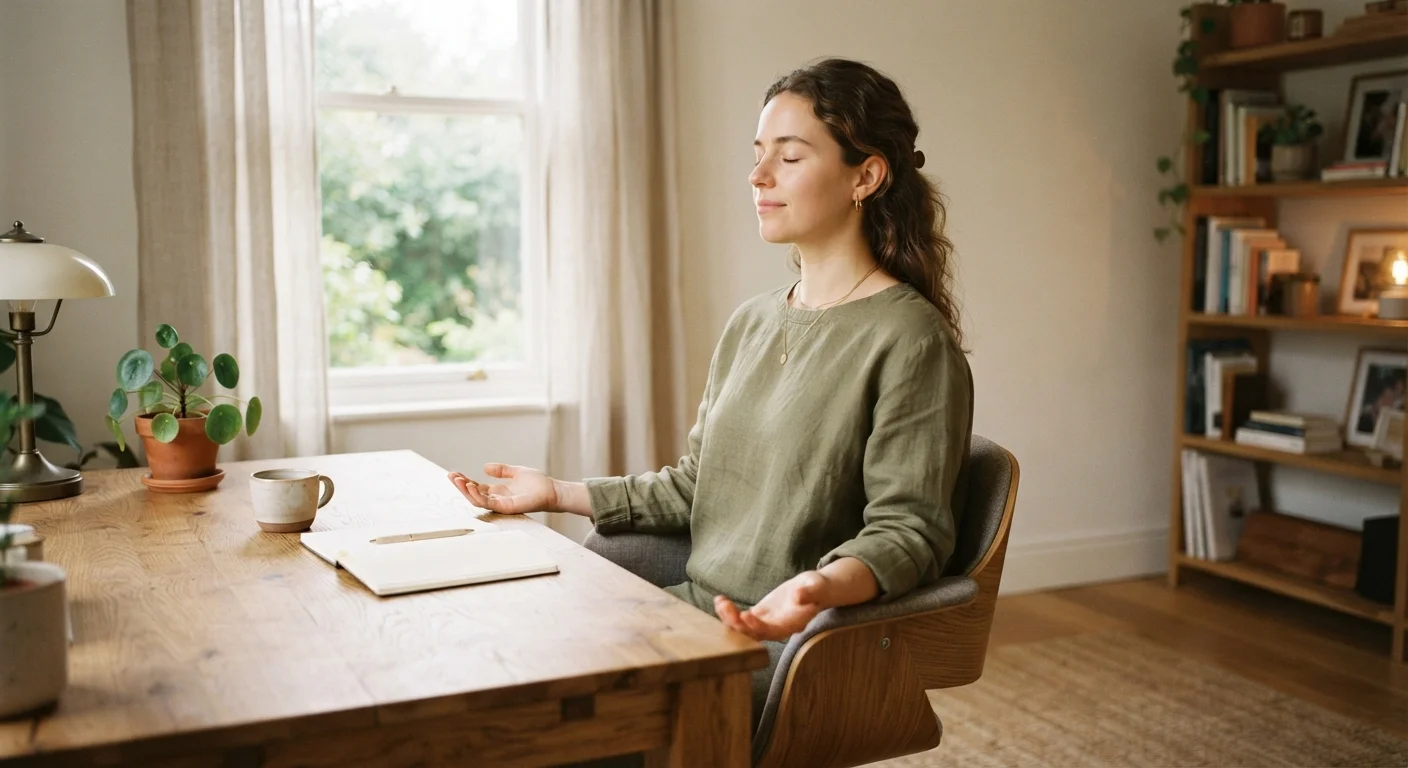
Plant both feet flat on the floor. Rest your hands loosely on your thighs or desk. Sit tall enough that your spine isn't collapsed, but don't force rigidity — let the chair do some of the work. Close your eyes or soften your gaze toward a neutral point a few feet ahead.
Take three slow anchor breaths
Inhale through your nose for a count of four, hold briefly, then exhale through your mouth for a count of six. Repeat three times. This deliberately extended exhale activates the parasympathetic nervous system, signaling to your body that it is safe to settle. You don't need to count perfectly — the intention to slow down is what matters.
Bring attention to the top of your head
Gently direct your inner attention to your scalp and the crown of your head. Notice any sensations without trying to change them — tingling, warmth, pressure, or simply nothing at all. All of these are fine. Spend about 30 seconds here before moving on.
Scan slowly downward through the face, neck, and shoulders
Move your attention through your forehead, eyes, jaw, and throat. The jaw and the area around the eyes are common holding places for daytime tension. Then drop awareness into your neck and shoulders. If you notice tightness, you might try a single gentle shrug-and-release, but the primary aim is observation — not fixing.
Move through the torso, arms, and hands
Bring awareness down through your chest and upper back, noticing the rise and fall of breath. Continue to your belly, lower back, and then your arms — from the elbows to the wrists and finally the hands resting in your lap. Hands and forearms often carry repetitive-use tension from keyboard work. Spend a breath or two in each area before continuing.
Complete the scan through hips, legs, and feet
Shift attention to your hips and the points of contact where your body meets the chair. Continue down through your thighs, knees, calves, and finally your feet pressing into the floor. Notice temperature, pressure, or any sense of heaviness. This grounded connection to the floor can anchor a sense of physical stability before you return to your tasks.
Close with a full-body awareness moment
Spend the final 30–60 seconds holding a broad, gentle awareness of your whole body at once — as if you're sensing the entire outline of yourself sitting in the room. Take one more slow breath. When you're ready, open your eyes, notice the space around you, and ease back into your work at your own pace.
Build the Habit With an Existing Cue
Linking your body scan to something you already do — like the moment your laptop finishes booting, or right after you pour your afternoon coffee — dramatically increases the chance it becomes routine. Behavioral researchers call this habit stacking, and it reduces the mental effort of remembering to practice. Start with just two or three days per week rather than aiming for daily perfection.
Once you've completed the scan, you might find it useful to pair this practice with light movement. The desk-friendly movement guide for the seated workday offers complementary stretches that work well immediately after a body scan.
This Is General Information, Not Medical Advice
The guidance in this article is intended for general educational purposes only. It is not a substitute for professional medical or psychological advice, diagnosis, or treatment. If you have a diagnosed mental or physical health condition, consult your healthcare provider before starting any new mindfulness or relaxation practice.
Making It a Sustainable Practice
A single session is valuable, but the real benefits of body scanning accumulate over time. Practitioners who practice consistently — even briefly and imperfectly — report greater body awareness and a reduced tendency to default to stress without noticing it. The key is lowering the bar for what counts as a successful session. A distracted five minutes still counts.
If you want to expand your repertoire of present-moment habits beyond formal meditation, everyday anchors and grounding habits offer a range of lighter-touch alternatives that fit into ordinary daily moments. Small, consistent actions tend to compound quietly — and noticing how your body feels at 2 p.m. on a Tuesday is a genuinely meaningful place to start.
This article is for informational and educational purposes only and does not constitute medical or psychological advice. Always consult a qualified healthcare professional regarding any personal health concerns.