

Key Takeaways
Mindfulness-Based Stress Reduction (MBSR)
Mindfulness-Based Stress Reduction is a structured eight-week programme that teaches people to use meditation, body awareness, and mindful movement to manage stress, pain, and difficult emotions. It was developed in a clinical setting and has since been studied extensively in peer-reviewed research. Participants learn to observe their thoughts and physical sensations with curiosity rather than reacting automatically.
MBSR was developed by Jon Kabat-Zinn at the University of Massachusetts Medical School in 1979 and draws on Buddhist meditative traditions adapted into a secular, clinically applicable format.
More Than a Meditation Class
When people hear "mindfulness programme," they often picture a brief app session or a yoga studio drop-in. Mindfulness-Based Stress Reduction is something more deliberate. It is a clinically developed, eight-week curriculum taught in group settings, designed to change how participants relate to stress — not just temporarily soothe it.
The programme emerged in 1979 from work at the University of Massachusetts Medical School and was initially created to help patients with chronic pain conditions manage suffering that medical treatment alone wasn't resolving. Decades of research and adaptation have since extended its application to general stress, anxiety, burnout, and the kind of relentless mental noise many adults recognise from daily life.
If you're curious about the broader concept underpinning this work, our explainer on what mindfulness actually is separates the science from the popular myths.
47
Randomised trials reviewed in landmark MBSR meta-analysis
A 2014 meta-analysis in JAMA Internal Medicine (Goyal et al.) reviewed 47 trials to assess mindfulness meditation's effects on psychological stress outcomes.
8 weeks
Standard duration of a full MBSR course
The programme consists of eight weekly group sessions plus a full-day retreat, making it one of the most time-intensive evidence-based stress interventions available.
~30–45 min
Recommended daily home practice
Participants are generally encouraged to practise independently each day between sessions, using guided audio recordings provided by the instructor.
What a Typical MBSR Course Looks Like
Each MBSR cohort meets weekly for eight sessions, each running roughly two to two-and-a-half hours. A trained instructor guides participants through a progression of formal practices:
- Body scan meditation: Systematically directing attention through different regions of the body, noticing physical sensation without trying to change it.
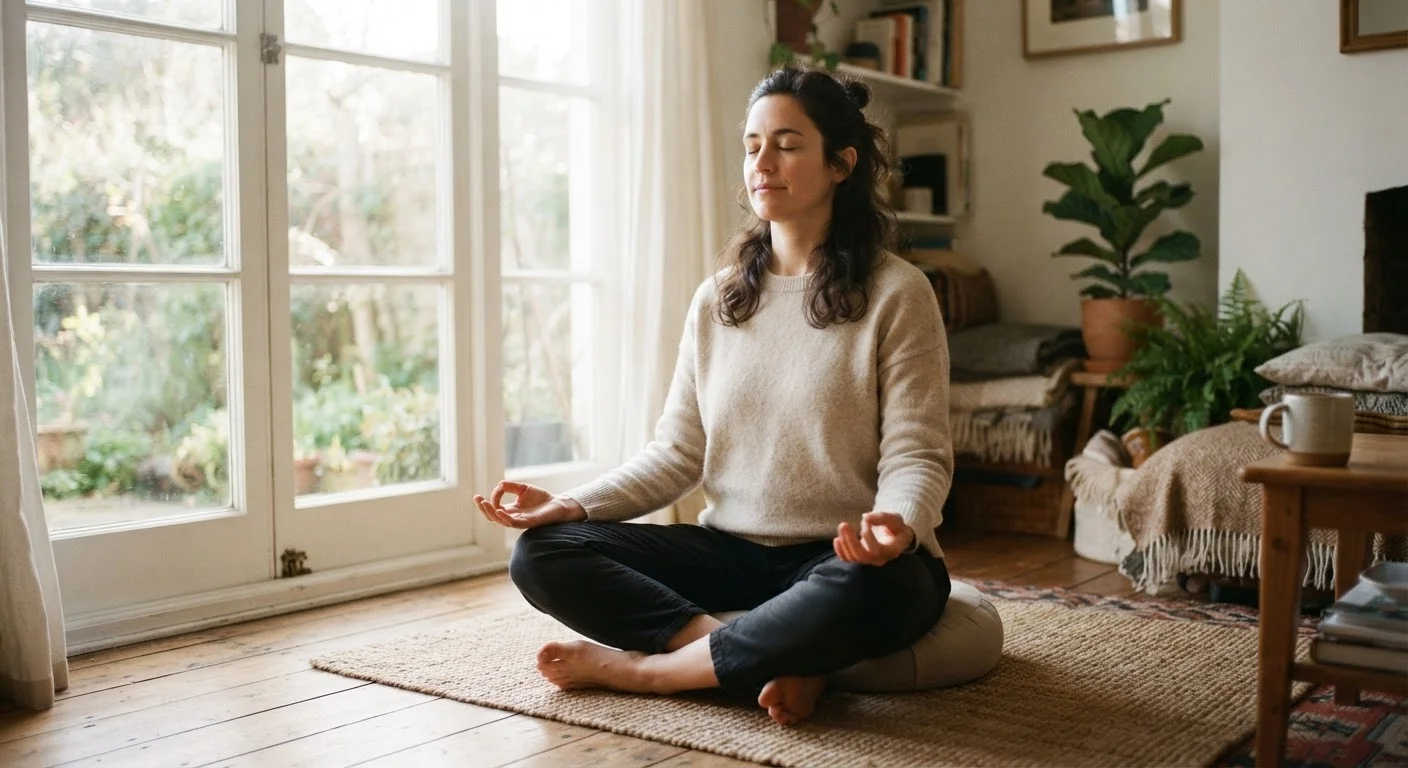
- Sitting meditation: Focusing on the breath, bodily sensations, sounds, and eventually the full field of awareness — including thoughts and emotions as they arise.
- Mindful movement: Slow, deliberate movement — often adapted from hatha yoga — designed to build awareness of physical sensation and breath simultaneously.
Around week six, programmes typically include a full-day silent retreat. For many participants, this intensive session is the most challenging and the most transformative part of the course.
Home practice is a non-negotiable component. Participants are encouraged to practise daily, often using guided audio recordings. The expectation is roughly 30–45 minutes per day — a real commitment for busy adults.
Starting Before You Enrol
If you're considering MBSR but aren't sure it's for you, try a simple five-minute body scan before committing to a full programme. Lie still, close your eyes, and slowly move your attention from your feet to the top of your head, noticing any sensations without trying to change them. This is the core skill the programme builds on — and experiencing it once can help you decide if the approach resonates.
What the Research Actually Shows
MBSR is among the most studied mind-body interventions available. A frequently cited meta-analysis published in JAMA Internal Medicine (Goyal et al., 2014) reviewed 47 trials and found moderate evidence that mindfulness meditation programmes reduce anxiety, depression, and pain. The word "moderate" matters — this is meaningful, replicable benefit, not a dramatic transformation in every participant.
Research also suggests MBSR may influence physiological stress markers, including cortisol levels and inflammatory indicators, though findings in this area are more mixed and the evidence base is still evolving. The psychological benefits — particularly reduced rumination and improved emotional regulation — tend to be the most consistently reported outcomes across studies.
It's worth being clear: MBSR is educational, not clinical. It does not replace therapy, medication, or medical care. For people managing diagnosed anxiety disorders, depression, or trauma, it may be one useful component of a broader treatment plan — but that plan should be guided by a qualified healthcare professional.
For a wider foundation in managing stress deliberately, our grounded introduction to stress management is a useful companion read.
How MBSR Fits Into a Busy Life
The daily practice commitment is the part many adults find most daunting — and most revealing. The programme essentially asks you to confront the fact that you don't naturally make time for stillness. That friction is itself part of the learning.
That said, MBSR is not the only path to mindfulness-based stress relief. If a full eight-week programme isn't feasible right now, smaller evidence-informed practices — micro-breaks, brief body scans, structured worry windows — can offer a meaningful starting point. Managing stress when you're pressed for time covers exactly this territory.
For those who want to carry these skills beyond day-to-day routines, mental wellness while travelling explores how mindfulness-based tools can support psychological stability in unfamiliar environments.
Whether or not you pursue a formal MBSR course, the core insight it cultivates — that you can observe stress without being controlled by it — is one worth working toward in whatever way fits your life.
This article is for informational purposes only and does not constitute medical advice. If you are experiencing significant mental health difficulties, please consult a qualified healthcare professional.