

Key Takeaways
When Your To-Do List Becomes the Problem
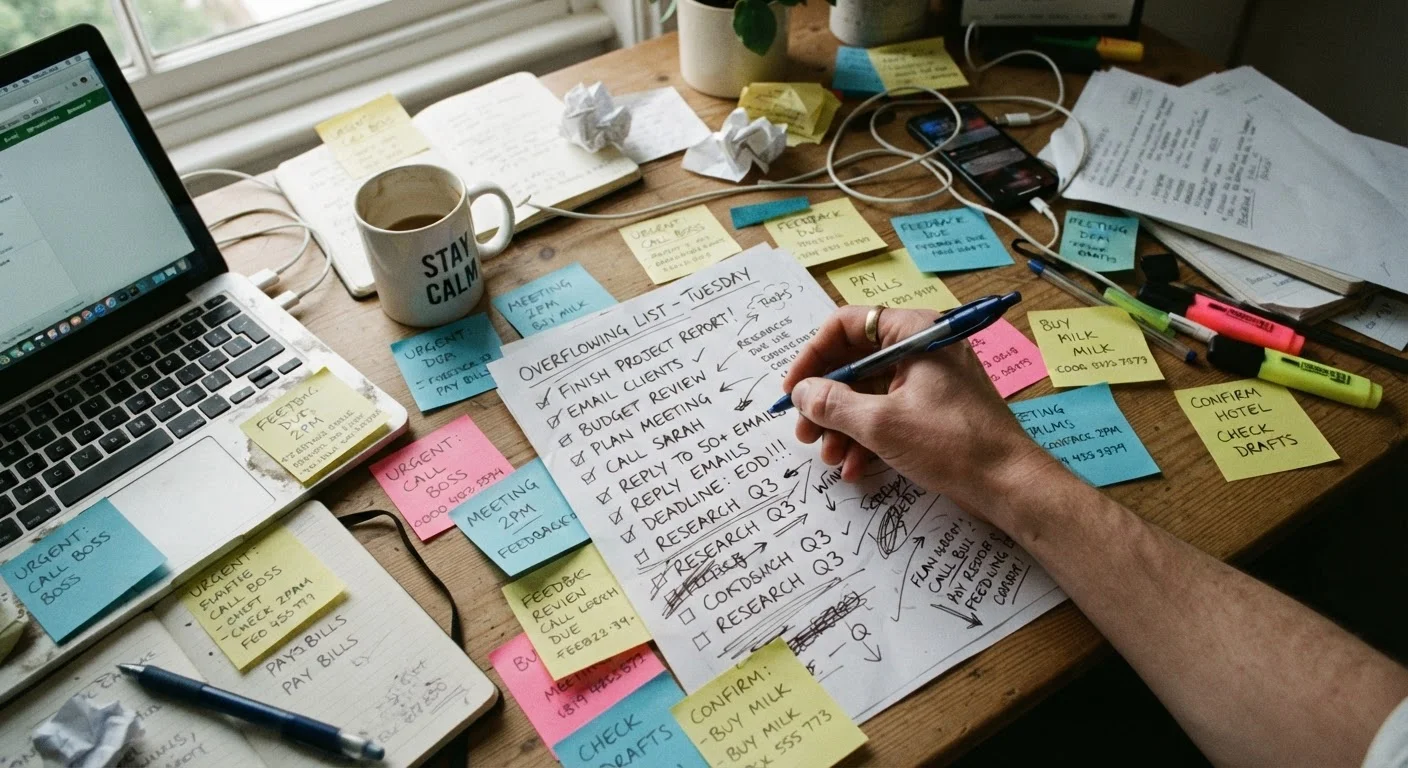
Most of us were taught that writing everything down is the responsible, organised thing to do. And to a point, that's true — externalising tasks frees up mental space. But there's a tipping point where the list itself becomes a source of dread rather than direction.
Research into cognitive load suggests that when we perceive more demands than we have capacity to meet, the resulting stress response can impair decision-making and focus — the very things we need to work through a list efficiently. In other words, a bloated task list can actively work against you.
The good news is that the most effective fix isn't adding a new productivity tool — it's unlearning a few deeply ingrained habits. Rethinking how you approach tasks is often the first, most impactful step.
Adding tasks to the list without ever removing completed or irrelevant ones.
Why it happens: We instinctively fear forgetting something, so we keep adding as a safety net. The list grows unchecked because deletion feels like failure or risk.
Assigning too many 'top priority' tasks to a single day.
Why it happens: Optimism bias makes us routinely underestimate how long tasks take, leading us to overcommit. It also feels uncomfortable to admit we can only do so much in a day.
Mixing ongoing responsibilities with discrete, completable tasks on the same list.
Why it happens: When we capture everything in one place without categorising it, items like 'respond to emails' sit alongside 'submit quarterly report' — creating a false equivalence that muddies focus.
Never questioning whether a task needs to be done at all.
Why it happens: Many tasks make it onto the list out of habit, obligation, or vague aspiration rather than genuine necessity. We rarely pause to ask whether the outcome justifies the effort.
Keeping all tasks in your head alongside the written list.
Why it happens: Even with a list in hand, we mentally rehearse undone tasks — a phenomenon sometimes called the Zeigarnik effect, where unfinished business keeps pulling at attention.
How to Build a List That Actually Works For You
The goal isn't a shorter list for its own sake — it's a list that reflects honest priorities and realistic capacity. That requires a different relationship with planning altogether.
Start by conducting a weekly review of your list, not just adding to it. Ask: what on here is truly mine to do this week? What has quietly become irrelevant? What can be delegated or simply dropped? This practice alone can dramatically reduce the weight of your list without sacrificing anything important.
~40%
Of planned tasks completed each day
Studies on daily planning suggest people typically complete only around 40% of what they intend each day, highlighting a persistent gap between ambition and realistic capacity.
23 min
Average refocus time after interruption
Research by Gloria Mark at the University of California, Irvine found it can take approximately 23 minutes to return to a task after an interruption — underscoring why fewer, protected priorities matter.
It also helps to time-block your top three priorities before anything else gets scheduled. When high-impact work has a protected slot, everything else finds its natural place — or falls away. If you find your mind racing even after trimming your list, weaving in brief moments of grounded awareness can help; the small, sustainable mindfulness habits described in our companion piece require no extra time in your day.
Finally, acknowledge that never truly switching off compounds the problem. A to-do list that bleeds into evenings and weekends isn't a productivity system — it's a recipe for exhaustion. Protecting recovery time is part of planning well, not a deviation from it.
This article is for informational purposes only and does not constitute professional medical or psychological advice. If work-related stress is significantly affecting your wellbeing, consider speaking with a qualified healthcare professional.