

Key Takeaways
Macronutrients
Macronutrients are the three main categories of nutrients — carbohydrates, protein, and fat — that the body requires in relatively large amounts to function. Unlike vitamins and minerals, macronutrients supply the calories (energy) your body uses to move, think, grow, and repair tissue. Every food you eat contains some combination of these three.
Each macronutrient yields a specific amount of energy per gram: carbohydrates provide approximately 4 kcal/g, protein approximately 4 kcal/g, and fat approximately 9 kcal/g.
Carbohydrates: The Body's Primary Fuel
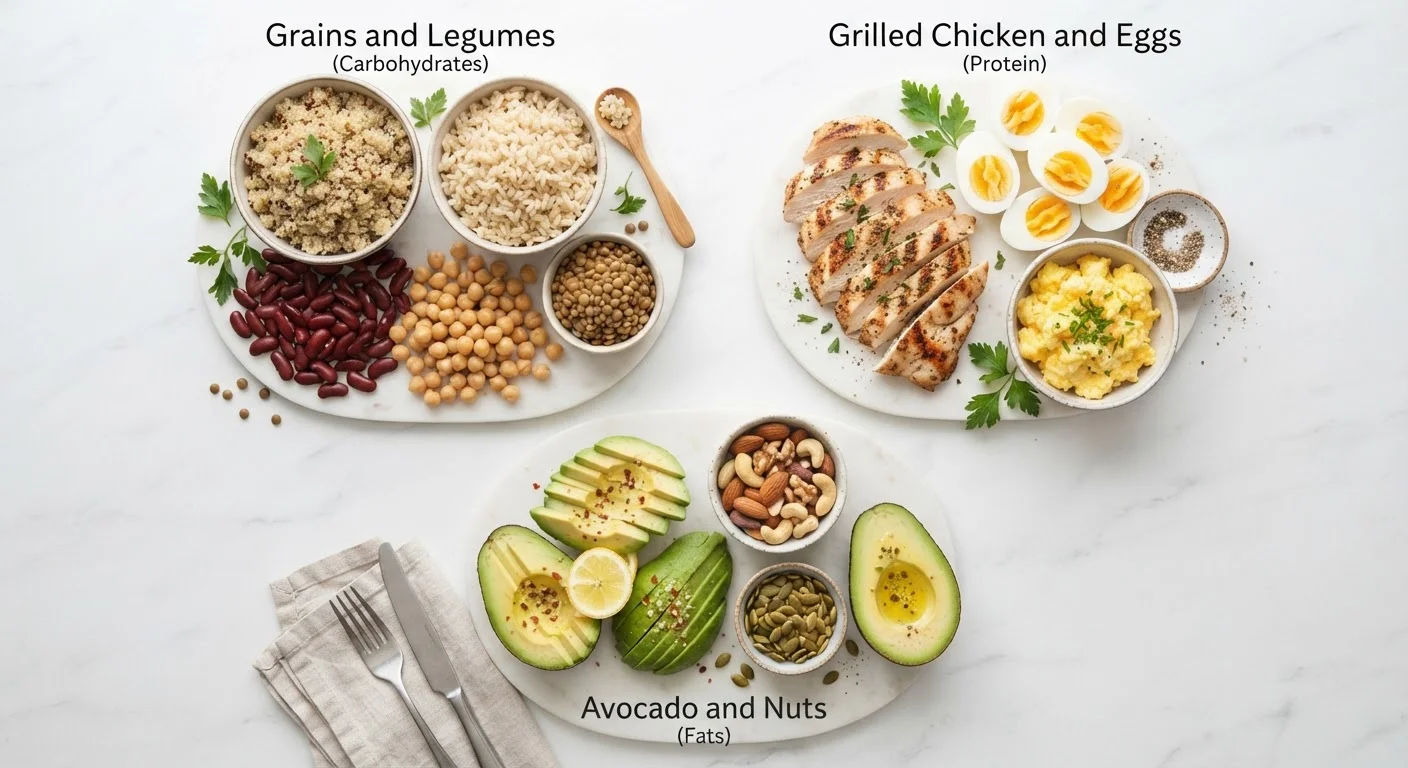
Carbohydrates are the body's first-choice energy source. When consumed, they are broken down into glucose — a simple sugar that circulates in the bloodstream and powers virtually every cell. The brain alone relies almost exclusively on glucose for moment-to-moment function, and working muscles draw heavily on stored carbohydrate (glycogen) during moderate-to-intense activity.
Not all carbohydrates behave the same way once inside the body. Simple carbohydrates — found in fruit, dairy, and refined sugars — digest quickly and raise blood glucose relatively fast. Complex carbohydrates — found in whole grains, legumes, and starchy vegetables — digest more slowly due to their fiber and starch structure, providing a more sustained release of energy and supporting digestive health in the process.
Fiber, technically a type of carbohydrate, deserves special mention. It passes largely undigested through the small intestine, feeding beneficial gut bacteria and helping regulate cholesterol and blood sugar levels. Most US adults fall well short of fiber recommendations, making whole-food carbohydrate sources particularly valuable.
45–65%
Recommended calorie share from carbohydrates
According to the Dietary Guidelines for Americans, carbohydrates should make up 45–65% of total daily calories for most adults.
10–35%
Recommended calorie share from protein
The Acceptable Macronutrient Distribution Range (AMDR) for protein is 10–35% of total daily calories, per the National Academies of Sciences.
20–35%
Recommended calorie share from fat
The AMDR for total fat is 20–35% of daily calories for adults, with emphasis on unsaturated fat sources.
Protein: Building Blocks for Growth and Repair
Protein is composed of chains of amino acids — 20 in total, nine of which the body cannot synthesize and must obtain from food (these are called essential amino acids). Once digested, amino acids are used to build and repair muscle tissue, produce enzymes and hormones, support immune function, and transport oxygen in the blood via hemoglobin.
Unlike carbohydrates and fat, the body has no dedicated long-term storage reservoir for protein. This is why consistent daily intake matters. Animal-based sources — such as poultry, fish, eggs, and dairy — typically contain all nine essential amino acids and are considered complete proteins. Most plant-based sources (with the exception of soy, quinoa, and a few others) are lower in one or more essential amino acids, though a varied plant-based diet can easily meet all amino acid needs over the course of a day.
Protein also plays a meaningful role in satiety. Research suggests it is the most satiating macronutrient on a per-calorie basis, which is relevant for those managing appetite or body composition. For more on how nutrients work together across a meal, see what a balanced plate actually looks like.
Fat: Far More Than Stored Energy
Fat is the most energy-dense macronutrient, but its role extends far beyond calorie storage. Dietary fats are essential for absorbing the fat-soluble vitamins A, D, E, and K — without adequate fat in a meal, absorption of these nutrients can be significantly reduced. Fat also provides the structural material for every cell membrane in the body and serves as a precursor for steroid hormones, including estrogen and testosterone.
The type of fat consumed is where the nutritional nuance lies:
- Unsaturated fats (monounsaturated and polyunsaturated) — found in olive oil, avocados, nuts, seeds, and fatty fish — are broadly supported by research as beneficial for cardiovascular and metabolic health.
- Saturated fats — found in butter, red meat, and full-fat dairy — are an area of ongoing research; current dietary guidelines generally recommend moderation rather than elimination.
- Trans fats (artificial) — largely removed from the US food supply through regulatory action — were strongly associated with cardiovascular harm and are now rarely found in packaged foods.
The brain is approximately 60% fat by dry weight, and omega-3 fatty acids — a type of polyunsaturated fat found in fatty fish, flaxseed, and walnuts — are particularly important for neurological function and have been studied for their anti-inflammatory properties.
“The quality of the foods we eat — not the precise ratio of macronutrients — is the strongest driver of long-term health outcomes. Whole foods provide nutrients that work synergistically in ways we are still discovering.”
— Walter Willett, Professor of Epidemiology and Nutrition, Harvard T.H. Chan School of Public Health
How Macronutrients Work Together — and Why Balance Matters
In practice, meals rarely deliver a single macronutrient in isolation. A bowl of lentil soup contains carbohydrates, protein, and fat simultaneously, and the body processes this combination differently than it would any single component eaten alone. Fat and protein slow gastric emptying, meaning they moderate the rate at which carbohydrates raise blood glucose — one reason why a mixed meal is generally more metabolically favorable than refined carbohydrates eaten alone.
The concept of macronutrient "ratios" — popularized by dietary patterns like ketogenic, high-protein, or low-fat diets — reflects the idea that shifting the proportion of each macronutrient can influence metabolism, satiety, and health outcomes. Research supports flexibility here: multiple dietary patterns with varying macronutrient distributions can support good health when built on whole, minimally processed foods.
What matters most is the quality of the foods providing those macronutrients. Whole grains, lean proteins, and healthy fats deliver not only their macronutrient content but also fiber, vitamins, minerals, and phytonutrients that interact in ways that a simplified macro-counting approach may miss. You can explore how the body actually uses these nutrients once consumed in our guide on how the body absorbs nutrients. For a quick-reference comparison, macronutrients at a glance offers a concise side-by-side summary.
This article is for general informational and educational purposes only and does not constitute medical or dietary advice. Consult a qualified healthcare professional or registered dietitian for guidance tailored to your individual health needs.