
The Glycaemic Index Explained: Blood Sugar, Carbohydrates, and What the Research Shows

Key Takeaways
Glycaemic Index (GI)
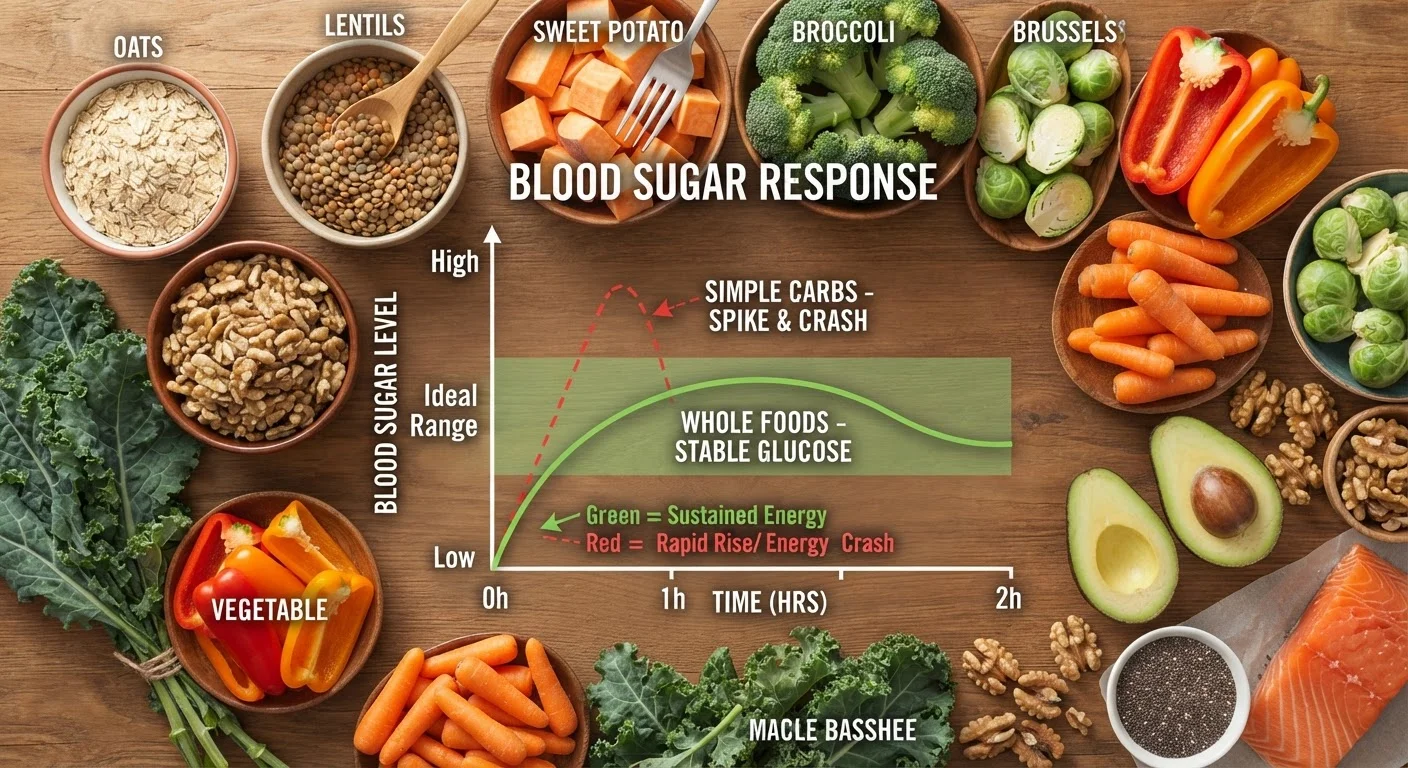
The glycaemic index is a numerical scale from 0 to 100 that ranks carbohydrate-containing foods by how quickly they raise blood glucose levels after eating. Foods are compared against a reference — typically pure glucose or white bread — scored at 100. A low GI score (55 or below) means a food raises blood sugar slowly and gradually; a high GI score (70 or above) means it causes a rapid spike.
GI values are measured under standardised laboratory conditions using the blood glucose response in healthy individuals over a two-hour period; real-world responses vary considerably based on food preparation, ripeness, and individual metabolic factors.
How the Glycaemic Index Was Developed
The glycaemic index was introduced in 1981 by Dr. David Jenkins and colleagues at the University of Toronto, originally as a tool to help people with diabetes make more informed food choices. Before GI research, carbohydrates were broadly classified as either simple or complex — a framework that turned out to be an oversimplification. White bread and a boiled potato, both considered complex carbohydrates, can raise blood sugar just as sharply as table sugar.
To build a GI score, researchers feed study participants a measured portion of a test food containing 50 grams of available carbohydrate, then monitor blood glucose at intervals over two hours. The area under the resulting curve is compared to the response from 50 grams of pure glucose (or white bread in some systems), which serves as the 100-point benchmark. The resulting score tells you the speed of glucose release — not its total quantity.
GI Values Vary Between Databases
Different GI databases — including those maintained by the University of Sydney and Atkinson et al.'s international tables — sometimes report different scores for the same food. Variations arise from differences in testing methodology, participant populations, and food sourcing. Use GI values as approximate guides rather than precise figures.
Glycaemic Load: The More Complete Picture
One of the most common criticisms of GI is that it ignores how much of a food you actually eat. This is where glycaemic load (GL) becomes useful. GL is calculated by multiplying a food's GI by the grams of available carbohydrate in a typical serving, then dividing by 100.
Watermelon illustrates this perfectly. Its GI is around 72 — placing it in the high category — yet a standard serving contains relatively few carbohydrates because it is mostly water. Its glycaemic load per serving is approximately 4, which is low. Eating a slice of watermelon is unlikely to significantly spike blood sugar in the way its GI alone would suggest. For everyday food decisions, GL is generally considered the more actionable metric.
Understanding how fibre differs from other carbohydrates is also relevant here — high-fibre foods tend to have lower GI values because fibre slows digestion and blunts glucose absorption.
55 or below
GI score range classified as low
According to the Glycemic Index Foundation's internationally used classification system for ranking carbohydrate foods.
~10 mmol/mol
Approximate HbA1c reduction with low-GI diets
A 2019 meta-analysis in The Lancet found low-GI diets produced meaningful improvements in HbA1c among people with type 2 diabetes compared to higher-GI control diets.
72
Glycaemic index of watermelon
Despite its high GI, watermelon's glycaemic load per standard serving is approximately 4 — classified as low — because of its high water content and small carbohydrate mass per serving.
Factors That Shift a Food's Real-World GI
Laboratory GI values are measured under controlled conditions, but eating is anything but controlled. Several variables alter the actual blood sugar impact of a food:
- Cooking method: Longer cooking raises GI by breaking down starch structure. Al dente pasta has a measurably lower GI than soft-cooked pasta.
- Ripeness: A ripe banana has a higher GI than an underripe one, as starch converts to sugar during ripening.
- Food combinations: Fat, protein, and fibre consumed alongside carbohydrates slow gastric emptying and reduce glycaemic response. A plain baked potato eaten alone has a very different effect than one served with a protein source.
- Processing and particle size: Finely milled flour raises blood sugar faster than coarsely ground grain, even when they originate from the same wheat.
- Cooling after cooking: Cooling cooked rice or potatoes increases resistant starch content, which lowers their effective GI.
These variables explain why individual blood sugar responses to the same food can vary considerably — a reality that population-level GI tables cannot fully capture. For context on how blood sugar readings are interpreted clinically, see our guide to decoding your blood pressure, cholesterol, and blood sugar numbers.
What the Research Says About GI and Health
A substantial body of research links low-GI dietary patterns with benefits for blood sugar management, particularly in people with type 2 diabetes or prediabetes. Systematic reviews and meta-analyses — including work published in journals such as The Lancet and Diabetes Care — generally support that replacing high-GI carbohydrates with low-GI alternatives can modestly improve HbA1c levels (a longer-term marker of blood sugar control) and reduce post-meal glucose spikes.
Evidence on weight management is more mixed. Some trials show low-GI diets support satiety and appetite regulation; others find no significant advantage over other dietary patterns when total calories are matched. Cardiovascular outcomes show a similar picture — promising associations in observational studies, but more variable results in controlled trials.
Importantly, GI does not capture a food's overall nutritional quality. Chocolate cake can have a lower GI than plain white rice, but that comparison reveals the limits of GI as a standalone guide. Nutrition scientists increasingly recommend using GI alongside other measures — overall diet quality, fibre content, and food processing level — rather than treating it as a single deciding metric.
If you have been told you have prediabetes or are managing type 2 diabetes, dietary adjustments involving GI are worth exploring with a qualified healthcare provider. Our article on what a prediabetes diagnosis means and what comes next provides further context.
“The glycaemic index is a useful tool, but it was never intended to be used in isolation. The overall quality and composition of the diet matters far more than the GI of any individual food.”
— David Jenkins, Professor of Nutritional Sciences, University of Toronto, and originator of the glycaemic index concept
Practical Ways to Apply GI Thinking
You don't need to memorise GI tables to benefit from the underlying principles. A few durable habits reflect what the research supports:
- Choose less-processed carbohydrates as a default — whole grains, legumes, and most intact fruits and vegetables tend to cluster toward the lower end of the GI scale.
- Pair carbohydrates with protein, healthy fat, or fibre at most meals. This combination consistently blunts post-meal glucose response without requiring GI calculations.
- Use cooking techniques that preserve food structure — steaming rather than boiling, and stopping pasta at al dente — to naturally moderate glycaemic impact.
- Read nutrition labels with GI in mind. Our guide to reading food labels without getting lost can help you identify fibre content and added sugars that influence GI effects.
GI is a genuinely useful lens for understanding carbohydrates, but it works best as part of a broader approach to eating — one focused on whole foods, dietary variety, and patterns sustained over time rather than single-meal scores.
This article is for general informational purposes only and does not constitute medical or dietary advice. If you have concerns about blood sugar management or a chronic health condition, consult a qualified healthcare professional before making significant changes to your diet.