
Thyroid Conditions in Adults: Hypothyroidism and Hyperthyroidism Side by Side

Key Takeaways
Our Verdict
Hypothyroidism and hyperthyroidism are mirror-image disorders driven by the same gland producing too little or too much hormone. While their symptoms point in opposite directions, both respond well to treatment when properly diagnosed. Early detection and consistent medical follow-up are the cornerstones of successful management for either condition.
| Best for | Recommended |
|---|---|
| Adults experiencing fatigue, weight gain, cold sensitivity, or depression | Evaluation for hypothyroidism |
| Adults with unexplained weight loss, rapid heartbeat, anxiety, or heat intolerance | Evaluation for hyperthyroidism |
| Those already diagnosed seeking long-term stability | Regular TSH monitoring and specialist follow-up |
What the Thyroid Does — and What Happens When It Misfires
The thyroid is a small, butterfly-shaped gland at the base of the neck that regulates metabolism, energy production, body temperature, and organ function by releasing thyroid hormones — primarily thyroxine (T4) and triiodothyronine (T3). A signal hormone called thyroid-stimulating hormone (TSH), released by the pituitary gland, controls how much T3 and T4 the thyroid produces.
When this feedback loop breaks down, one of two common disorders can develop. Hypothyroidism occurs when the thyroid produces insufficient hormone, slowing virtually every system in the body. Hyperthyroidism occurs when the thyroid overproduces hormone, pushing those same systems into overdrive. Understanding which condition is present — and how it differs from the other — is essential for getting appropriate care. Adults managing multiple chronic conditions should also be aware that thyroid disorders frequently intersect with other diagnoses, as explored in this overview of multimorbidity in adults.
Symptoms: Opposite Ends of the Spectrum
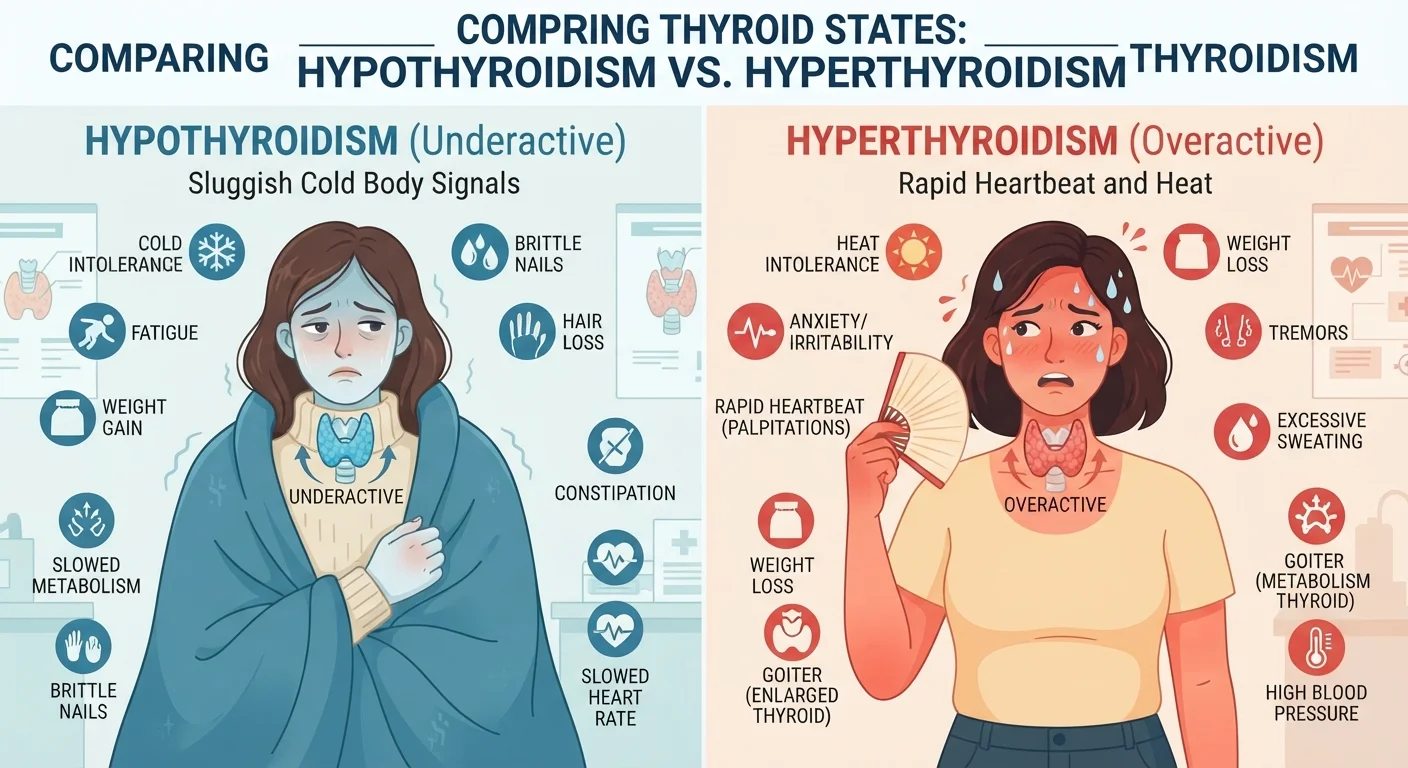
The symptom profiles of these two conditions reflect their underlying biology — one system running too slow, one running too fast.
Hypothyroidism Symptoms
- Persistent fatigue and sluggishness
- Unexplained weight gain despite normal eating habits
- Cold intolerance and low body temperature
- Dry skin, brittle nails, and hair thinning or loss
- Constipation and slowed digestion
- Depression, brain fog, and slowed thinking
- Heavy or irregular menstrual periods
- Elevated cholesterol levels
Hyperthyroidism Symptoms
- Unintentional weight loss despite increased appetite
- Rapid or irregular heartbeat (palpitations)
- Heat intolerance and excessive sweating
- Anxiety, irritability, and nervousness
- Tremors, particularly in the hands
- Frequent bowel movements or diarrhea
- Sleep disturbances and insomnia
- Lighter or missed menstrual periods
Because many of these symptoms overlap with other conditions — and because thyroid disorders can develop gradually — many adults go undiagnosed for extended periods. A clinician's assessment is the only reliable way to distinguish thyroid dysfunction from other causes.
| Feature | Hypothyroidism | Hyperthyroidism | |
|---|---|---|---|
| Core problem | Too little thyroid hormone | Too much thyroid hormone | |
| Most common cause | Hashimoto's thyroiditis (autoimmune) | Graves' disease (autoimmune) | |
| Weight effect | Weight gain | Weight loss | |
| Energy & mood | Fatigue, depression, brain fog | Anxiety, irritability, insomnia | |
| Heart rate | Slowed heart rate | Rapid or irregular heart rate | |
| Temperature sensitivity | Cold intolerance | Heat intolerance | |
| Primary diagnostic marker | High TSH, low free T4 | Low TSH, high free T4/T3 | |
| Standard treatment | Levothyroxine (synthetic T4) | Antithyroid drugs, radioactive iodine, or surgery |
Causes and Risk Factors
The two disorders share some risk factors but arise from different underlying mechanisms.
Hypothyroidism is most commonly caused by Hashimoto's thyroiditis, an autoimmune condition in which the immune system mistakenly attacks thyroid tissue. Other causes include thyroid surgery, radiation treatment to the neck, certain medications (such as lithium or amiodarone), and, less commonly, iodine deficiency. The condition becomes more prevalent with age and affects women approximately five to eight times more often than men.
Hyperthyroidism is most often caused by Graves' disease, another autoimmune disorder in which antibodies stimulate the thyroid to produce excess hormone. Toxic nodular goiter — where nodules on the gland independently overproduce hormone — is the second most common cause. Thyroiditis (inflammation of the gland) can also temporarily trigger hyperthyroidism. Like hypothyroidism, it occurs more frequently in women and in people with a family history of thyroid disease.
Know Your Family History
Both Graves' disease and Hashimoto's thyroiditis run in families. If a close relative has been diagnosed with either condition, inform your doctor so they can factor that into your care. Routine TSH screening is widely recommended for adults with thyroid-related symptoms, a family history of thyroid disease, or other autoimmune conditions. Early detection significantly simplifies management.
Diagnosis and Treatment Approaches
Diagnosis for both conditions begins with a blood panel measuring TSH, free T4, and often free T3. An elevated TSH with low free T4 confirms hypothyroidism; a suppressed TSH with high free T4 or T3 points to hyperthyroidism. Antibody tests can identify autoimmune causes, and imaging such as thyroid ultrasound or a radioactive iodine uptake scan may be ordered for hyperthyroidism.
Treating Hypothyroidism
The standard treatment is daily oral levothyroxine, a synthetic form of T4. Dosing is individualized based on TSH levels, age, weight, and other health factors, with periodic blood tests used to fine-tune the prescription. Most people with hypothyroidism require lifelong treatment and can achieve full symptom resolution with proper management.
Treating Hyperthyroidism
Options include antithyroid medications (such as methimazole or propylthiouracil) that reduce hormone production, radioactive iodine therapy that gradually shrinks thyroid tissue, or surgery to remove part or all of the gland. Each approach carries its own risk profile and suitability considerations. Radioactive iodine and surgery often result in hypothyroidism afterward, requiring lifelong levothyroxine therapy. Beta-blockers may be prescribed short-term to manage heart-related symptoms while definitive treatment takes effect.
This article is for informational purposes only and is not a substitute for professional medical advice, diagnosis, or treatment. Always consult a qualified healthcare provider regarding any medical concerns or before making changes to your health management plan.