

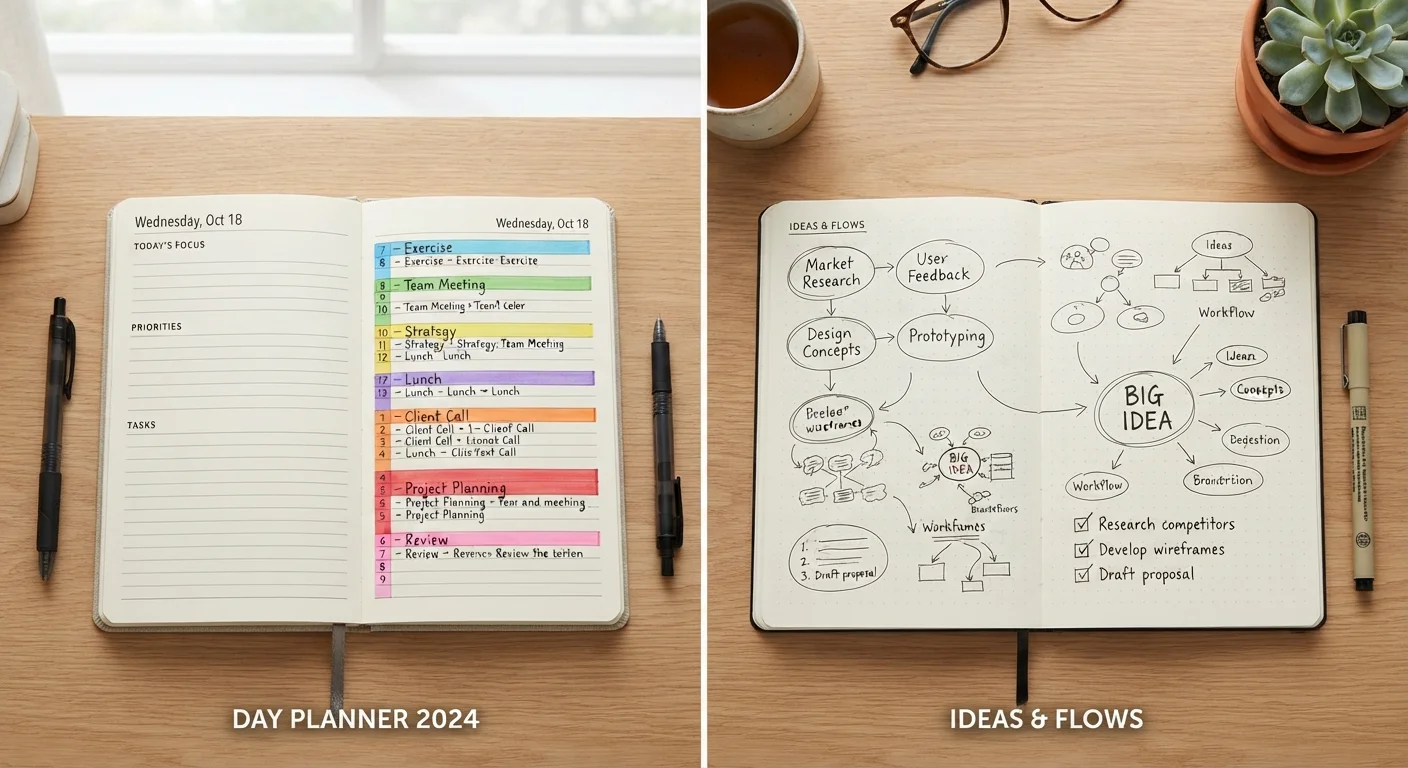
Key Takeaways
Option A
Fixed Schedule
The predictable, disciplined framework for daily life.
Best for: People with consistent obligations, stable energy patterns, and goals that benefit from daily repetition at the same time.
Option B
Flexible Routine
The adaptive, intention-driven approach to structuring your day.
Best for: People with variable workloads, caregiving responsibilities, or creative work that doesn't fit neatly into timed blocks.
If your days follow a predictable, consistent pattern
Fixed Schedule
Consistent external anchors like commute times or meeting windows make time-blocking highly effective and easy to maintain.
If your workload or family demands shift frequently
Flexible Routine
A habits-first approach lets you protect what matters most without being derailed when the day changes unexpectedly.
If you struggle with procrastination or task initiation
Fixed Schedule
Pre-committed time slots remove the moment-to-moment choice of when to start, which is often where delay occurs.
If you do creative or deep-focus work with variable energy
Flexible Routine
Flexible frameworks let you schedule cognitively demanding work when your energy is actually high, not just when the clock says so.
If you want the benefits of both consistency and adaptability
Fixed Schedule
A hybrid model using fixed anchors for high-priority tasks and flexible windows for everything else captures the strengths of both approaches.
What Each Approach Actually Means
A fixed schedule assigns specific tasks or habits to specific clock times — wake at 6:30, exercise at 7:00, deep work from 9:00 to 11:00. The structure repeats daily or weekly with minimal variation. Time-blocking, one of its most common implementations, is explored in depth in our guide to time blocking.
A flexible routine, by contrast, defines what you want to accomplish each day without locking those tasks to a fixed time. You might commit to meditating, exercising, and doing your most demanding work — but when those happen shifts based on how the day unfolds. The goal is habit completion, not clock adherence.
Neither is purely about productivity. Both are strategies for protecting energy, reducing friction, and making space for what matters. The difference lies in how much the structure bends when life doesn't cooperate.
Head-to-Head: Key Differences
The comparison below highlights the most meaningful distinctions between the two approaches across practical dimensions most adults care about.
| Criterion | Fixed Schedule | Flexible Routine |
|---|---|---|
| Core mechanism | Time-anchored task assignment | Priority-based habit completion |
| Decision fatigue | Low — structure is pre-built | Moderate — daily judgment required |
| Resilience to disruption | Low — one shift can unravel the day | High — tasks move, not disappear |
| Best energy alignment | Consistent energy patterns | Variable or creative energy cycles |
| Habit formation speed | Faster — strong contextual cues | Slower — relies on intention-setting |
| Suits caregiving/variable roles | Poorly | Well |
| Psychological fit | High need for predictability | High need for autonomy |
One pattern worth noting: fixed schedules tend to perform better when your external environment is stable. When it isn't — shifting deadlines, caregiving demands, irregular sleep — the rigidity that makes fixed schedules powerful can become a liability. Our article on the trade-offs of a highly structured day covers this tension in more detail.
The Science Behind Structure and Habit Formation
Research on habit formation consistently shows that contextual cues — time, location, preceding actions — are among the strongest triggers for automatic behavior. Fixed schedules leverage this by creating reliable cues. When 7:00 a.m. reliably means a walk, the habit requires less willpower over time because the cue does the initiating.
Flexible routines rely more on implementation intentions: pre-deciding that you will do something, even if the when is open. Studies in behavioral science suggest these if-then plans ("If I finish lunch, then I'll go for a walk") are nearly as effective as time-anchored cues — particularly for people whose days vary widely.
66 days
Average time for a habit to become automatic
A 2010 study published in the European Journal of Social Psychology found habit formation took 18 to 254 days, with 66 days as the median — far longer than the commonly cited 21-day myth.
~2–3x
Effectiveness boost from implementation intentions
A meta-analysis by Peter Gollwitzer found that forming specific if-then plans significantly increased goal follow-through compared to vague intentions alone.
35,000
Estimated daily decisions made by adults
Commonly cited in behavioral economics literature to illustrate the cognitive load of unstructured days — though the exact figure is an approximation rather than a precise scientific measurement.
Chronotype also matters here. Morning-types may find fixed early schedules energizing, while evening-types may perform poorly under the same structure. A flexible routine that lets you schedule cognitive work when your alertness peaks can be more effective than a fixed schedule misaligned with your biology.
For those managing eating patterns alongside a busy schedule, the same logic applies — see fitting an eating pattern around a busy schedule for practical meal-timing strategies under variable conditions.
Building a Hybrid: Taking the Best of Both
Most people benefit from a model that isn't purely fixed or purely flexible. A practical hybrid approach works like this:
- Anchor your non-negotiables to fixed times. Sleep, your most important work block, and any time-sensitive commitments stay fixed. These are your structural pillars.
- Leave the rest as ordered intentions. Rather than scheduling secondary tasks to the minute, list them in priority order and complete them when windows appear.
- Use flexible buffers deliberately. Build 20–30 minute gaps between fixed blocks. These absorb overruns and give you room to respond without abandoning the structure entirely.
This approach sidesteps the all-or-nothing thinking that makes people abandon routines after one disrupted day. If you're unsure where your current schedule is losing you time and energy, a daily routine audit is a useful first step before redesigning anything.
For a closer look at task-level organization within either framework, our comparison of time-blocking vs. task batching covers how to group work effectively regardless of your scheduling style.
This article is for general informational purposes only and does not constitute professional medical, psychological, or behavioral health advice. Consult a qualified professional for personalized guidance.