

Key Takeaways
Our Verdict
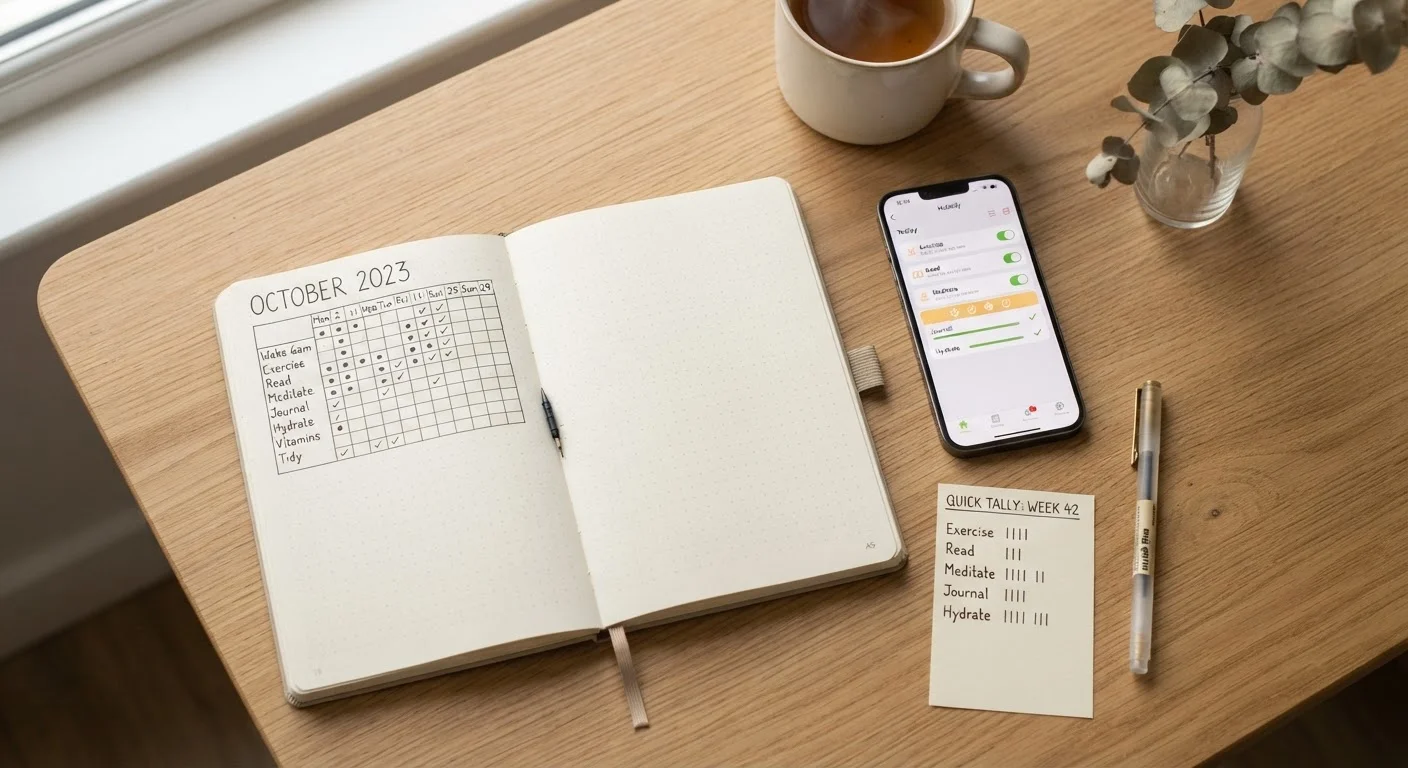
No single habit-tracking method outperforms the others in every situation. Paper journals reward reflection and depth; apps excel at automation and data; tally systems win on simplicity and speed. The research consistently shows that what predicts habit formation is consistent tracking — not the tool you use to do it.
| Best for | Recommended |
|---|---|
| Those who want to build self-awareness alongside behavior change | Paper journals |
| People juggling multiple habits and wanting reminders and trend data | Habit-tracking apps |
| Anyone starting fresh who needs the lowest possible friction | Simple tallies |
| Those prone to tracking anxiety or perfectionism | Simple tallies |
Why the Tracking Method Matters More Than You Think
Self-monitoring is one of the most replicated mechanisms in behavior change research. A 2015 meta-analysis published in Psychological Bulletin found that self-monitoring significantly improved goal attainment across health, performance, and productivity domains. But the how of tracking is rarely examined as carefully as the what.
The method you choose shapes how much cognitive load tracking demands, how frequently you review progress, and — critically — whether you stick with it past week three. For building consistent daily routines, a tracking system that feels cumbersome will reliably be abandoned. One that fits naturally into an existing workflow has a far better chance of persisting. Before defaulting to the flashiest app or the prettiest journal, it's worth understanding what each approach actually delivers.
Paper Journals: Depth Over Convenience
A handwritten habit journal — whether a dedicated tracker or a simple notebook — brings two meaningful advantages: it slows you down, and it creates a physical artifact of your effort.
The act of writing by hand engages encoding processes that screen-based input doesn't reliably replicate, according to research on note-taking and memory consolidation. When you fill in yesterday's meditation or sleep window by hand, you're more likely to notice the pattern than when you tap a checkmark. This reflective quality makes paper tracking particularly effective when the goal involves self-awareness — managing stress, understanding energy fluctuations, or building the kind of intentional daily awareness that compounds over time.
The drawbacks are real. Paper doesn't send reminders. It can't calculate averages, generate streak graphs, or sync across devices. A missed week creates a visual gap that some people find discouraging rather than motivating. Paper journals also work best for a small number of habits — trying to track eight behaviors across columns grows tedious quickly.
Match the Tool to the Habit Phase
Habit formation research suggests behavior becomes automatic after consistent repetition over weeks, not days. During the first two to four weeks, prioritize tools that minimize friction over tools that maximize data. Once the behavior feels more routine, you can layer in richer tracking without the overhead derailing the habit itself.
Best fit: Habits tied to mood, cognition, or subjective experience — sleep quality, anxiety patterns, creative output. If you're also keeping a symptom journal for healthcare purposes, a paper format often works well for both simultaneously.
Habit-Tracking Apps: Automation and Accountability
Apps built specifically for habit tracking typically offer push notifications, streak counters, visual heatmaps, and the ability to track multiple habits simultaneously. For people managing several behaviors at once — exercise, hydration, reading, sleep — an app reduces the overhead of maintaining separate records.
The automation advantage is genuine. Research on implementation intentions suggests that well-timed reminders can substantially increase follow-through, particularly during the early phase of habit formation when a behavior isn't yet automatic. An app can approximate the function of an accountability partner without requiring another person's time.
The risks, however, are worth naming. Streak mechanics can create what researchers call loss aversion around tracking itself — a missed day feels disproportionately costly, sometimes prompting people to abandon the habit entirely rather than accept the broken streak. Some users also report that the gamification layer gradually replaces the intrinsic motivation that originally drove the behavior. If you notice tracking becoming a source of stress rather than clarity, that's a signal worth paying attention to. See also: how tracking can undermine the very habits it's meant to support.
| Paper Journals | Habit-Tracking Apps | Simple Tallies | |
|---|---|---|---|
| Setup effort | Moderate — design your own layout | Low — templates built in | Minimal — pen and paper only |
| Daily friction | Medium — requires writing time | Low — one tap per habit | Very low — one mark |
| Reminders / prompts | None — self-directed only | Yes — push notifications | None — self-directed only |
| Insight depth | High — notes, context, reflection | Medium — streaks and trend data | Low — count only |
| Handles multiple habits | Limited — columns get unwieldy | Strong — built for it | Poor — one habit at a time ideally |
| Risk of abandonment | Moderate — no external prompts | Higher if streak anxiety develops | Low — too simple to feel burdensome |
| Best habit phase | Maintenance and reflection | Early to mid — building momentum | Very early — establishing repetition |
Best fit: Multiple simultaneous habits, anyone who benefits from external prompts, and people who find visual trend data motivating rather than anxiety-inducing.
Simple Tallies: The Underestimated Workhorse
A tally is a mark on paper, a token moved from one jar to another, a dot on a sticky note. It is the lowest-friction tracking system available — and friction is the enemy of new habits.
James Clear's popularized account of habit formation (drawing on earlier behavioral research) emphasizes that reducing the effort required to perform and record a behavior is one of the most reliable levers available. A tally asks almost nothing: one mark, one second, done. This simplicity makes tallies especially effective during the earliest phase of habit building, when the priority is simply getting the repetition count up rather than analyzing patterns.
Tallies are also forgiving. A missed day doesn't generate a broken streak notification — it's just a smaller number. For people who have experienced tracking anxiety or abandoned more complex systems in the past, starting with a tally often creates a psychological runway for eventually adding more structure.
The limitation is equally obvious: tallies tell you how many times but nothing else. They don't capture context, mood, or quality. They're poorly suited to complex behaviors with multiple sub-components.
Best fit: Single-behavior focus in the early weeks of a new habit, or as a fallback system during high-stress periods when maintaining a more complex system isn't realistic. Tally thinking also maps naturally onto simple time-logging approaches during transitions.
Choosing — and Switching — Strategically
The evidence doesn't support one universal winner. What the research does support is that consistency of tracking, not sophistication, predicts outcomes. A tally you maintain for 60 days outperforms an app you abandon after 12.
A practical framework: start with the method that requires the least setup for the habit you're trying to build. Add complexity only when the simpler method stops giving you useful information. And treat method-switching not as failure but as calibration — your daily routine system should serve your life, not the other way around.
One under-discussed option is hybrid tracking: a tally for daily completion paired with a brief weekly paper review. This preserves the low friction of daily tallying while introducing the reflective depth that drives meaningful behavior adjustment.
This article is for general informational purposes only and does not constitute medical or psychological advice. If you are managing a health condition, consult a qualified healthcare professional before making changes to your routine.