

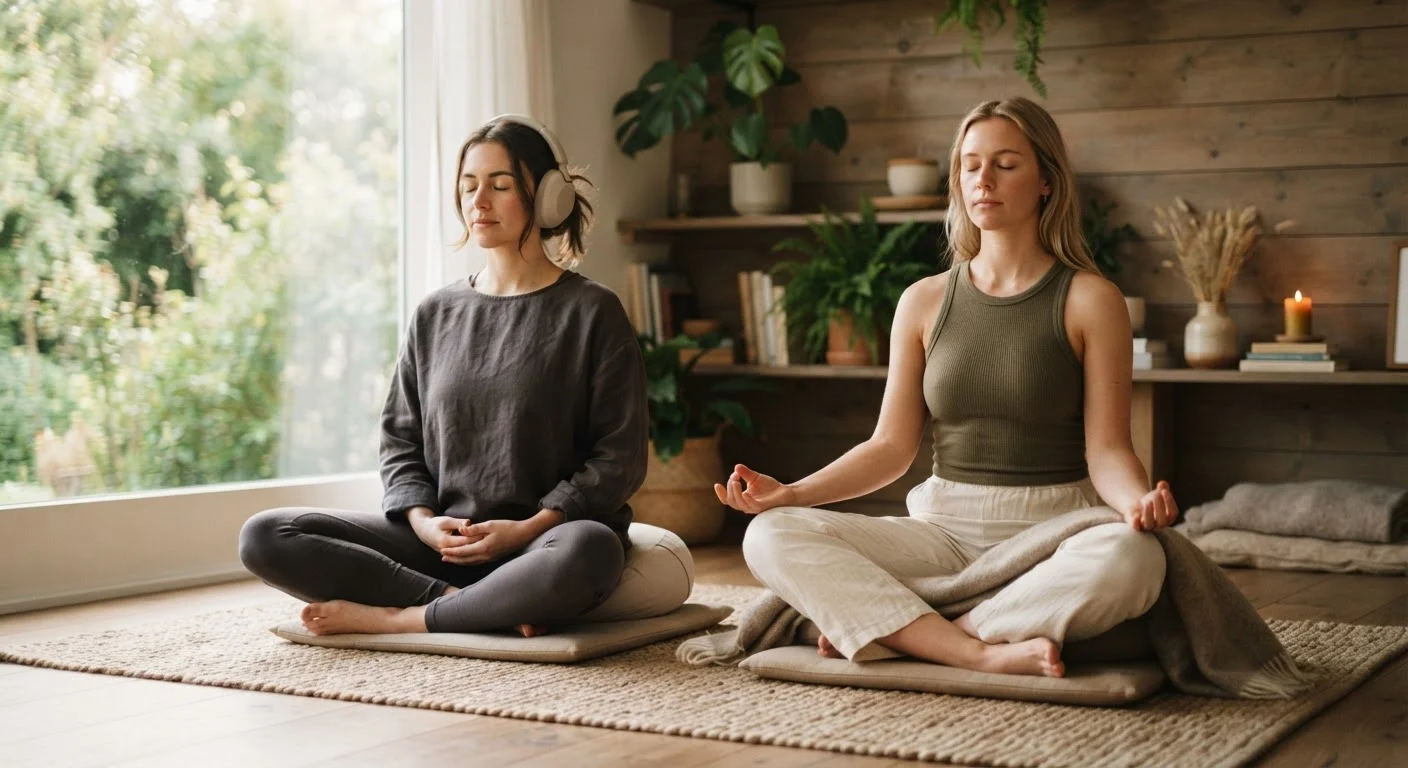
Key Takeaways
Option A
Guided Meditation
The structured, instructor-led approach to mindfulness.
Best for: Beginners or busy adults who benefit from external direction to stay focused and engaged during practice.
Option B
Silent Meditation
The self-directed, unguided path to inner stillness.
Best for: Experienced practitioners or those who prefer independent, flexible practice without external cues.
If you're new to meditation and struggle with a wandering mind
Guided Meditation
An instructor's voice provides structure and anchors attention, reducing the frustration beginners often experience when sitting in silence.
If you have an established practice and want deeper self-awareness
Silent Meditation
Without external prompts, you develop a more autonomous relationship with your mind and sharpen your ability to self-regulate.
If your schedule is unpredictable and you need flexibility
Guided Meditation
Widely available apps and recordings let you practice anywhere, at any time, with minimal setup.
If you find audio cues distracting or prefer a technology-free routine
Silent Meditation
Removing devices and narration eliminates external noise, allowing a quieter, more personal inner experience.
If you want to build a long-term, adaptable mindfulness habit
Guided Meditation
Starting with guided sessions builds foundational technique that you can gradually carry into independent silent practice over time.
What Each Style Actually Involves
Guided meditation involves listening to an instructor — either in person, via a recording, or through an app — who directs your attention using narration, imagery, or breathing cues. The guide does much of the cognitive scaffolding for you, telling you where to focus and when to let thoughts pass. This external structure is a significant advantage for anyone whose mind tends to race the moment silence falls.
Silent meditation, by contrast, places the entire responsibility for focus on the practitioner. Common forms include breath awareness, loving-kindness (metta) meditation, or open awareness practices — all conducted without verbal prompts. You set your own anchor and return to it when the mind wanders. For many people, this feels daunting at first, but it gradually becomes a more intimate and self-sustaining practice.
It's worth noting that "silent" doesn't necessarily mean sitting in a noise-free room — it refers to the absence of instructional guidance, not necessarily environmental silence. Understanding this distinction matters if you're weighing which style fits your daily reality. For a broader look at how different mindfulness formats compare, see formal vs. informal mindfulness practice.
| Criterion | Guided Meditation | Silent Meditation |
|---|---|---|
| Instruction | Audio or in-person narration | Self-directed, no prompts |
| Best entry point | Beginners and those easily distracted | Intermediate to advanced practitioners |
| Skill developed | Following structured attention cues | Independent self-regulation |
| Flexibility | High — apps and recordings available anytime | High — requires no equipment at all |
| Technology required | Usually yes (app, audio, or instructor) | None needed |
| Session length | Typically structured (5–30 min) | Fully flexible, set by practitioner |
| Common formats | Body scan, visualization, MBSR | Breath awareness, Vipassana, Zen sitting |
The Research Behind Each Approach
Both styles have meaningful research support, though the evidence base differs in focus. Studies on guided meditation — particularly Mindfulness-Based Stress Reduction (MBSR), developed by Jon Kabat-Zinn — consistently show reductions in perceived stress, anxiety symptoms, and markers of emotional reactivity. The guided format makes it easier to recruit participants for research, which is one reason the evidence base for structured programs is relatively robust.
Silent meditation practices, including Vipassana and Zen sitting, have a longer historical record and are increasingly studied in clinical and neuroscientific settings. Research suggests that long-term silent practitioners show measurable differences in attention regulation and emotional processing. However, most of this research focuses on people with established practices, making it harder to generalize to beginners.
8 weeks
MBSR program duration showing measurable stress reduction
The standard Mindfulness-Based Stress Reduction program, widely studied in clinical settings, runs for eight weeks of guided practice.
~14%
U.S. adults who meditate regularly
According to a National Center for Health Statistics survey, approximately 14% of U.S. adults reported meditating in the past year, up from earlier decades.
10–20 min
Typical daily session length in research studies
Many well-cited studies on meditation benefits use daily sessions of 10 to 20 minutes, suggesting modest time commitments can produce meaningful effects.
The honest takeaway: neither style has a definitively stronger evidence base across all outcomes. What the research does suggest is that consistency matters more than format. A style you'll actually return to tomorrow is more valuable than one that's theoretically optimal but feels like a chore. See the real trade-offs of regular meditation practice for a candid look at what commitment to either path genuinely requires.
How to Choose — or Combine Both
The most useful question isn't "which is better?" but rather "which will I actually do?" If you're starting out, guided meditation lowers the barrier significantly. You don't need to know how to meditate — you just follow along. Many people find that after several weeks of guided practice, they naturally begin to extend sessions into silence at the end, organically building toward independent practice.
Experienced meditators sometimes cycle between both. A guided session can reinvigorate a stale routine or help when stress makes self-direction difficult. Silent practice may feel more natural on calmer days or when you want space without a narrator's voice shaping the experience.
If you'd like to explore how the style of focus — not just guidance level — affects your practice, breath-focused vs. body-focused calm techniques offers a complementary comparison worth reading. And before your next session, consider the grounding steps outlined in this pre-meditation checklist — a small preparation habit that can make either style more effective.
This article is for general informational and educational purposes only. It is not a substitute for professional medical or mental health advice. If you are experiencing significant anxiety, depression, or other mental health concerns, please consult a qualified healthcare provider.