

Key Takeaways
Start here
Why Fat Type Matters More Than Fat Amount
Core concepts
Saturated Fats: What the Research Actually Says
Build on it
Unsaturated Fats: The Heart-Friendly Category
Critical knowledge
Trans Fats: The One Type Worth Avoiding
Apply it
How to Apply This in Practice
Why Fat Type Matters More Than Fat Amount
For decades, dietary fat was treated as a single villain. Low-fat products flooded grocery shelves, and the advice to simply eat less fat dominated public health messaging. The science has since become considerably more refined. We now understand that fat is an essential macronutrient — involved in hormone production, fat-soluble vitamin absorption, and cell membrane integrity — and that the type of fat consumed is a far more meaningful variable than total fat intake alone.
Dietary fats fall into three broad categories: saturated, unsaturated, and trans. Each has a distinct molecular structure, a different set of food sources, and a different relationship with health outcomes. Understanding those distinctions equips you to make better decisions at the grocery store, in the kitchen, and when interpreting nutrition research. This guide is part of a broader look at what macronutrients actually do in the body.
Saturated fat
A type of dietary fat whose carbon chain has no double bonds, making it solid at room temperature. Found mainly in animal products and some tropical oils.
Unsaturated fat
A dietary fat with one or more double bonds in its carbon chain, typically liquid at room temperature. Includes both monounsaturated and polyunsaturated varieties.
Trans fat
A type of fat formed when liquid oils are partially hydrogenated, or found naturally in small amounts in ruminant animal products. Artificial trans fats are associated with cardiovascular harm.
LDL cholesterol
Often called 'bad' cholesterol, LDL carries cholesterol to cells and, when elevated, is associated with increased cardiovascular risk.
HDL cholesterol
Often called 'good' cholesterol, HDL helps carry cholesterol away from arteries toward the liver. Higher levels are generally associated with lower cardiovascular risk.
Omega-3 fatty acids
A family of polyunsaturated fats — found in fatty fish, walnuts, and flaxseeds — that the body cannot make on its own and that are linked to anti-inflammatory effects.
Partial hydrogenation
An industrial process that adds hydrogen to liquid vegetable oil to make it more solid and shelf-stable, producing artificial trans fats as a byproduct.
Saturated Fats: What the Research Actually Says
Saturated fats are characterized by carbon chains with no double bonds — every carbon atom is 'saturated' with hydrogen atoms. This structure makes them stable and solid at room temperature. Primary food sources include red meat, full-fat dairy products, butter, lard, palm oil, and coconut oil.
The relationship between saturated fat and cardiovascular disease has been debated extensively in nutrition science. Earlier research linked high saturated fat intake to elevated LDL (low-density lipoprotein) cholesterol, a recognized risk factor for heart disease. More recent analyses have complicated this picture, suggesting that the food matrix — the whole food in which fat appears — and the dietary pattern surrounding it may matter as much as the saturated fat itself.
One consistent finding: what you replace saturated fat with is critical. Swapping saturated fat for refined carbohydrates does not appear to improve cardiovascular risk, while replacing it with polyunsaturated fats is associated with more favorable outcomes in population research. Major health organizations, including the American Heart Association, generally recommend keeping saturated fat to a modest share of total calories as part of an overall heart-healthy pattern — but consult a healthcare provider for guidance tailored to your situation.
Unsaturated Fats: The Heart-Friendly Category
Unsaturated fats contain one or more carbon-to-carbon double bonds, making them liquid at room temperature and generally less stable than saturated fats. They split into two subtypes: monounsaturated (one double bond) and polyunsaturated (multiple double bonds).
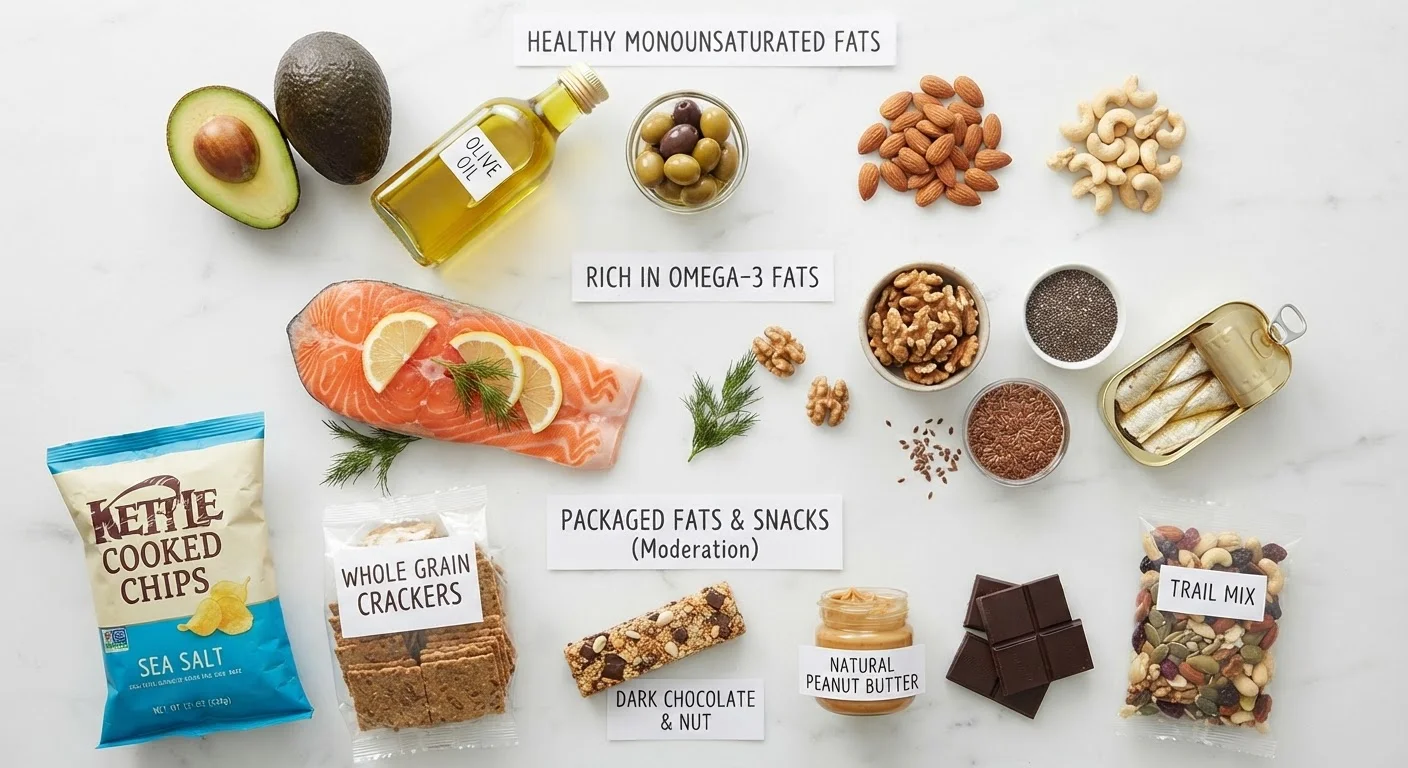
Monounsaturated fats (MUFAs) are found in olive oil, avocados, and many nuts, including almonds and cashews. They are associated in research with improved LDL-to-HDL cholesterol ratios and reduced cardiovascular risk, particularly in the context of Mediterranean-style dietary patterns.
Polyunsaturated fats (PUFAs) include the omega-3 and omega-6 fatty acid families. Omega-3s — found in fatty fish like salmon and mackerel, walnuts, flaxseeds, and chia seeds — are linked to anti-inflammatory effects and cardiovascular benefit. Omega-6s are abundant in vegetable oils such as sunflower and corn oil. Both are essential fatty acids, meaning the body cannot synthesize them and must obtain them from food. The ratio of omega-6 to omega-3 intake is an active area of nutrition research, though clear universal targets remain debated.
Easy Way to Boost Unsaturated Fat Intake
Swapping butter for olive oil in everyday cooking is one of the simplest, evidence-supported shifts you can make toward a more unsaturated-fat-rich diet. Using avocado in place of mayonnaise or cheese as a topping adds monounsaturated fat alongside fiber and micronutrients. Small, consistent substitutions tend to stick better than large dietary overhauls.
For a broader framework on building meals around foods rich in these fats, the Balanced Eating hub offers practical, evidence-based strategies.
Trans Fats: The One Type Worth Avoiding
Trans fats exist in two forms. Artificial trans fats are created when hydrogen is added to liquid vegetable oil under pressure — a process called partial hydrogenation — producing a semi-solid fat used historically in margarine, shortening, packaged baked goods, and fried fast food. Natural trans fats occur in small quantities in the fat of ruminant animals and appear in some dairy products.
Artificial trans fats have the strongest and most consistent evidence of harm among all fat categories. They simultaneously raise LDL cholesterol and lower HDL (high-density lipoprotein) cholesterol — a doubly unfavorable effect on cardiovascular risk markers. The U.S. Food and Drug Administration revoked their Generally Recognized As Safe (GRAS) status, and most manufacturers have phased them out of their formulations in the U.S.
Hidden Trans Fats Are Still a Risk
Even though most U.S. manufacturers have removed artificial trans fats, they can still appear in some imported foods, older packaged goods, or items fried in partially hydrogenated oil. A Nutrition Facts panel showing '0g trans fat' does not guarantee complete absence — serving sizes below 0.5g are legally rounded to zero. Always check the ingredient list for 'partially hydrogenated oil' as the definitive indicator.
Natural trans fats, by contrast, do not appear to carry the same risk profile based on current research, though evidence continues to accumulate. When evaluating whole foods versus processed foods, trans fat presence remains a useful marker of ultra-processing.
How to Apply This in Practice
Translating fat chemistry into shopping and cooking decisions does not require memorizing molecular structures. A few practical principles cover most situations:
- Prioritize food sources of unsaturated fat — olive oil as a primary cooking fat, fatty fish a couple of times per week, a handful of nuts or seeds as a snack or salad topping.
- Moderate saturated fat with context — full-fat dairy, meat, and coconut oil are not off-limits, but they work best as part of a dietary pattern that also emphasizes vegetables, legumes, and whole grains.
- Read ingredient lists, not just nutrition panels — 'partially hydrogenated oil' in the ingredients signals artificial trans fat even when the panel shows 0g per serving, because rounding rules allow that labeling at amounts below 0.5g per serving.
- Consider the whole food, not just the nutrient — a handful of walnuts delivers polyunsaturated fat alongside fiber, micronutrients, and phytochemicals that a refined oil cannot replicate.
Understanding fat types is one chapter in a larger story about balanced eating as a whole. No single nutrient determines health outcomes in isolation — dietary patterns, food quality, and overall lifestyle all interact. If you have specific cardiovascular concerns or dietary conditions, work with a registered dietitian or your healthcare provider to build an approach suited to your needs.
This article is for general informational and educational purposes only and does not constitute medical or dietary advice. Consult a qualified healthcare professional before making changes to your diet, particularly if you have an existing health condition.
Balanced Eating Hub
A practical collection of evidence-based strategies for building nutritious, well-rounded meals every day — including how fat fits into overall dietary patterns.
Nutrition Labelling Decoded
A clear walkthrough of how to read Nutrition Facts panels and ingredient lists, including how to identify fats like partially hydrogenated oils hidden in packaged foods.