

Key Takeaways
Option A
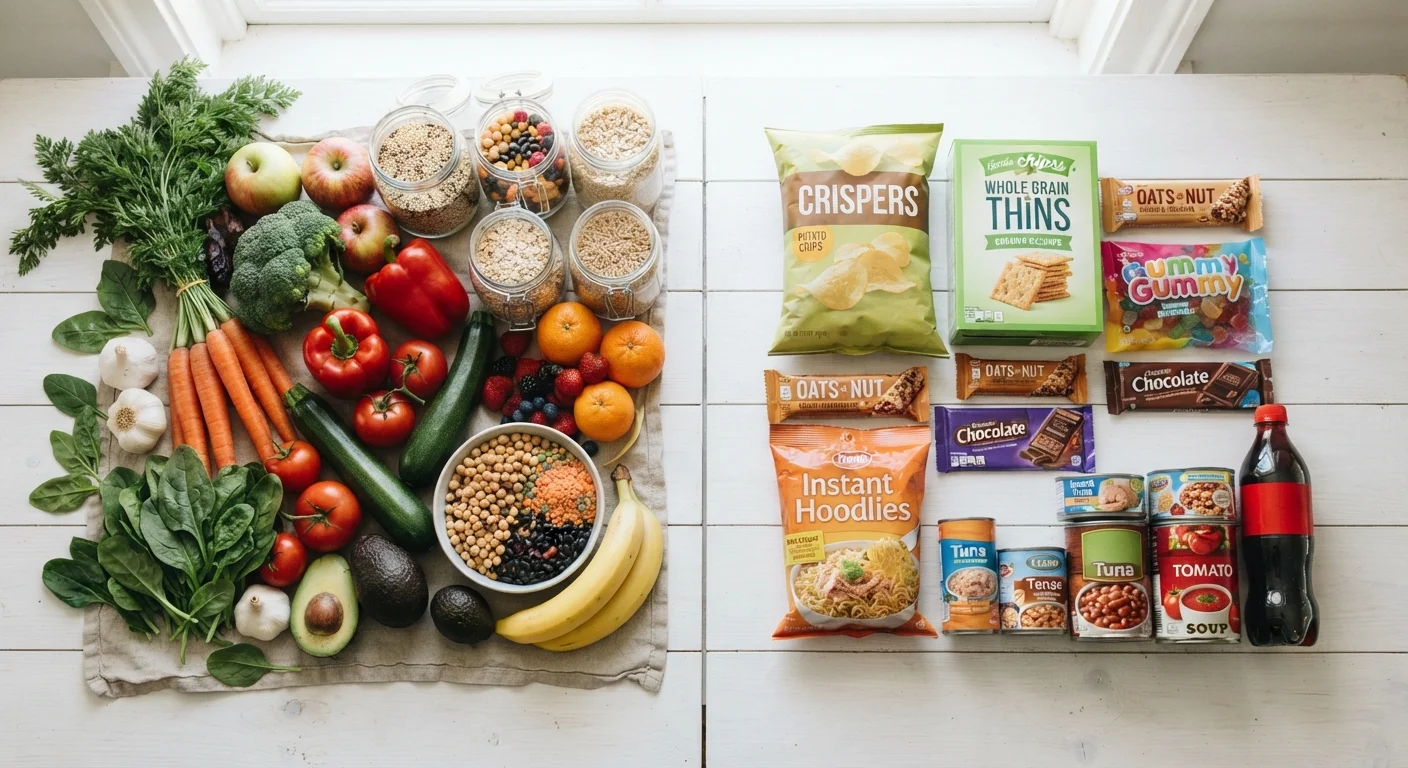
Whole Foods
The nutrient-dense, minimally altered foundation of eating well.
Best for: People prioritizing nutrient density, fiber intake, and long-term dietary quality with minimal additives.
Option B
Processed Foods
A broad spectrum ranging from mildly modified to heavily engineered.
Best for: Busy adults who need convenient, shelf-stable options and benefit from understanding which processing levels carry real trade-offs.
If your primary goal is maximizing nutrient density
Whole Foods
Whole foods retain the full matrix of fiber, vitamins, minerals, and phytonutrients that processing often diminishes or removes entirely.
If you need fast, shelf-stable convenience without nutritional compromise
Processed Foods
Minimally processed options like canned legumes, frozen vegetables, and plain yogurt offer genuine nutritional value with far greater practicality for busy schedules.
If you're building a sustainable everyday eating pattern
Whole Foods
A diet anchored in whole foods with strategic use of minimally processed products supports both long-term health outcomes and realistic daily habits.
If you want to reduce chronic disease risk based on current evidence
Whole Foods
Epidemiological research consistently associates diets high in whole foods with lower rates of cardiovascular disease, type 2 diabetes, and certain cancers.
What 'Whole' and 'Processed' Actually Mean
The terms are used constantly, but rarely defined clearly. A whole food is one that has undergone little to no modification from its natural state — think an apple, a dried lentil, or a raw walnut. What you see is essentially what the food started as.
Processed food is a far broader category. Nutritionists and food scientists typically use the NOVA framework to separate processing levels into four groups: unprocessed or minimally processed foods (fresh produce, plain frozen vegetables), processed culinary ingredients (oils, flours, salt), processed foods (canned tomatoes, cheese, cured meats), and ultra-processed foods (packaged snacks, flavored cereals, reconstituted meat products). The last group is where the most significant health concerns are concentrated.
Understanding this spectrum is essential. Lumping frozen spinach and a fast-food meal into the same category obscures the real nutritional distinctions that affect health outcomes. For a deeper look at how nutrition science draws these lines, see what nutrition science distinguishes between whole and processed foods.
The Nutritional Gap: Where the Differences Are Real
Whole foods carry a nutritional advantage rooted in their structural integrity. A whole grain like oats contains bran, germ, and endosperm — the full matrix that delivers fiber, B vitamins, and minerals together. Refining strips the bran and germ, leaving mostly starch. Fortification can replace some lost nutrients, but research suggests that the interaction between food components — sometimes called the food matrix effect — may matter as much as any single nutrient in isolation.
Ultra-processed foods typically deliver more sodium, added sugars, and refined fats alongside fewer micronutrients per calorie. They're also engineered for palatability in ways that can make moderation difficult. Fiber — one of the most consistently beneficial dietary components for gut health and cardiovascular function — is often largely absent.
| Criterion | Whole Foods | Ultra-Processed Foods |
|---|---|---|
| Fiber content | Naturally high | Typically very low |
| Added sugar | None | Often significant |
| Sodium levels | Naturally low | Often elevated |
| Micronutrient density | High, in natural matrix | Low; may be fortified |
| Ingredient list length | Single ingredient | Often 15+ ingredients |
| Shelf stability | Generally shorter | Extended by design |
| Preparation required | Varies; often moderate | Minimal to none |
| Research-linked health outcomes | Associated with reduced chronic disease risk | Associated with higher chronic disease risk |
Minimally processed foods, however, occupy a different position entirely. Frozen vegetables retain most of their nutrient content. Canned legumes are a cost-effective protein and fiber source. Plain Greek yogurt is a minimally processed fermented food with genuine nutritional merit. The goal isn't to avoid all processing — it's to identify which types and frequencies of processing are worth concern.
For context on how dietary fat quality fits into this picture, a field guide to dietary fats breaks down the distinctions that matter most.
Making the Shift: Practical Strategies for Busy Adults
Eating more whole foods doesn't require eliminating all convenience. The most effective approach is building a baseline of whole-food staples and making deliberate choices about which processed products serve a real purpose in your routine.
A few evidence-informed strategies:
- Default to minimally processed staples — dry or canned legumes, frozen vegetables, whole grains, and eggs form a practical, nutrient-dense foundation.
- Read ingredient lists, not just labels — a short, recognizable ingredient list generally signals lower processing levels, regardless of what the front panel claims.
- Limit ultra-processed foods rather than eliminating all processed foods — this is a more sustainable and nutritionally accurate target.
- Cook in batch — preparing whole grains, roasted vegetables, or legumes in bulk reduces the daily friction that drives processed food reliance.
For a broader framework on how these principles connect, balanced eating from principles to daily practice covers the full picture. Those following plant-centered approaches may also find value in how different frameworks apply the whole-food concept.
Not All Processing Is Equal
The NOVA classification system, developed by researchers at the University of São Paulo, is one of the most widely used tools for categorizing food by degree of processing. It distinguishes ultra-processed products — those containing additives, flavorings, and ingredients rarely found in home kitchens — from foods that are simply preserved or cooked. Using NOVA as a mental model helps move the conversation beyond the misleading binary of 'natural good, processed bad.'
This article is for general informational purposes only and does not constitute medical or dietary advice. Consult a registered dietitian or qualified healthcare professional before making significant changes to your eating habits, especially if you have an existing health condition.