

| Regulatory Definition | None — no single authority defines "whole food" for labeling |
| Core Principle | Minimal processing; retention of natural nutritional structure |
| Key Nutrient Retained | Dietary fiber — often reduced or removed during industrial refining |
| Frameworks Using the Concept | WFPB, Paleo, Mediterranean, DASH, U.S. Dietary Guidelines |
| Processing Spectrum | Whole food status is a continuum, not a binary category |
What 'Whole Food' Actually Means
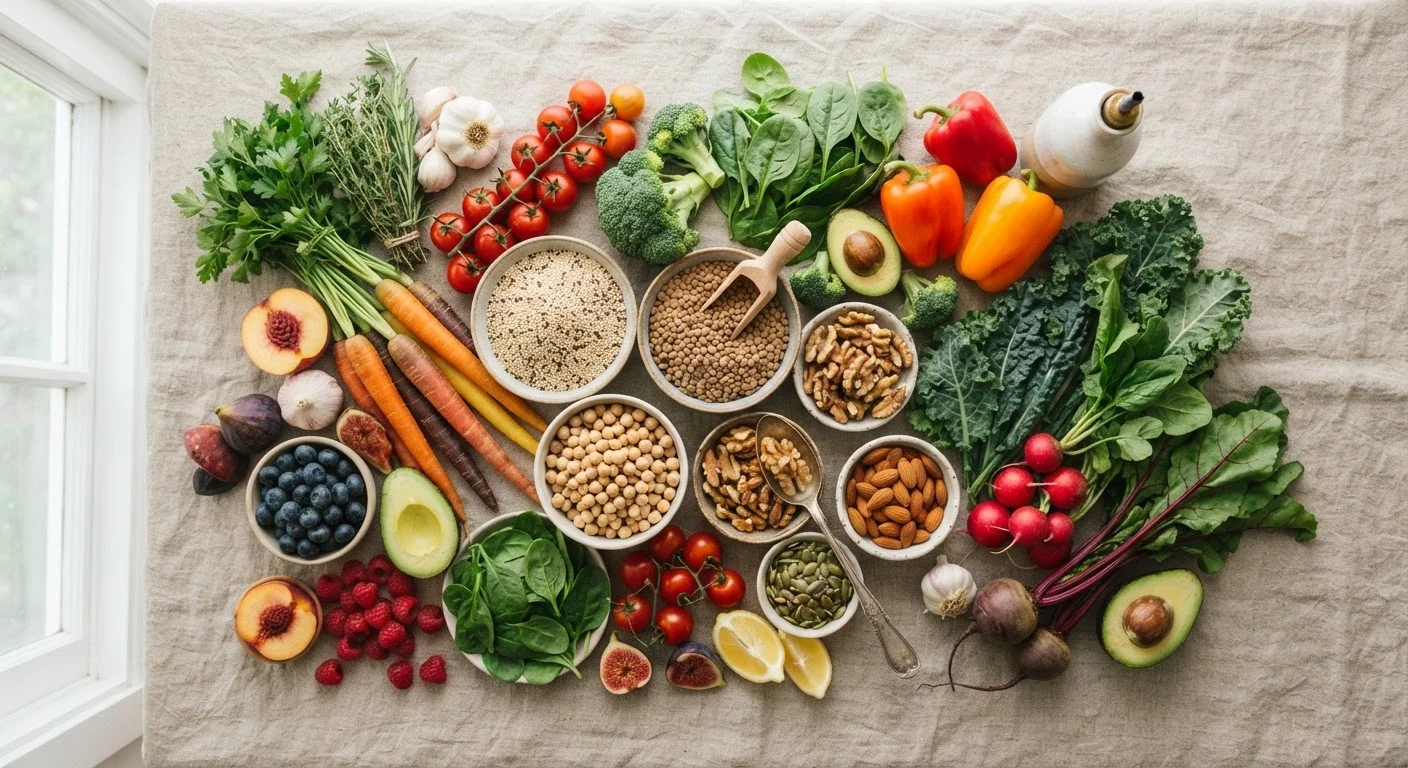
The phrase whole food is used so broadly across dietary guidelines, wellness communities, and food marketing that its meaning has become genuinely slippery. At its most foundational level, a whole food is one that has been minimally processed and retains most of its original nutritional structure — think lentils, oats, broccoli, walnuts, or a fresh apple.
| Regulatory Definition | None — no single authority defines "whole food" for labeling |
| Core Principle | Minimal processing; retention of natural nutritional structure |
| Key Nutrient Retained | Dietary fiber — often reduced or removed during industrial refining |
| Frameworks Using the Concept | WFPB, Paleo, Mediterranean, DASH, U.S. Dietary Guidelines |
| Processing Spectrum | Whole food status is a continuum, not a binary category |
The key distinction is not about whether a food has been touched at all. Freezing vegetables, cooking beans, or grinding whole grains into flour are all forms of processing — but they don't necessarily compromise a food's status as a whole food under most frameworks. What most definitions target is the addition of refined sugars, hydrogenated oils, artificial additives, or the removal of fiber and micronutrients through industrial refining.
Because no single regulatory body defines "whole food" for labeling purposes, the term functions more as a nutritional philosophy than a legal standard. Understanding how different eating frameworks interpret it is essential for applying the concept meaningfully. For a deeper look at where processing levels fit into nutrition science, see what nutrition science distinguishes between whole and processed foods.
How Major Dietary Frameworks Define and Apply the Term
Different eating approaches use the whole-food concept as a shared foundation, but they apply it with varying boundaries and priorities.
Whole-Food, Plant-Based (WFPB)
The WFPB framework is arguably the most explicit in its use of the term. It centers the diet on unrefined or minimally refined plant foods — vegetables, fruits, legumes, whole grains, nuts, and seeds — while largely excluding animal products and processed plant foods (including refined oils). Unlike veganism, WFPB is defined primarily by what foods are kept in their whole form, not solely by ethical exclusion. For a clear breakdown of how WFPB compares to plant-based, vegan, and vegetarian labels, see where plant-based, vegan, and vegetarian diets actually differ.
Paleo
The paleo framework grounds its whole-food emphasis in evolutionary reasoning. It favors foods presumed available before agricultural processing: meats, fish, eggs, vegetables, fruits, nuts, and seeds. Grains, legumes, and dairy are typically excluded — not because they are processed in the industrial sense, but because they represent foods introduced through agriculture. From a paleo perspective, "whole" is filtered through a lens of ancestral diet rather than processing level alone.
Mediterranean
The Mediterranean dietary pattern doesn't use the whole-food label explicitly, but it strongly emphasizes minimally processed foods — olive oil, fish, legumes, vegetables, and whole grains — while allowing moderate amounts of dairy and wine. It tolerates more flexibility around minimal processing than WFPB or paleo approaches.
DASH and Dietary Guidelines Frameworks
Evidence-based frameworks like DASH (Dietary Approaches to Stop Hypertension) and the U.S. Dietary Guidelines incorporate whole-food principles by emphasizing nutrient-dense, minimally processed foods while permitting lean proteins and low-fat dairy. These frameworks tend to focus on food groups and nutrient targets rather than a strict whole-food identity.
Whole Food
A food that is minimally processed and retains most of its original nutritional structure, including fiber, vitamins, and minerals. The term has no single regulatory definition and is interpreted differently across dietary frameworks.
Minimal Processing
Basic preparation steps — such as freezing, cooking, or grinding — that do not substantially alter a food's nutritional profile or add refined ingredients. Minimally processed foods are generally considered consistent with whole-food principles.
Refined Food
A food that has undergone industrial processes removing key components such as fiber, bran, or germ, often resulting in a product with fewer micronutrients and altered macronutrient ratios compared to the original ingredient.
Whole-Food, Plant-Based (WFPB)
A dietary framework that emphasizes unrefined or minimally refined plant foods and largely excludes animal products and processed plant foods. It is defined by food form and processing level, not solely by ethical considerations.
Nutrient Density
A measure of how many beneficial nutrients a food provides relative to its calorie content. Whole foods tend to be more nutrient-dense than heavily refined alternatives.
Paleo Framework
A dietary approach that favors foods presumed to have been available before large-scale agriculture — such as meat, fish, vegetables, fruits, nuts, and seeds — while excluding grains, legumes, and dairy.
For a structured comparison of how these frameworks align across key dimensions, the eating pattern framework overview provides a useful side-by-side reference.
Applying the Concept Practically
Regardless of which framework resonates with you, a few practical principles hold across nearly all whole-food-oriented approaches:
- Prioritize foods with recognizable ingredients. Foods with short ingredient lists consisting of items you could find in a kitchen are generally closer to whole-food status than those with long lists of additives and refined components.
- Focus on fiber retention. Most health-supporting properties of whole foods — digestive health, satiety, blood sugar regulation — are tied to fiber, which is often reduced or eliminated during industrial processing.
- Context and degree matter. Frozen vegetables, canned beans with no added salt, and minimally processed whole-grain bread can fit into a whole-food approach. The distinction between whole foods and processed foods is a spectrum, not a binary.
Adopting a whole-food orientation doesn't require adopting a rigid framework wholesale. The balanced eating hub offers practical strategies for integrating these principles into everyday meals without overhauling your entire approach at once. And if you're ready to think beyond any single framework, building an eating pattern that reflects your life explores how to personalize evidence-based principles to your actual circumstances.
This article is for general informational and educational purposes only and is not a substitute for personalized medical or nutritional advice. Consult a qualified healthcare professional or registered dietitian before making significant changes to your diet.