

Key Takeaways
Start here
Why Sedentary Adults Need a Different Starting Point
Before you move
Before You Begin: Safety and Readiness
Week one
Your First Two Weeks: Movement Foundations
Next step
How to Progress Without Overdoing It
Long game
Building a Routine That Actually Sticks
Why Sedentary Adults Need a Different Starting Point
Returning to exercise after a long sedentary period is not the same as resuming where you left off — and it's certainly not the same as following a program designed for people who already train regularly. After extended physical inactivity, muscles weaken, connective tissue loses elasticity, and cardiovascular efficiency declines. Jumping straight into a demanding routine dramatically increases the likelihood of injury, excessive soreness, and early dropout.
The good news: your body responds to even modest movement stimulus. Research consistently shows that previously inactive adults experience meaningful fitness gains from low-to-moderate intensity exercise — often faster than people who are already conditioned. Starting small isn't settling; it's working with your physiology rather than against it.
For a broader picture of what home fitness can look like over time, the complete guide to working out at home covers planning, motivation, and progression in full.
Sedentary baseline
A starting point where someone has had little to no regular physical activity over a sustained period, often months or years.
Progressive overload
The practice of gradually increasing exercise demand — through more reps, longer duration, or harder movements — so the body continues to adapt and improve.
DOMS
Delayed-onset muscle soreness: the achiness felt 24–48 hours after unfamiliar exercise, caused by microscopic muscle adaptation. It's normal and temporary.
Bodyweight exercise
Any movement that uses your own body as resistance rather than weights or machines — such as squats, push-ups, or bridges.
Motor pattern
A learned movement sequence your nervous system memorizes through repetition, making common movements — like a squat — more automatic and efficient over time.
Before You Begin: Safety and Readiness
Before your first session, take five minutes to set yourself up properly. Use our home workout readiness checklist to confirm your space, footwear, and hydration are in order.
- Clear your space. You need roughly a 6×4 foot area — enough to lie down and extend your arms. Remove tripping hazards. For tips on making any room work, see setting up a home workout space in any room size.
- Wear supportive footwear. Even indoors, appropriate shoes protect joints during standing exercises.
- Check in with a healthcare professional if you have cardiovascular disease, diabetes, joint conditions, or any recent injury. This is general information, not medical advice — your provider knows your individual situation best.
- Have water nearby. Hydration affects performance and recovery even in short sessions.
If you're managing an ongoing health condition, training at home with a chronic condition offers specific guidance on adapting exercise safely.
Start Shorter Than You Think You Should
Most beginners overestimate what they need in the first session and underestimate how accumulative short sessions become. A 10-minute workout completed consistently three times a week outperforms a 45-minute session done once and then abandoned. Err on the side of leaving your first few sessions feeling like you could have done more — that's a sign you've set the right starting intensity.
Your First Two Weeks: Movement Foundations
The goal of weeks one and two is not fitness — it's movement familiarity. You're teaching your body to move with control, re-establishing motor patterns, and building the habit of showing up. Aim for two to three sessions of 10 to 20 minutes each.
A Sample Beginner Session Structure
- Warm-up (3–5 min): Standing marches in place, slow arm circles, gentle torso rotations. This raises your heart rate slightly and lubricates your joints before load.
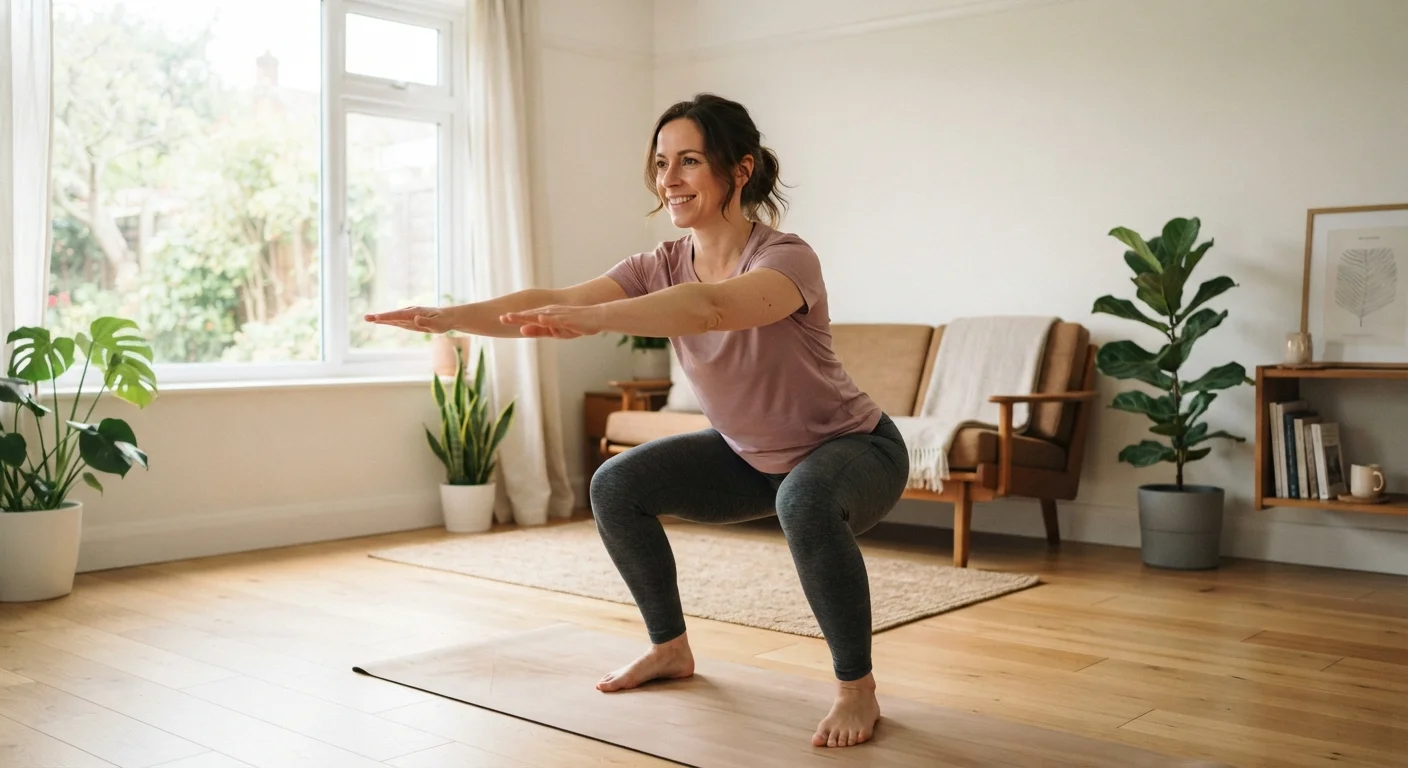
- Main movement (8–12 min): Rotate through three to four simple bodyweight exercises — wall push-ups, sit-to-stand from a chair, standing heel raises, and floor bridges. Perform each for 8 to 10 repetitions, rest, repeat once.
- Cool-down (2–3 min): Slow walking in place, a gentle standing quad stretch, and steady breathing to bring your heart rate back down.
Keep every rep controlled and deliberate. If you can't maintain form, stop the set — quality matters far more than quantity at this stage. Building more movement into daily life between sessions also accelerates adaptation; the daily movement hub has simple strategies for doing exactly that.
How to Progress Without Overdoing It
Progression is the engine of fitness improvement, but premature progression is one of the most common reasons beginners quit. The principle of progressive overload — gradually increasing the demand placed on your body — works best when applied conservatively.
A practical rule: change only one variable at a time, and only when your current sessions feel manageable. Variables you can adjust include:
- Duration: Add 5 minutes to a session before increasing anything else.
- Repetitions: Move from 8 to 12 reps of an exercise before making it harder.
- Exercise difficulty: Progress from a wall push-up to an incline push-up to a standard floor push-up over several weeks.
- Session frequency: Add a third weekly session only after two-session weeks feel routine.
When you're ready to incorporate resistance training, starting strength training as an adult outlines what realistic early progress looks like and how to approach it safely.
Pain Is Not a Progression Signal
There's an important difference between the effort-related discomfort of working muscles and joint or sharp pain that signals potential injury. Never push through pain in your joints, lower back, or anywhere that feels distinctly wrong — stop the movement and assess. If discomfort persists beyond a session, consult a healthcare professional before continuing.
Building a Routine That Actually Sticks
Consistency beats intensity at every stage of fitness, but especially at the beginning. A three-week streak of short, manageable sessions does more for your long-term health than one brutal week followed by two weeks of avoidance.
Practical Strategies for Consistency
- Anchor your sessions to an existing habit.
- Pair exercise with something you already do — morning coffee, lunch break, or the first 15 minutes after work. Habit-stacking reduces the mental friction of deciding when to work out.
- Schedule it like an appointment.
- Put sessions in your calendar with the same weight you'd give a meeting. Treat cancellation as the exception, not the default.
- Lower the bar on hard days.
- A 10-minute session on a difficult day is infinitely better than nothing. Give yourself permission to do less, and you'll almost always do more once you start.
- Track what you do, not what you planned.
- A simple log — even a handwritten one — builds a visible record of momentum. Seeing progress accumulate is one of the most reliable motivation tools available.
This article is for general informational and educational purposes only and is not a substitute for professional medical advice. Always consult a qualified healthcare provider before beginning a new exercise program, particularly if you have any pre-existing health conditions or concerns.