

Key Takeaways
Why Home Workouts Work for Busy Adults
The single biggest barrier to regular exercise isn't willpower — it's logistics. Commuting to a gym, booking a class, and finding a parking spot all add 30–60 minutes of overhead to a workout that could have taken 25 minutes at home. Eliminating that friction is one of the most underrated fitness strategies available.
Research consistently shows that exercise frequency and consistency predict outcomes far better than training location. As the science behind home workout effectiveness confirms, structured bodyweight and minimal-equipment training can drive real strength and cardiovascular adaptation — the key variables are progressive overload and recovery, not the address of the building you're in.
For adults juggling careers, family, and health goals, home training offers genuine advantages: zero travel time, flexible scheduling, and the ability to exercise during a lunch break or after the kids are in bed. The trade-offs are real too — less social energy, fewer equipment options — but for most busy adults, the net gain is significant. See our honest assessment of gym-versus-home trade-offs for a balanced look at both sides.
43%
Adults citing time as top exercise barrier
The CDC's National Health Interview Survey consistently identifies time constraints as the leading reason U.S. adults report not meeting physical activity guidelines.
150 min
Weekly moderate activity recommended
The U.S. Department of Health and Human Services Physical Activity Guidelines for Americans recommend at least 150 minutes of moderate-intensity aerobic activity per week for adults.
3×/week
Minimum frequency for strength gains
Exercise science research generally supports that two to three resistance training sessions per week are sufficient to produce meaningful muscle strength adaptations in most adults.
Setting Up Your Space
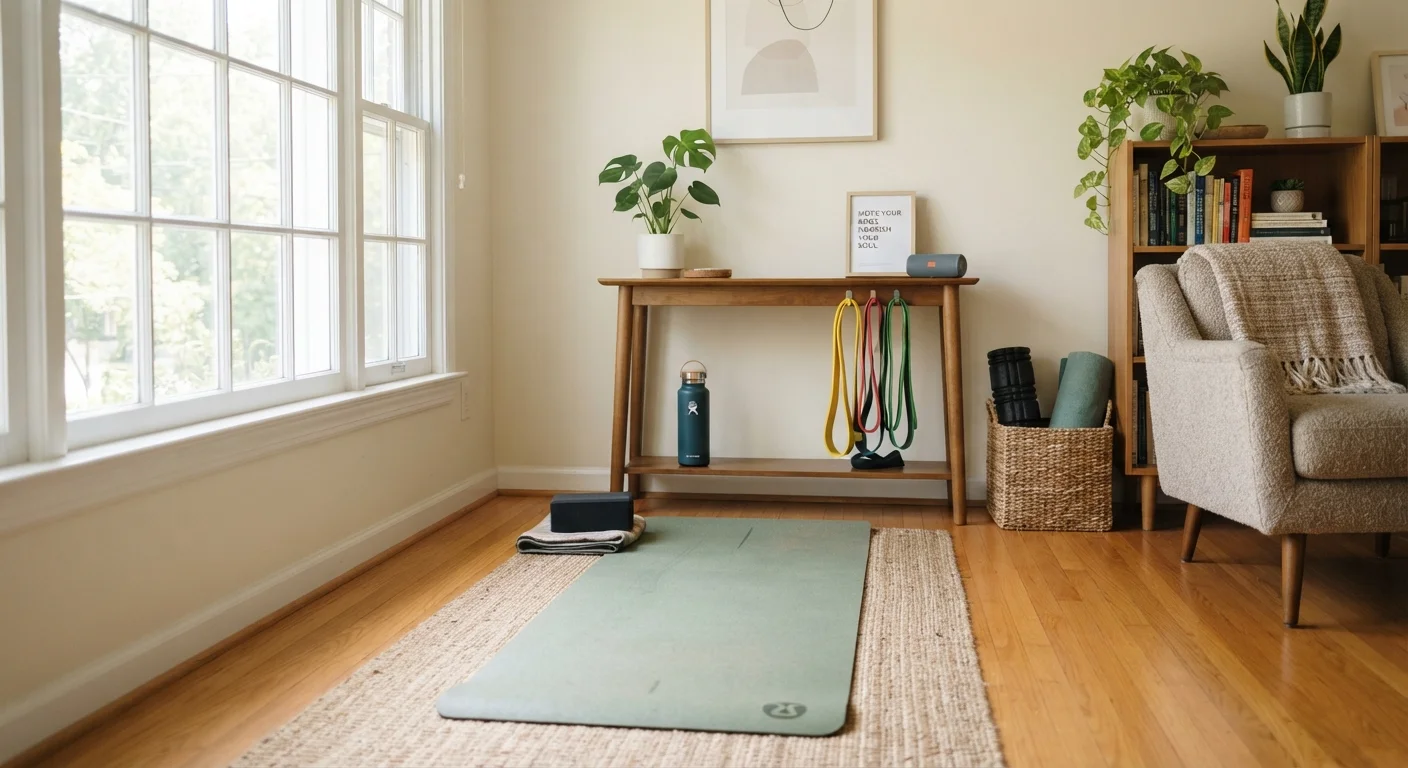
You don't need a dedicated room — you need a plan. A cleared patch of floor roughly 6 by 4 feet accommodates the vast majority of bodyweight movements: push-up variations, lunges, planks, and floor core work. In a pinch, a hallway or bedroom works fine.
What matters more than square footage is consistency of location. Designating a specific spot — even a corner of the living room — creates an environmental cue that signals workout time to your brain, reducing the mental energy required to begin. Our detailed guide to setting up a workout space in any room size covers layout, flooring, and safety considerations across space types.
For equipment, start minimal: a mat for floor work, and optionally a resistance band or two. Both pack flat and cost little. Add only what a specific goal demands — heavier resistance for strength progression, a jump rope for cardio density — rather than pre-purchasing equipment you may not use.
Before buying any equipment, spend two weeks training with only bodyweight. You'll quickly identify the specific movement pattern — not a general category like 'weights' — where added resistance actually becomes the limiting factor.
Most adults plateau on technique and consistency long before they exhaust the difficulty ceiling of bodyweight progressions, making premature equipment purchases a common source of wasted spend and clutter.
Set your workout clothes out the night before. This single environmental cue has an outsized effect on follow-through, particularly for early-morning sessions when decision fatigue hasn't yet set in.
Behavior science research on habit formation shows that reducing the number of decisions required to initiate a behavior significantly increases the likelihood of completion.
Building a Realistic Routine
The most effective home routine is one you'll actually complete. Begin by auditing your week honestly: identify two or three reliable 20–30 minute windows, and anchor workouts to existing habits — morning coffee, lunch break, or after dinner. Treat these slots as appointments.
A well-rounded weekly structure for most adults includes: two to three strength-focused sessions (bodyweight or resistance-band circuits targeting major muscle groups), one to two cardio or conditioning sessions (jumping jacks, stair climbing, high-knees intervals), and at least one active recovery day of light stretching or walking. This structure aligns with general physical activity guidelines while remaining achievable without equipment.
If you're returning to exercise after a period of inactivity, a gentler on-ramp is important. Our guide for previously sedentary adults outlines a gradual approach to building volume safely. Always consult a qualified healthcare professional before starting a new exercise program, especially if you have existing health conditions.
Progressively increase challenge over time — add reps, reduce rest, or advance to harder exercise variations — rather than simply repeating the same workout indefinitely. This principle of progressive overload is what drives ongoing adaptation.
Choosing the Right Exercises
Compound movements — exercises that engage multiple muscle groups simultaneously — deliver the highest return on time invested. For home training, a core set of patterns covers the full body:
- Push: push-ups and their progressions (incline, decline, close-grip)
- Pull: resistance-band rows, door-frame pull-ups if a bar is available
- Squat: bodyweight squats, split squats, single-leg progressions
- Hinge: glute bridges, single-leg hip hinges
- Core: planks, dead bugs, bear crawls
- Cardio: jumping jacks, burpees, stair climbing, marching in place
Rotate through these patterns across your weekly sessions. Unfamiliar with terms like sets, reps, or RPE (rate of perceived exertion)? Our glossary for home trainers breaks down the vocabulary you'll encounter in most programs.
For desk workers logging long sedentary hours, layering in brief movement breaks during the workday complements structured sessions. The desk-friendly movement reference guide offers practical options that require no change of clothes or equipment.
Staying Motivated and Tracking Progress
Motivation fluctuates — structure compensates for it. Schedule workouts in advance, log completions simply (a notebook or phone note works), and review the log weekly. Seeing a streak of completed sessions is a more reliable driver of consistency than enthusiasm alone.
Track what you can measure without special tools: the number of push-up repetitions completed, plank hold time, or perceived effort on a 1–10 scale. These simple metrics reveal progress that an unsatisfying look in the mirror often hides. When reps plateau, that's the signal to advance the exercise variation — not to question the program.
Social accountability also matters. Sharing a weekly summary with a friend, joining an online community, or following a structured program with a defined endpoint (four weeks, eight weeks) all increase completion rates compared to open-ended, self-directed routines.
Home training and travel fitness complement each other naturally — the bodyweight skills you build at home transfer directly to hotel rooms and unfamiliar cities. Explore staying active while traveling to extend your routine beyond your living room.
This article is for general informational and educational purposes only and does not constitute medical advice. Consult a qualified healthcare professional before beginning any new exercise program, particularly if you have existing health conditions or have been inactive for an extended period.