

Key Takeaways
Home Workout Effectiveness
Home workouts refer to structured physical training performed without a commercial gym, typically using bodyweight movements, minimal equipment, and available space. Research consistently shows that when programmed with sound principles — progressive overload, adequate volume, and recovery — home-based exercise can produce measurable improvements in strength, cardiovascular fitness, and body composition. The location of training matters far less than the quality and consistency of the program itself.
Physiological adaptations such as muscle hypertrophy and cardiovascular conditioning are driven by mechanical tension, metabolic stress, and training volume — stimuli that can be generated with or without gym equipment.
The Science of Adaptation Doesn't Care Where You Train
The human body adapts to the demands placed on it — a principle called the SAID principle (Specific Adaptation to Imposed Demands). Whether those demands come from a cable machine or a push-up, the underlying biology is identical. Muscles under sufficient mechanical tension initiate a repair-and-rebuild process that, over time, produces stronger, more resilient tissue. The cardiovascular system responds to sustained elevated heart rate by improving stroke volume and oxygen delivery capacity — regardless of whether that heart rate was raised on a gym treadmill or through a living room circuit.
What this means practically: the stimulus matters, not the setting. A push-up performed to near-failure with good form creates a comparable muscle-building signal to a machine chest press at equivalent relative intensity. The critical variables are volume (total work performed), intensity (how challenging each set feels relative to your maximum), and consistency (how reliably you repeat the stimulus over weeks and months).
~90%
Strength gains achievable vs. gym training
A 2021 meta-analysis in the Journal of Human Kinetics found that bodyweight resistance training produced strength improvements approaching those of gym-based programs when volume and intensity were matched.
50+ min
Weekly time saved by skipping the gym commute
Research on exercise barriers consistently identifies travel time as a leading reason adults drop gym memberships; eliminating commute can meaningfully increase workout frequency.
3–6 weeks
Time to early measurable fitness improvements
Exercise physiology literature generally shows detectable neuromuscular and cardiovascular adaptations beginning within three to six weeks of consistent structured training, regardless of setting.
Progressive Overload: The Rule That Makes Home Training Work
The concept that separates a productive home routine from random movement is progressive overload — systematically increasing the challenge placed on your muscles and cardiovascular system over time. Without it, the body reaches a comfortable equilibrium and stops adapting. This is why many people find their home workouts stop producing results after a few weeks, a problem explored in depth in our article on why home workout progress stalls.
At home, progressive overload can be applied in several concrete ways:
- Increase repetitions — perform more reps of the same movement in the same time.
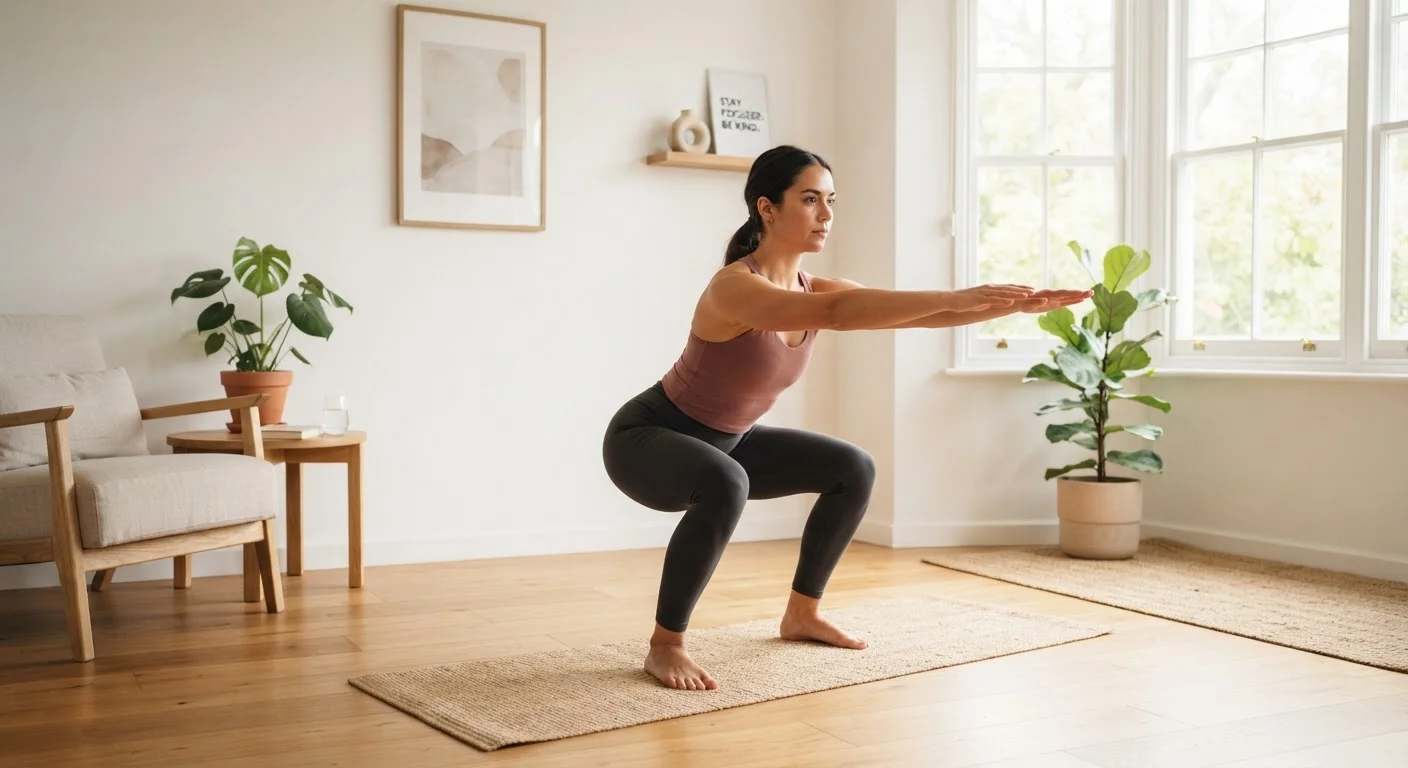
- Slow the tempo — a three-second lowering phase on a squat dramatically increases time under tension.
- Reduce rest periods — shorter recovery between sets increases cardiovascular and metabolic demand.
- Advance the exercise variation — progress from a standard push-up to an archer push-up or pseudo-planche push-up.
- Change leverage — elevating feet on a chair during a push-up shifts load toward the upper chest and shoulders.
Our guide on progressive overload at home details exactly how to apply each of these strategies across common bodyweight movements.
Track Your Reps and Sets Every Session
Keeping a simple log — even a note on your phone — of what you did, how many reps, and how it felt is the most reliable way to ensure you're progressing rather than repeating. If the numbers aren't moving upward over weeks, it's time to apply one of the overload strategies above. Small, consistent increases compound into significant results over months.
Compound Movements: Maximum Return in Minimum Space
The most time-efficient home workouts prioritize compound movements — exercises that recruit multiple muscle groups simultaneously. Squats, hip hinges, push-up variations, pulling movements (using a bar or suspension point), and lunges each work large amounts of muscle tissue in a single pattern, making them far more productive per minute than isolation exercises.
A well-designed home session built around four to six compound movements can stimulate the entire body in under 30 minutes. Research on short workouts versus longer sessions confirms that brief, high-quality efforts accumulate meaningful fitness benefits when performed consistently. For a curated list of the most effective options, see compound movements you can do at home.
The foundational principles of strength and cardio training apply equally in any setting — at home, on the road, or in a hotel room during travel.
Setting Up for Success at Home
Effective home training requires minimal infrastructure, but a few intentional choices make consistency significantly easier. A clear patch of floor roughly six feet by four feet is sufficient for the majority of bodyweight exercises. Good lighting, a non-slip surface, and enough ceiling clearance for jumping movements are the practical basics.
Beyond space, structure matters. Scheduling workouts at a consistent time — treating them as appointments rather than optional — is one of the strongest predictors of long-term adherence. Our article on setting up a home workout space in any room size walks through how to create a functional training environment whatever your living situation.
For a comprehensive framework covering routine design, exercise selection, motivation, and progress tracking, The Busy Adult's Complete Guide to Working Out at Home provides a complete roadmap.
This article is for general informational and educational purposes only and does not constitute medical advice. Consult a qualified healthcare professional before beginning any new exercise program, particularly if you have existing health conditions or injuries.