

Key Takeaways
Why Compound Movements Are Worth Prioritizing
If you only have 20 or 30 minutes to train, the type of exercise you choose matters enormously. Isolation exercises — like a bicep curl or a calf raise — work one muscle or muscle group at a time. Compound movements, by contrast, recruit multiple muscle groups and joints simultaneously, making them significantly more efficient per minute of effort invested.
Research consistently shows that multi-joint exercises produce greater hormonal responses, higher calorie expenditure, and broader neuromuscular adaptations than their isolation counterparts. That means more strength, better coordination, and more metabolic work in less time — a meaningful advantage for anyone balancing work, family, and everything else.
The good news is that the most valuable compound patterns don't require a gym. A squat, a hip hinge, a push, a pull, and a single-leg stance are all movements your body is built for — and all achievable on a living room floor. For a deeper look at why home-based training can rival gym work, see our guide to home workout effectiveness.
Pair Opposing Patterns for Efficiency
Pairing a push with a pull (e.g., push-ups followed by inverted rows) and a hinge with a squat keeps opposing muscle groups balanced while allowing brief rest between efforts. This approach lets you train more total volume in the same time window — a practical strategy for anyone short on minutes.
The five foundational movement patterns below cover the full body. Program two or three into a single session for a complete, time-efficient workout.
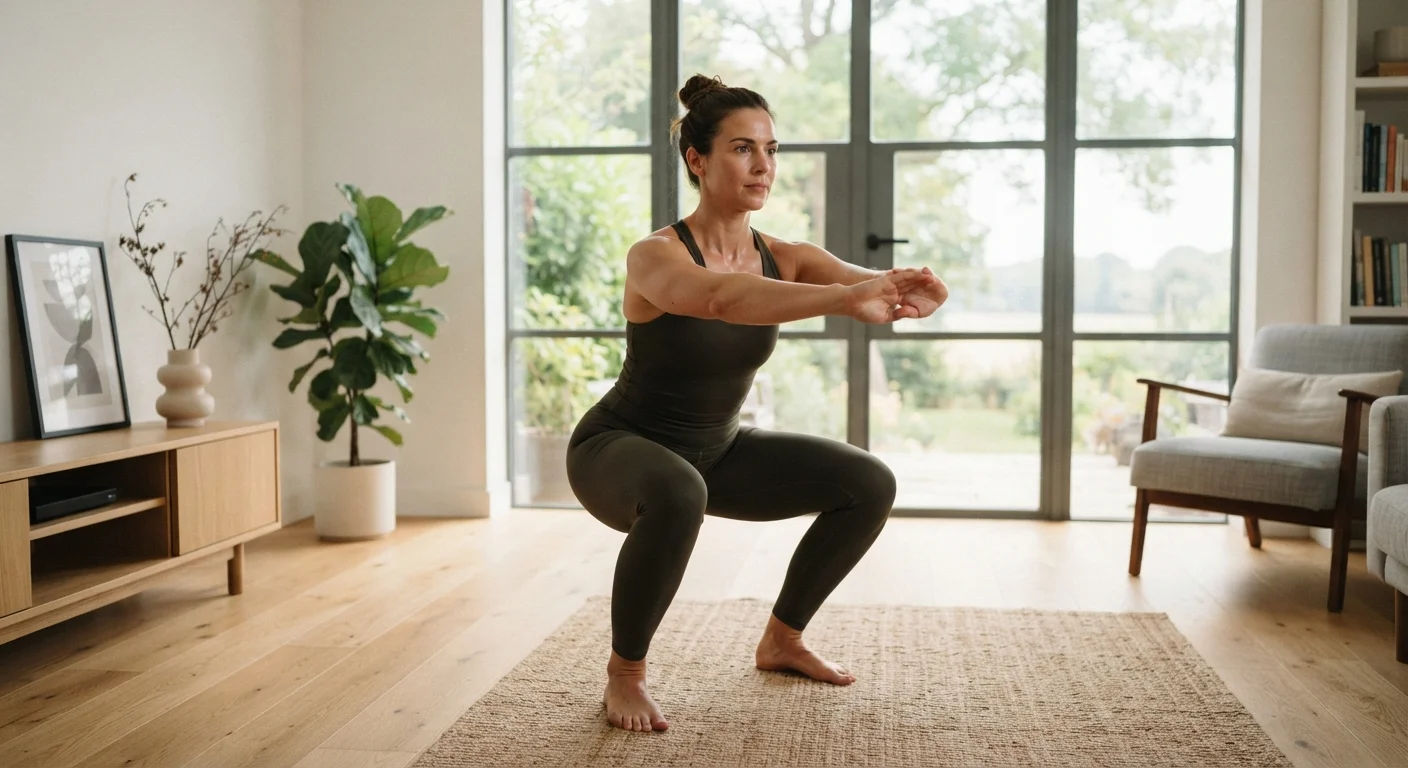
Bodyweight Squat
The squat is the most fundamental lower-body compound pattern. It loads the quadriceps, hamstrings, glutes, and core simultaneously while also training hip and ankle mobility — a combination that directly supports daily tasks like sitting, standing, and climbing stairs.
How to perform it: Stand with feet hip- to shoulder-width apart, toes turned slightly outward. Brace your core, push your hips back, and bend your knees until your thighs are roughly parallel to the floor. Drive through your heels to return to standing.
Progressions: Begin with a chair-assisted squat if needed (hover just above the seat). Advance to a full bodyweight squat, then to a slow-tempo squat (3 seconds down, 1 second pause, 2 seconds up) to increase difficulty without any equipment.
The squat trains the entire lower body and core in a single, functional movement pattern.
Hip Hinge (Bodyweight Deadlift or Good Morning)
The hip hinge is one of the most underused movement patterns in home training — and one of the most important. It targets the posterior chain: glutes, hamstrings, and lower back extensors, which are chronically underworked in people who spend significant time seated.
How to perform it: Stand with feet hip-width apart. Soften your knees slightly, then push your hips straight back — not down — while maintaining a long, neutral spine. Feel a stretch in your hamstrings, then drive your hips forward to return to standing. Think of it as closing a door with your hips, not bending forward with your back.
Progressions: Begin with a wall-assisted hinge (stand a foot from a wall and tap it with your glutes). Progress to a single-leg Romanian deadlift for unilateral challenge and greater balance demand.
The hip hinge directly strengthens the posterior chain muscles most weakened by prolonged sitting.
Push-Up
The push-up is a horizontal push pattern that trains the chest, anterior deltoids, triceps, and core in a single movement. It also requires meaningful scapular stability — an often-neglected element of shoulder health that isolation pressing rarely addresses.
How to perform it: Start in a high plank with hands slightly wider than shoulder-width. Keep your body in a rigid line from head to heels. Lower your chest toward the floor while keeping elbows at roughly a 45-degree angle from your torso — not flared wide. Press back to the start position with control.
Progressions: Incline push-ups (hands elevated on a counter or chair) reduce the load and are an ideal entry point. Standard push-ups come next, followed by slow-tempo or deficit push-ups for greater range of motion.
The push-up trains the chest, shoulders, triceps, and core — no equipment required.
Inverted Row or Doorframe Pull
Horizontal pulling is the movement most commonly absent from home workouts — and that absence creates muscular imbalances that contribute to poor posture and shoulder dysfunction over time. A makeshift inverted row, using a sturdy table or low bar, corrects this gap without a pull-up bar.
How to perform it: Lie beneath a sturdy table. Grip the edge with an overhand grip and straighten your body into a rigid plank. Pull your chest up to the edge while driving your elbows toward your hips. Lower with control. The more horizontal your body, the harder the movement.
Progressions: Bend your knees and plant your feet flat to reduce difficulty. As strength improves, straighten your legs and eventually elevate your feet. If a pull-up bar is available, transition to a vertical pull pattern.
Horizontal pulling counters the posture effects of prolonged sitting and desk work.
Reverse Lunge
The reverse lunge is a single-leg compound movement that trains the glutes, quads, and hamstrings while demanding hip stability and balance. Unlike the forward lunge, the reverse variation places less shear force on the knee, making it more accessible for a wider range of people.
How to perform it: Stand tall and step one foot directly backward, lowering the back knee toward the floor in a controlled descent. Keep your front shin as vertical as possible and your torso upright. Push through the front heel to return to standing.
Progressions: Use a wall or doorframe for balance support initially. Progress to unsupported reps, then add a brief pause at the bottom position, or increase tempo on the descent to build eccentric strength.
The reverse lunge builds single-leg strength and stability with lower knee stress than forward variations.
Pike Push-Up
The pike push-up introduces a vertical pressing pattern without needing overhead equipment. It shifts the load from the chest toward the shoulders and upper back, targeting the deltoids and upper trapezius — muscles that support upright posture and overhead reach.
How to perform it: Begin in a high plank, then walk your hands toward your feet until your hips pike high into the air, forming an inverted V. Bend your elbows to lower the crown of your head toward the floor, then press back up. Keep your core engaged throughout.
Progressions: A shallow pike reduces the shoulder load — work toward a higher hip position as strength increases. Elevating your feet on a chair increases the vertical demand and serves as a bridge toward more advanced shoulder training.
The pike push-up shifts pressing load onto the shoulders, filling the vertical push gap in home training.
Building These Movements Into Your Day
You don't need a dedicated training block to benefit from compound movements. A few sets of squats before lunch, a push-up progression between meetings, or a slow hinge warm-up in the morning all accumulate into real fitness over time. Our article on how small movements add up explains the physiology behind this approach.
If you want a more structured method for weaving movement into existing routines without carving out a dedicated gym slot, building a movement-rich day offers a practical framework. For a portable reference covering form cues and modifications for these and other exercises, see our bodyweight exercise pocket reference.
Start with whatever variation of each pattern you can perform with control, prioritize consistent practice over high volume, and allow your body to adapt gradually. Progress — more reps, slower tempo, or a more challenging variation — follows naturally from that foundation.
Form Over Reps, Always
With compound movements, technique failure — a rounding lower back during a hinge, knees caving in a squat — signals the end of a working set, not the target rep count. Performing fewer reps with sound mechanics builds strength safely and avoids reinforcing faulty movement patterns. Reduce volume or choose an easier variation whenever form breaks down.
This article is for general informational and educational purposes only and is not a substitute for professional medical or fitness advice. If you have an existing injury, chronic condition, or other health concern, consult a qualified healthcare or fitness professional before beginning a new exercise program.