

Key Takeaways
Why Gym-Free Movement Works
The idea that physical fitness requires a gym membership, scheduled workout slots, or special equipment is a relatively modern assumption — and research increasingly challenges it. Non-exercise activity thermogenesis (NEAT), which refers to all the energy your body burns through movement that isn't formal exercise, plays a substantial role in metabolic health, weight management, and cardiovascular function.
When small movements are distributed across a full day, they can collectively rival the caloric expenditure and physiological stimulus of a single structured session. For a deeper look at the mechanisms, see The Science Behind Why Small Movements Add Up Over Time.
The practical upshot: consistency across your waking hours matters more than the intensity of any single session, especially for adults navigating busy schedules.
~30%
Daily energy burn from NEAT in active individuals
Research published in exercise physiology literature estimates that non-exercise activity thermogenesis can account for up to 30% of daily energy expenditure in highly active individuals.
2–10 min
Effective length of a movement snack
Studies on short activity bouts suggest that intervals as brief as two minutes of brisk movement can produce measurable improvements in post-meal blood glucose levels.
26+ hrs
Extra annual movement from three daily 2-minute snacks
Three two-minute movement snacks per workday across 260 working days accumulates to more than 26 hours of additional activity per year.
Mapping Your Day for Hidden Movement Opportunities
Before adding anything new, audit what your existing day already contains. Most people have several underused windows for movement that require no extra time — they simply require a different choice within time already spent.
- Morning routine: Calf raises while brushing teeth, a brief stretch sequence before leaving the bedroom.
- Commuting: Parking farther away, getting off transit one stop early, or taking stairs instead of elevators.
- Work blocks: Standing or walking during phone calls, setting a timer to change posture every 30–45 minutes.
- Kitchen and household tasks: Squatting to retrieve low items rather than bending, pacing while waiting for water to boil.
- Evening wind-down: A short walk after dinner, gentle mobility work while watching television.
Turning Everyday Routines Into Opportunities for More Steps offers a practical breakdown of how to apply this audit across common daily contexts.
Movement Snacks: The Engine of an Active Day
A movement snack is a brief, purposeful burst of physical activity — typically two to ten minutes — inserted between sedentary periods. The concept has solid research support: short bouts of moderate activity spread across the day can improve blood glucose regulation, reduce postural discomfort, and contribute to weekly activity totals.
Effective movement snacks don't require changing clothes or breaking a sweat. Consider:
- The 2-minute stair climb between tasks at home or work.
- Ten bodyweight squats before sitting back down after a bathroom break.
- A brisk walk around the block after lunch instead of scrolling at your desk.
- A set of wall push-ups or incline push-ups using a countertop during natural work pauses.
For a full playbook, see Movement Snacks: Fitting Activity Into a Packed Schedule.
Anchoring Movement to Existing Habits
One of the most durable strategies in behavior design is habit stacking — linking a new behavior to an already-established one. Rather than scheduling movement as a separate to-do, you attach it to something that already happens reliably every day.
Examples in practice:
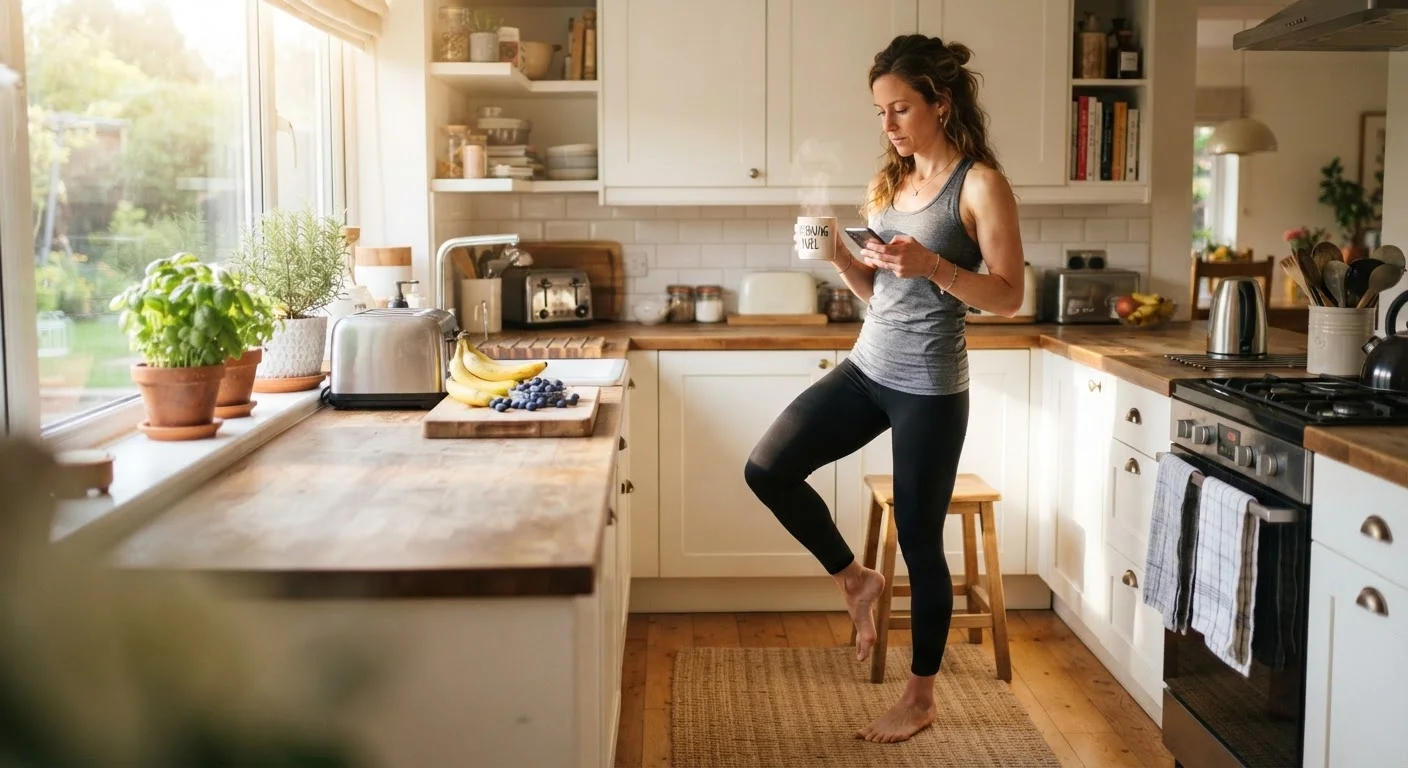
- After pouring your morning coffee → do five minutes of light stretching before sitting down.
- Before every virtual meeting → stand and do five to eight slow squats.
- Every time you send a long email → walk around your space once before starting the next task.
This approach works because it reduces the decision-making load. Over time, the movement becomes triggered by the existing cue rather than relying on motivation. Making Movement Automatic: Habit Design for Consistent Daily Activity explores the behavioral science behind this in detail.
Pair your most frequent daily trigger — like making coffee or opening your laptop — with a consistent micro-movement. Even 60 seconds of deliberate movement at that cue trains your nervous system to expect activity there.
Habit research consistently shows that specificity of cue is one of the strongest predictors of habit adherence; vague intentions ('I'll move more') rarely translate into behavior change.
When habit stacking, start with the movement that requires the least preparation. If it takes effort to begin, you'll skip it on hard days — simplicity is what keeps the chain unbroken.
Behavioral scientists refer to this as reducing 'activation energy.' The lower the friction of starting, the higher the likelihood of consistent follow-through over weeks and months.
Strength and Mobility Without Equipment
Maintaining muscular strength and joint mobility doesn't require weights — it requires progressive challenge applied consistently. Bodyweight exercises, when performed through a full range of motion and gradually made more demanding, provide a meaningful training stimulus.
A functional daily movement practice might include:
- Hinge patterns: Deadlift-style hip hinges using a backpack or laundry basket as light load.
- Push patterns: Standard, incline, or wall push-ups depending on current strength level.
- Squat patterns: Bodyweight squats, split squats, or slow tempo variations for added difficulty.
- Carry patterns: Walking with grocery bags or a loaded bag builds grip and core stability.
These movements are explored in depth in Compound Movements You Can Do at Home and Why They Matter and Progressive Overload at Home: Making Exercises Harder Without Weights.
For desk-bound workers, pairing these with mobility exercises is particularly valuable. Desk-Friendly Movements: A Reference Guide for the Seated Workday is a useful companion resource.
Tracking Progress and Staying Consistent
What gets measured gets maintained. You don't need sophisticated tools — a simple daily log of movement moments, step count from a phone or basic wearable, or even a tally of completed habit stacks can provide the feedback needed to stay on track.
Focus on process metrics rather than outcome metrics in the early weeks. Noting how many movement opportunities you took advantage of is more useful than fixating on weight or fitness benchmarks. Small, consistent gains compound: someone who adds three two-minute movement snacks to each workday accumulates roughly 30 extra minutes of activity per week — over a year, that's more than 26 hours of movement that wouldn't have existed otherwise.
Walking deserves particular attention as a foundational metric. Walking as a Foundation: What Regular Daily Steps Do for Your Health provides evidence-based context for why step count remains one of the most reliable indicators of overall activity level.
As your habits solidify, you can layer in slightly more structured bodyweight circuits — using the A Pocket Reference for Bodyweight Exercises You Can Do Anywhere as a no-equipment guide — or apply the principles in our Home Workouts hub to add occasional focused sessions without disrupting your movement-rich day.
This article is for general informational and educational purposes only and is not a substitute for professional medical advice. If you have any health concerns or underlying conditions, please consult a qualified healthcare professional before making significant changes to your physical activity habits.