

Key Takeaways
Why Unfamiliar Cities Don't Have to Break Your Routine
One of the most common reasons travelers skip exercise is the sense that working out away from home requires a specific setup — a gym, familiar equipment, or a set schedule. In reality, most cities offer more fitness infrastructure than visitors realize. The challenge is knowing how to look for it.
Research on exercise behavior suggests that environmental cues play a significant role in whether people follow through on physical activity. When your usual cues disappear — your regular gym, your habitual running route — the motivation to move can fade quickly. The solution isn't to replicate your home setup; it's to build a flexible approach that works with whatever city you're in.
For a broader view of how to maintain a fitness routine across different travel contexts, see our complete guide to fitness while traveling. This article focuses specifically on the practical skill of reading a city for its exercise potential — and acting on it.
What you will need
How to Scout and Use Your Urban Environment
The steps below will guide you from arrival to your first outdoor workout, using nothing more than what's available in the city around you. If you're new to working out while traveling, our first-timer's guide to exercising while traveling covers the fundamentals before you begin.
Do a Quick Environmental Scan Within Your First Hour
As soon as you arrive, take ten minutes to identify the physical landscape around your accommodation. Look for parks, plazas, wide pavements, staircases, pedestrian bridges, and open public spaces. Satellite map views — available on most smartphone mapping apps — are especially useful for spotting green spaces that aren't obvious from street level.
Note the approximate distances: a park that's a five-minute walk away is accessible before breakfast; one that's 30 minutes away needs planning. Also check whether the area feels safe and well-trafficked at the times you're likely to exercise.
Identify Your Workout Venues by Type
Different urban features lend themselves to different kinds of exercise. Use this breakdown as a starting point:
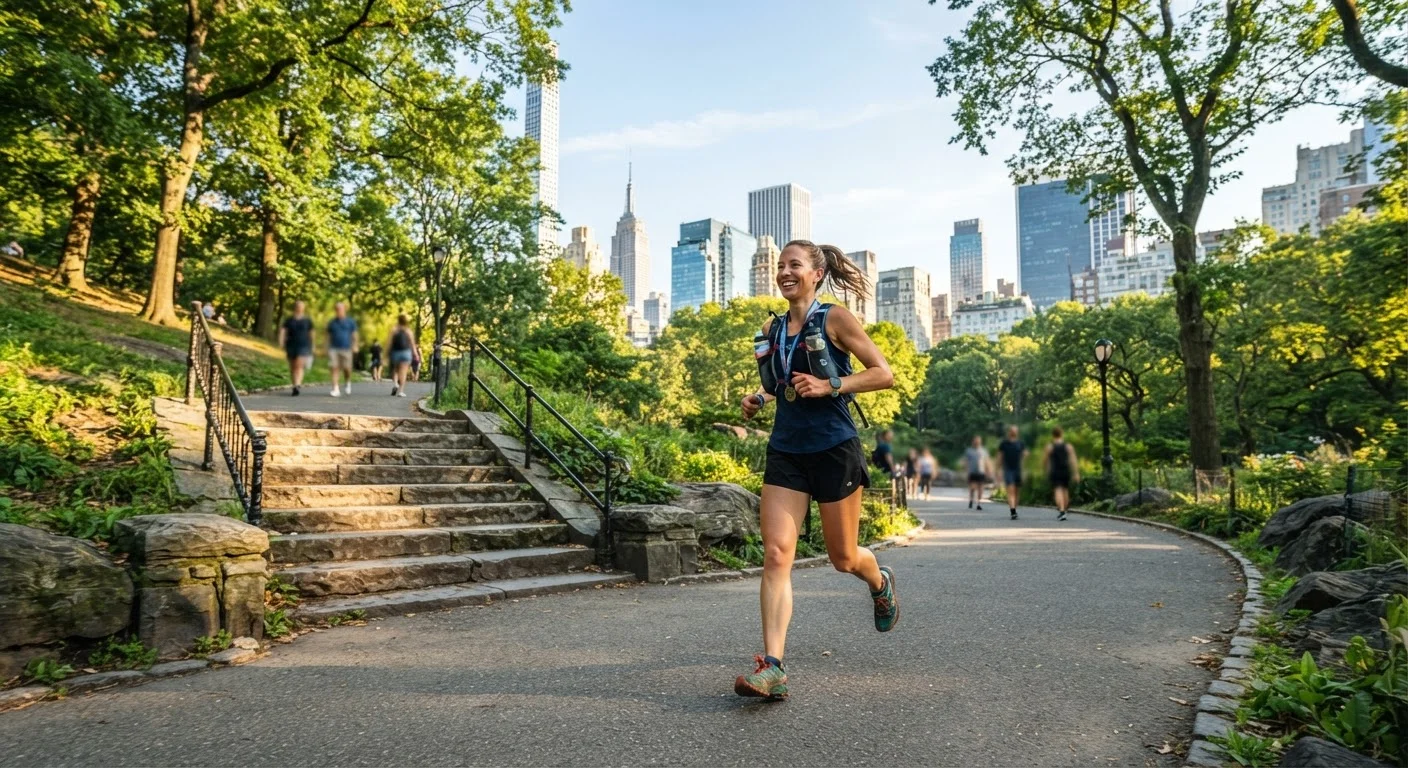
- Parks and open green spaces: Suitable for running, bodyweight circuits, yoga, and stretching. Many urban parks include outdoor fitness equipment — look for it along main paths.
- Public staircases and steps: Ideal for stair climbing intervals, step-ups, and single-leg strength work. Monumental staircases near landmarks are often particularly well-maintained.
- Wide pavements and pedestrian zones: Good for brisk walking, jogging, and lunges. Early mornings typically mean less foot traffic.
- Hotel corridors and room floors: When outdoor options are limited by weather or safety, a hallway offers space for walking lunges, and your room floor is sufficient for push-ups, planks, and core work.
For a deeper exploration of how urban spaces can substitute for a full gym, see urban fitness strategies for travelers.
Build a Simple Bodyweight Circuit for Your Available Space
Once you know your venue, match your workout to it. A basic bodyweight circuit requires no equipment and can be scaled to any fitness level. A straightforward structure: choose four to six exercises, perform each for 30–45 seconds with brief rest intervals, and repeat the circuit two to three times. Useful exercises that travel well include:
- Squats and jump squats
- Push-up variations (standard, wide, narrow)
- Reverse lunges
- Glute bridges (performable on a park bench or room floor)
- Plank holds and mountain climbers
If you have access to stairs, stair climbs between sets add a cardiovascular element without any equipment. The article building a movement-rich day without a gym offers additional ideas for structuring equipment-free activity.
Use Walking as a Structured Workout, Not Just Transport
Walking is consistently underrated as exercise, particularly when done at a purposeful pace. In an unfamiliar city, you can combine sightseeing with structured movement by setting a distance or time goal rather than just wandering. Walking uphill, taking stairs instead of escalators, and varying your pace all increase the physical demand.
To maximize steps without adding dedicated workout time, integrate movement into planned activities: walk to a restaurant rather than taking a taxi, choose accommodation that requires you to climb stairs, or add a 20-minute detour on the way back from a meeting. The daily movement hub has practical strategies for embedding more steps into any kind of day.
Adapt and Iterate Based on What You Find
Your first outdoor workout in a new city is reconnaissance as much as exercise. Notice what worked — a quiet path, a useful set of steps, a shaded plaza — and adjust the next session accordingly. If the weather or neighborhood changes your plans, fall back on a hotel room circuit rather than skipping movement entirely.
The goal is consistency of habit, not perfection of setting. Travelers who maintain activity across trips typically do so by lowering their expectations for any single session while keeping the frequency high. For travelers still deciding whether hotel gyms are worth the effort, exploring options beyond the hotel gym is a useful complement to this approach.
Pack Light, Move More
A resistance band and a jump rope weigh almost nothing and dramatically expand your workout options in any space. Neither requires a gym, and both can be used in a hotel room, a park, or a rooftop. If you're committed to staying active while traveling, these two items offer the highest return per gram of luggage.
Once you've established a pattern, you'll find that the skill of adapting your workouts transfers well beyond travel. Our piece on turning everyday routines into more steps shows how the same mindset applies at home.
This article is for general informational purposes only and does not constitute medical or fitness advice. Consult a qualified healthcare or fitness professional before beginning a new exercise program, particularly if you have any underlying health conditions.