

Key Takeaways
Why Travel Disrupts Sleep More Than You Think
Most travelers blame a bad night's sleep on an uncomfortable mattress or a noisy corridor. Those factors matter, but the deeper disruptors are physiological. Your circadian rhythm — the internal 24-hour clock regulating hormone release, body temperature, and alertness — is exquisitely sensitive to environmental cues. Cross several time zones, alter your meal schedule, or expose yourself to bright light at the wrong time, and your clock loses its anchor.
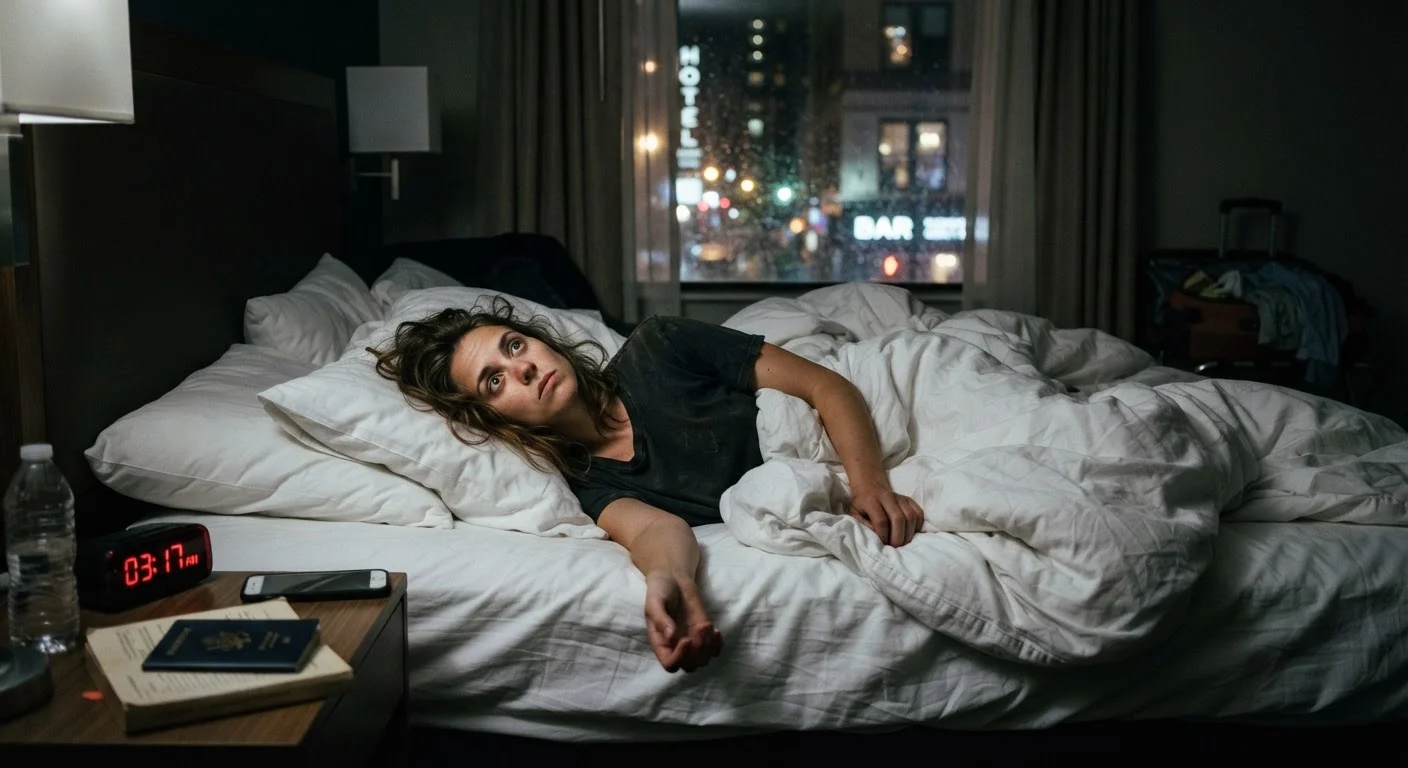
Research on what sleep scientists call the first-night effect shows that one hemisphere of the brain remains in lighter sleep during an unfamiliar night, essentially standing guard in a new environment. This is measurable on EEG and explains why even a comfortable hotel room can produce fitful, unrestorative sleep — it's a neurological response, not just nerves.
Jet lag adds another layer. Flying east tends to be harder than flying west because advancing your body clock is biologically more difficult than delaying it. Cabin pressurization, low humidity, and reduced oxygen partial pressure at altitude also affect how rested you feel on arrival — separate from what time zone your body thinks it inhabits. For a closer look at the science behind these mechanisms, see why your sleep suffers when you travel.
It's also worth noting that frequent travelers — those crossing time zones repeatedly within weeks — don't fully adapt between trips. Chronic circadian disruption has well-documented associations with mood instability, reduced immune function, and digestive issues. The gut-clock connection is one underappreciated consequence that many road warriors don't link back to their sleep debt.
Alcohol Is Not a Sleep Aid
Many travelers use alcohol to hasten sleep onset in unfamiliar rooms. While it can reduce the time it takes to fall asleep, alcohol suppresses REM sleep — the restorative phase associated with memory consolidation and emotional regulation — and typically causes wakefulness several hours into the night as it metabolizes. This is particularly problematic on long-haul flights and the first night at a new destination, when sleep quality is already compromised.
What You Need Before You Start
Effective sleep protection on the road isn't improvised at check-in. A few deliberate preparations make the strategies below significantly more effective.
What you will need
With these in place, you're ready to work through the steps systematically rather than reactively.
Step-by-Step: Protecting Your Sleep From Departure to Arrival
Shift your sleep window gradually before departure
If you're crossing three or more time zones, begin nudging your bedtime and wake time toward the destination's schedule two to three days before you fly. For eastward travel, go to bed and wake 30–60 minutes earlier each day. For westward travel, shift later. This doesn't eliminate jet lag, but it reduces the size of the gap your body clock needs to bridge on arrival.
Use light exposure strategically on the day of travel
Light is the primary signal your suprachiasmatic nucleus — the brain's master clock — uses to set your rhythm. On eastward flights, seek bright morning light at your destination and avoid bright light in the evening for the first two days. On westward flights, do the opposite: evening light helps delay your clock. Wearing sunglasses during unwanted light periods is a practical tool many travelers underuse.
Set your watch — and your behavior — to local time immediately
As soon as you board, mentally and behaviorally commit to destination time. Eat, hydrate, and attempt sleep according to when those activities would normally occur at your destination, not at home. Anchoring yourself to two time zones simultaneously prolongs adaptation. If it's nighttime at your destination mid-flight, use your sleep mask and earplugs and attempt rest even if you don't feel tired.
Optimize your hotel room environment on arrival
Request a room away from elevators, ice machines, and street-facing walls when booking or at check-in. On arrival, immediately set the thermostat to a cool sleeping temperature — most sleep researchers consider the mid-60s Fahrenheit (around 18°C) a reasonable general range, though individual preference varies. Block out light with the curtains fully drawn or use your sleep mask. If noise is unavoidable, a consistent background sound (a fan or white noise app) masks irregular sounds more effectively than silence.
Build a minimal but consistent pre-sleep routine
Your brain relies on behavioral cues to begin releasing melatonin. Consistent pre-sleep behaviors — a short stretch, dimming the room lights 30–45 minutes before bed, limiting screen use — act as reliable signals even in unfamiliar spaces. You don't need an elaborate ritual; you need a consistent one. The same sequence done nightly at home and replicated on the road tells your nervous system the environment is safe to relax in. For more on which wind-down habits actually work physiologically, see what actually signals your brain it's time to sleep.
Resist compensatory behaviors that compound the problem
Long naps (over 20–30 minutes) during the day, alcohol as a sleep aid, and heavy meals close to bedtime all feel like logical coping strategies but consistently worsen sleep architecture. Alcohol shortens REM sleep and causes rebound wakefulness in the second half of the night. Daytime naps longer than a short rest delay your ability to fall asleep at the local bedtime. If you exercise while traveling — which supports sleep quality — timing it to the late afternoon rather than late evening may help maintain your rhythm. See how jet lag affects exercise performance for more on the circadian-exercise relationship.
Consistency Beats Perfection Every Time
You won't replicate your home sleep environment on the road, and trying to optimize every variable can itself become a source of anxiety that disrupts sleep. Focus on two or three anchors — consistent wake time, strategic light exposure, and a brief wind-down cue — and hold those even when everything else is imperfect. Stability in a few key behaviors is more protective than a long checklist executed inconsistently.
Poor in-flight choices are one of the most common wellness gaps travelers overlook — a pattern explored in detail in common wellness mistakes travelers make. And if you're weighing whether to watch a film or sleep on a long-haul flight, the evidence-based answer is explored in screen time vs. rest on long-haul flights.
This article is for general informational and educational purposes only and is not a substitute for professional medical advice. If you have ongoing sleep difficulties, a sleep disorder, or a chronic health condition, consult a qualified healthcare professional before making significant changes to your sleep routine.