

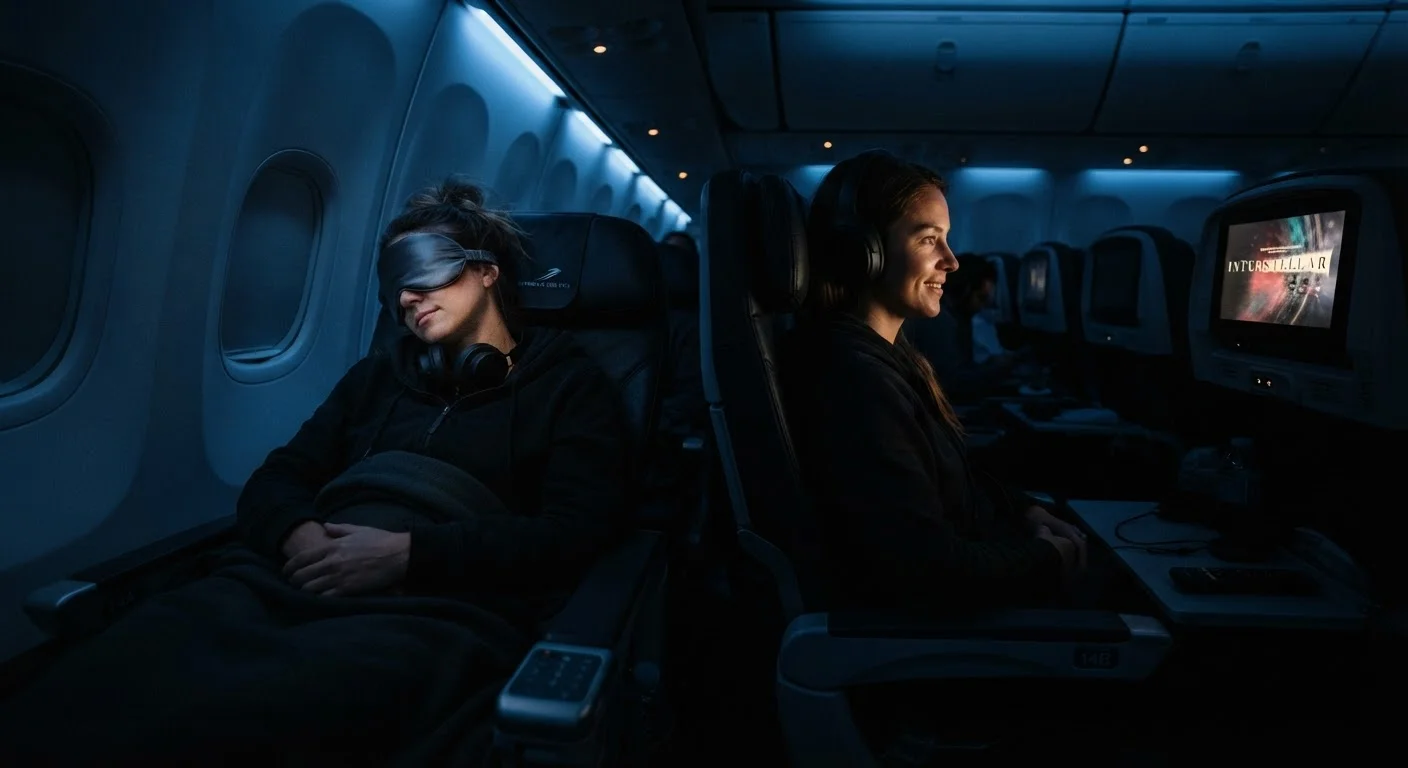
Key Takeaways
Reduces flight anxiety and perceived duration
Engaging content occupies attention and can meaningfully lower stress during long or turbulent flights, making the journey more tolerable.
Beneficial for westward or daytime-arrival flights
When you're landing during waking hours at your destination, staying alert mid-flight may actually support a smoother circadian adjustment.
Supports mental decompression between work and travel
For travelers transitioning from demanding schedules, passive entertainment can offer a genuine mental reset before arrival demands begin.
Flexible — can be timed strategically
Watching during the first leg of a long flight, before any planned sleep window, lets travelers enjoy entertainment without sacrificing recovery-critical rest.
Blue light suppresses melatonin before sleep windows
Screen use in the 60–90 minutes before attempting sleep on the plane delays melatonin onset, making it harder to fall and stay asleep in an already challenging environment.
Worsens jet lag on eastbound long-haul routes
Staying awake through what would be nighttime at the destination keeps the body anchored to origin-time rhythms, prolonging adjustment after landing.
Cognitive fatigue compounds with sleep deprivation
Passive screen use doesn't restore the brain the way sleep does; arriving with a full content queue watched and no sleep often means impaired focus and mood for the first day.
Eye strain worsened by dry cabin air
Low cabin humidity dries the eyes faster, and extended screen use amplifies discomfort — a compounding issue on already physically taxing long-haul flights.
Our Verdict
Neither choice is universally right. On eastward long-haul flights where arrival coincides with nighttime at your destination, prioritizing sleep is strongly supported by circadian science. On shorter or westward routes where flexibility exists, a film or two poses minimal recovery risk. The most informed travelers use destination local time as their guide and treat sleep as a deliberate strategy rather than an afterthought.
Travelers on long-haul or multi-time-zone flights who want to minimize jet lag and arrive functional, not exhausted.
Why This Choice Actually Matters
Most travelers treat the in-flight entertainment menu as a default — something to fill the hours between boarding and landing. But on flights spanning six or more time zones, what you do with those hours has a measurable effect on how well your body adjusts to a new schedule.
Circadian rhythms — the internal 24-hour biological clock governing sleep, alertness, hormones, and digestion — are highly sensitive to light exposure and sleep timing. Disrupting them across time zones is exactly what produces jet lag: fatigue, foggy thinking, and irregular sleep at your destination. The decisions you make mid-flight, including whether to watch three movies or attempt four hours of sleep, feed directly into this system.
This isn't about eliminating enjoyment from travel. It's about making an informed trade-off. For more on why travel fundamentally disrupts rest, see why your sleep suffers when you travel.
The Case for In-Flight Entertainment
Reduces flight anxiety and perceived duration
Engaging content occupies attention and can meaningfully lower stress during long or turbulent flights, making the journey more tolerable.
Beneficial for westward or daytime-arrival flights
When you're landing during waking hours at your destination, staying alert mid-flight may actually support a smoother circadian adjustment.
Supports mental decompression between work and travel
For travelers transitioning from demanding schedules, passive entertainment can offer a genuine mental reset before arrival demands begin.
Flexible — can be timed strategically
Watching during the first leg of a long flight, before any planned sleep window, lets travelers enjoy entertainment without sacrificing recovery-critical rest.
Watching films or shows isn't without genuine benefit. Anxiety about flying is common, and engaging content can serve as a legitimate distraction from turbulence, discomfort, or pre-arrival stress. For travelers on westward routes — such as New York to Los Angeles or London to New York — arriving in the afternoon or evening local time, staying mentally alert during the flight may actually ease the adjustment.
Entertainment also reduces perceived flight duration, which matters when physical comfort is already compromised by cabin pressure, limited movement, and dry air. Feeling mentally occupied rather than restless can lower cortisol levels associated with travel stress.
The key variable is when you watch. If your destination's local time is daytime when you land, a few hours of screen time during the flight is unlikely to derail recovery — especially if you stay well hydrated throughout.
The Case for Prioritizing Sleep
Blue light suppresses melatonin before sleep windows
Screen use in the 60–90 minutes before attempting sleep on the plane delays melatonin onset, making it harder to fall and stay asleep in an already challenging environment.
Worsens jet lag on eastbound long-haul routes
Staying awake through what would be nighttime at the destination keeps the body anchored to origin-time rhythms, prolonging adjustment after landing.
Cognitive fatigue compounds with sleep deprivation
Passive screen use doesn't restore the brain the way sleep does; arriving with a full content queue watched and no sleep often means impaired focus and mood for the first day.
Eye strain worsened by dry cabin air
Low cabin humidity dries the eyes faster, and extended screen use amplifies discomfort — a compounding issue on already physically taxing long-haul flights.
Sleep deprivation compounds rapidly across long-haul travel. Arriving with a significant sleep deficit — common after overnight eastbound flights — impairs cognitive function, mood regulation, and immune response. Research consistently shows that even partial sleep on a flight can soften the severity of jet lag compared to remaining awake throughout.
Blue light emitted by seat-back screens and personal devices suppresses melatonin production, the hormone that signals the body to prepare for sleep. Using screens for the final 60–90 minutes before a planned sleep window on the plane makes falling asleep meaningfully harder in an already difficult environment.
~30%
Melatonin reduction from blue light exposure
Research published in the Journal of Clinical Endocrinology & Metabolism found that evening exposure to blue-enriched light can suppress melatonin levels by roughly 30% compared to dim light conditions.
5+ hours
Sleep debt typical after overnight long-haul flights
Studies on transmeridian travelers consistently find significant sleep deficits after overnight long-haul routes, particularly among passengers who remained awake for most of the journey.
Timing sleep to align with nighttime at your destination — even if it's midday at your origin — is one of the most evidence-supported strategies for resetting your circadian rhythm faster. This requires treating sleep as a planned activity: using an eye mask, earplugs or noise-cancelling headphones, a neck pillow, and limiting screen use during that window. For context on what else disrupts in-flight and travel rest, this overview of sleep on the road is worth reading.
Making a Practical Decision for Your Flight
The most useful framework is simple: check the local time at your destination when you'll land, then work backwards. If arrival is in the morning or early afternoon local time, sleep during as much of the overnight flight as possible and limit screens to the first hour or two after takeoff. If you're landing in the late afternoon or evening, a moderate amount of entertainment followed by a short rest is a reasonable balance.
Short-haul flights under four hours rarely warrant much adjustment — the circadian impact is modest. The calculus shifts significantly on flights of eight hours or more, especially across five or more time zones.
A Practical Mid-Flight Compromise
You don't have to choose between zero entertainment and maximum sleep. Many sleep researchers suggest a two-phase approach: watch content during the first one to two hours after takeoff, then transition intentionally into a sleep window timed to your destination's night. Dim your screen, switch the interface to night mode, and give yourself a buffer of screen-free time before closing your eyes. Small adjustments like these preserve some enjoyment without sacrificing the sleep that matters most.
Combining your rest strategy with light movement also helps. Getting up periodically, stretching, and walking the aisle improves circulation and reduces the stiffness that makes sleep harder. See movement snacks for long-haul flights for practical ideas that work around a crowded cabin.
Whatever you choose, consistency matters more than perfection. One film watched during a sensible window won't derail recovery. Four films watched through what should have been your sleep hours might. Treat it as a deliberate decision rather than a default, and your arrival-day self will notice the difference.
This article is for general informational purposes only and does not constitute medical advice. Consult a qualified healthcare professional for guidance related to sleep disorders, circadian health conditions, or any personal medical concerns.