

Key Takeaways
Why Moving on a Long-Haul Flight Actually Matters
Spending eight, twelve, or even sixteen hours in a pressurized aluminum tube is genuinely hard on the body. Cabin air tends to be dry and low in humidity, circulation naturally slows during extended inactivity, and the confined seating position compresses the hip flexors, hamstrings, and lower back in ways that can linger well past landing.
The most commonly cited concern is deep vein thrombosis (DVT) — the formation of blood clots, typically in the legs, during prolonged immobility. While DVT is more likely in people with specific risk factors, extended sitting on flights is a recognized contributing circumstance. Beyond clot risk, many travelers simply arrive feeling stiff, sluggish, and puffy — outcomes that can blunt the first day or two of any trip.
The good news is that you don't need much space or time to counteract these effects. The concept of "movement snacks" — brief, intentional bouts of physical activity distributed across a longer period — translates well to the flight cabin. Research supports the idea that frequent short movement sessions can meaningfully support circulation and muscular comfort when sustained exercise isn't possible. For a broader look at how this principle applies beyond the airport, see movement snacks for busy schedules.
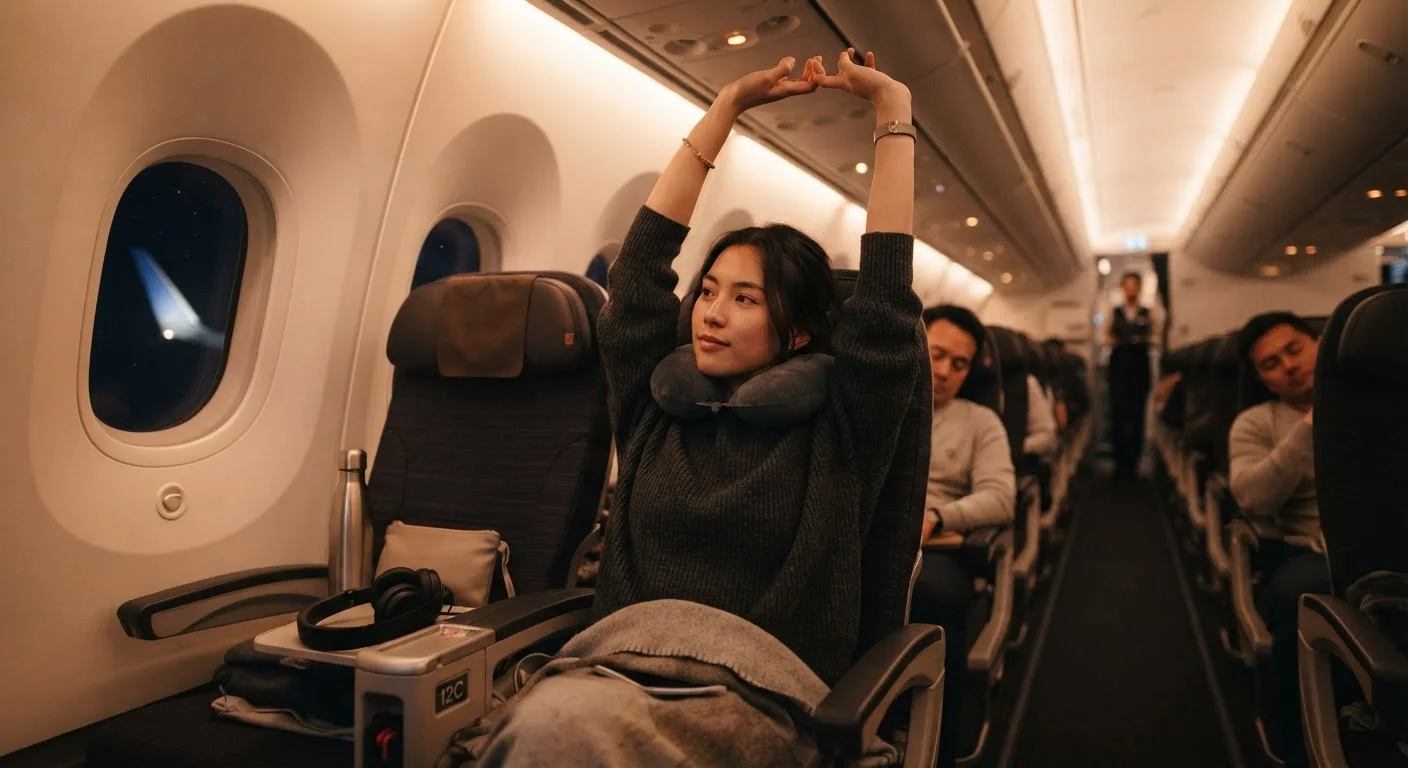
The exercises below are designed to be low-profile, safe to perform in a standard economy seat or nearby aisle, and effective enough to make a real difference over the course of a long flight.
Ankle Circles and Alphabet Tracing
This is arguably the most important in-seat exercise for circulation. Lift one foot slightly off the floor and rotate the ankle slowly in full circles — ten rotations clockwise, then ten counterclockwise. Repeat on the other side. For variety, try "writing" the alphabet with your toes, which moves the ankle through its full range of motion in multiple directions.
The calf muscles act as a secondary pump for venous blood return to the heart. Activating them through ankle movement helps keep blood moving when you're not walking. This exercise can be done under the seat in front of you without attracting any attention.
Ankle circles activate the calf's venous pump — your most important in-seat circulation tool.
Seated Calf Raises
With both feet flat on the floor, press through the balls of your feet to raise your heels as high as possible, hold briefly, then lower slowly. Aim for two to three sets of fifteen to twenty repetitions. This exercise directly contracts the gastrocnemius and soleus muscles — the two main calf muscles responsible for pumping blood back up the leg.
Calf raises work equally well standing in the aisle if you want to combine light movement with a stretch break. Hold the overhead bin or headrest for balance and perform the same motion in a standing position for a slightly greater range of motion.
Calf raises directly contract the muscles most responsible for pumping blood back toward the heart.
Seated Hip Flexor and Glute Activation
Extended sitting shortens the hip flexors and leaves the glutes in a prolonged inactive state — a combination that contributes to lower back discomfort both in-flight and after landing. To counter this, perform a seated glute squeeze: tighten both glutes firmly, hold for five seconds, and release. Ten repetitions per set, several times throughout the flight.
Follow this with a seated knee-to-chest stretch: grasp one knee with both hands and draw it gently toward your chest, holding for twenty to thirty seconds per side. This stretches the glute and lower back simultaneously without requiring aisle space.
Glute squeezes and knee-to-chest stretches directly address the muscle groups most compressed by prolonged sitting.
Shoulder Rolls and Neck Releases
The upper body bears its own postural toll during long flights — particularly the neck and upper trapezius muscles, which tighten when holding the head still against headrests or looking at small screens. Shoulder rolls — five forward, five backward — decompress the shoulder girdle and encourage thoracic mobility. Follow with slow neck tilts: bring your right ear toward your right shoulder and hold gently for twenty seconds, then switch sides.
Avoid aggressive neck rotations or any movement that causes sharp discomfort. Gentle, sustained holds are more effective and safer than rapid or forceful stretching.
Gentle shoulder rolls and neck tilts release the upper-body tension that accumulates from hours of static posture.
Aisle Walk and Standing Forward Fold
When it's safe to move through the cabin — typically during cruising at stable altitude — walk to the rear galley or an open aisle area and perform a brief standing forward fold. With feet hip-width apart, hinge at the hips and let your upper body hang forward, bending the knees slightly if needed. This decompresses the lumbar spine and stretches the hamstrings after prolonged hip flexion in the seat.
Even a two-minute walk to stretch your legs provides meaningful contrast to prolonged sitting. Combine it with the standing calf raises from item two for a more complete micro-session. Always follow crew instructions and stay seated during turbulence.
A brief aisle walk combined with a standing forward fold decompresses the lower back more effectively than any seated stretch.
Deep Diaphragmatic Breathing
While not exercise in the conventional sense, deliberate diaphragmatic breathing — breathing slowly and fully into the belly rather than the chest — supports both relaxation and circulation. Inhale for a count of four, expanding the abdomen; hold briefly; exhale slowly for a count of six. Repeat for five to ten cycles.
The diaphragm's pumping action during deep breathing creates pressure changes in the thoracic cavity that assist venous blood return. It also activates the parasympathetic nervous system, which can reduce the low-grade stress that long travel days often produce. This exercise pairs well with any of the seated movements above as a natural cooldown or transition.
Deep diaphragmatic breathing supports venous circulation and activates the body's parasympathetic recovery response.
Making Movement Part of Your Flight Routine
The key to actually doing these exercises mid-flight is building them into a rhythm rather than relying on willpower. Setting a quiet timer or alarm every 60 to 90 minutes is a simple way to remind yourself to move — many smartwatches include an inactivity alert that works well for this purpose.
Set a Recurring Movement Reminder
Use your phone's timer or a smartwatch inactivity alert to prompt movement every 60 to 90 minutes. Treat each alert as a non-negotiable two-minute break — the same way you might step away from a desk. Consistency matters far more than the duration of each session.
If you're in an aisle seat, take advantage of natural breaks — meals, bathroom visits, or a stretch of turbulence-free cruising — to perform a few of the standing or aisle-based movements. Window-seat passengers can still complete every seated exercise on this list without disturbing their neighbors.
Pair your movement routine with adequate hydration. Mild dehydration is common on flights and compounds the effects of inactivity, making tissues less pliable and increasing overall fatigue. Limiting alcohol and caffeine — both diuretics — and sipping water consistently throughout the journey supports the same goals your movement snacks are targeting. For more on managing the interplay between rest and activity during long flights, how you use screen time and sleep matters too.
If you have a pre-existing circulatory condition, have recently had surgery, or are pregnant, consult your healthcare provider before travel for personalized guidance on in-flight movement and compression support. This article is general wellness information and is not a substitute for medical advice.
Once you've landed, keep the momentum going. Staying active throughout your full trip doesn't have to be complicated — even short movement sessions in the days that follow help your body readjust after a long-haul journey. And if a packed itinerary is your usual obstacle, fitting movement into a busy travel day is more achievable than it sounds.
This article is for general informational purposes only and does not constitute medical advice. If you have health concerns related to air travel, speak with a qualified healthcare professional before your journey.