

Key Takeaways
Option A
Bodyweight Training
The zero-kit, anywhere approach to staying strong.
Best for: Travelers who want a reliable workout with absolutely nothing to pack or carry.
Option B
Resistance Bands
The lightweight upgrade that adds genuine load variety.
Best for: Active adults who want to replicate gym-style resistance work in a hotel room or small space.
If you travel light and refuse to pack any gear
Bodyweight Training
Push-ups, squats, lunges, and planks require nothing beyond floor space and your own bodyweight — perfectly suited to carry-on-only travel.
If you want to maintain muscle mass and load progression while traveling
Resistance Bands
Bands allow you to vary tension and target pulling muscles like the back and biceps that bodyweight exercises struggle to load adequately.
If you're new to exercising on the road
Bodyweight Training
No setup, no learning curve — bodyweight movements are familiar and easy to start immediately, even after a long flight.
If you have a specific rehabilitation or mobility focus
Resistance Bands
Bands offer low-load, controlled resistance that is commonly used in physical therapy contexts, making them useful for targeted mobility or recovery work. Always consult a healthcare professional before starting any rehabilitation program.
If you want the most versatile setup without sacrificing luggage space
Resistance Bands
A set of flat or loop bands fits in a jacket pocket and effectively doubles the exercise variety available in a small hotel room.
What Each Approach Actually Offers
Staying active while traveling doesn't require a gym membership or a heavy bag of equipment. The two most practical options — bodyweight training and resistance bands — each come with a distinct set of trade-offs worth understanding before you decide what to bring (or not bring) on your next trip.
Bodyweight training uses gravity and your own mass as the load. Movements like push-up variations, squats, reverse lunges, glute bridges, and plank progressions can challenge most major muscle groups. The ceiling on difficulty is real, but it's higher than many people expect — single-leg squats, archer push-ups, and pike holds are demanding by any standard. The practical advantage is absolute: nothing to pack, nothing to forget, nothing to break.
Resistance bands are elastic tools — typically flat therapy bands or looped fabric bands — that create tension throughout a movement rather than just at its peak. That continuous tension is actually a different stimulus from free weights, and research suggests it can be effective for muscle activation and hypertrophy. Bands are especially valuable for pulling movements (rows, pull-aparts, face pulls) that bodyweight training handles poorly without a bar. A full set weighs under 500 grams and compresses into a small pouch.
For a deeper look at how these approaches compare in a home routine context, see our full home routine comparison.
| Criterion | Bodyweight Training | Resistance Bands |
|---|---|---|
| Pack weight | Zero — nothing to carry | Under 500g for a full set |
| Setup time | Instant — no setup | 1–2 minutes to anchor or position |
| Pulling exercises | Limited without a bar | Rows, pull-aparts, curls — all accessible |
| Load progression | Via leverage and volume | Via band thickness or stacking |
| Noise level | Low (jumping aside) | Very low — nearly silent |
| Space required | Roughly a yoga mat footprint | Roughly a yoga mat footprint |
| Durability concern | None | Latex can degrade with heat or age |
| Beginner accessibility | Very high — movements are familiar | High — some technique learning needed |
The Practical Realities of Training on the Road
Travel introduces constraints that make gear choices more consequential than they are at home. Space, noise, time pressure, and fatigue all shape what you'll actually do at 7 a.m. in a hotel room.
~150g
Weight of a single loop resistance band
A standard fabric loop band weighs roughly 150 grams, meaning a set of five adds less than a typical paperback book to your luggage.
2–3x/week
Frequency linked to strength maintenance
General exercise guidelines from major health organisations suggest two to three resistance sessions per week are sufficient to maintain muscle mass during periods of reduced training volume.
Bodyweight training wins decisively on friction. You can run through a circuit the moment you wake up, in any configuration of furniture, on carpet or tile, without anchoring anything or worrying about damaging the room. That low threshold matters: evidence suggests that shorter, more consistent sessions are often more sustainable during travel than longer, sporadic ones.
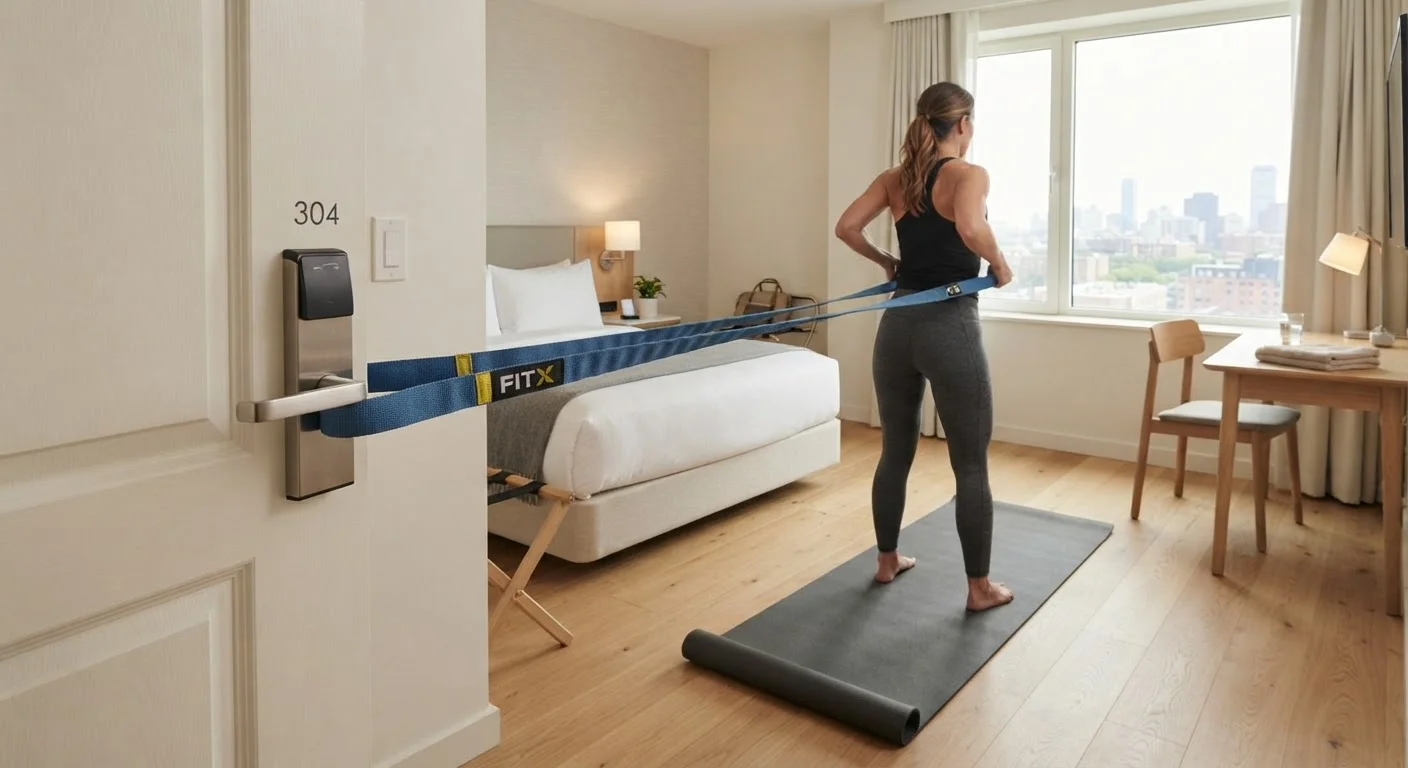
Resistance bands do require a small amount of setup — anchoring to a door, looping around furniture, or simply holding them under your feet. That's a minor but real barrier when you're jet-lagged. They also have durability considerations: latex bands can snap, particularly in extreme temperatures (common when bags sit in cargo holds or hot cars), so checking them before use is a sensible habit.
Where bands pull ahead is specificity. If your training normally includes rows, lat work, or external shoulder rotation exercises, bodyweight alternatives are awkward at best. A set of bands closes that gap meaningfully. If you're new to working out while traveling, starting with bodyweight keeps things simple; experienced exercisers often find bands worth the minimal added weight.
It's also worth noting that neither method fully replicates heavy compound loading. For most travelers the goal is maintenance — preserving strength and routine — rather than peak development. As explored in what's actually possible with bodyweight work, bodyweight training has genuine limits for advanced strength athletes, and bands share some of those same ceiling constraints.
The broader case for equipment-free fitness is well established — home workouts can deliver real fitness outcomes when programmed consistently, and travel training is simply home training in a different room.