

Key Takeaways
Our Verdict
Neither short workouts nor full sessions win outright — what matters most is which format you'll actually complete. Short workouts reliably preserve fitness and mental well-being during travel; full sessions offer more when time and facilities allow. The smartest travelers adapt fluidly between both rather than committing rigidly to one.
| Best for | Recommended |
|---|---|
| Frequent travelers with unpredictable schedules | Short workouts (15–20 minutes) |
| Those pursuing structured strength or endurance goals | Full sessions when available |
| Travelers staying in one place for several days or more | A hybrid of short daily movement plus longer sessions |
| Anyone prioritizing mental health and energy management on the road | Short workouts (consistent daily movement) |
The Real Question Isn't Duration — It's Consistency
When fitness routines meet travel schedules, something usually gives. The debate between squeezing in a 15-minute hotel room circuit versus finding a full hour at a gym gets framed as a question of effectiveness — but that framing misses a more fundamental issue: the workout you actually do is infinitely more valuable than the optimal one you skip.
Research consistently shows that shorter, high-effort sessions can maintain cardiovascular fitness, muscular endurance, and even strength over periods of reduced training volume. A review published in the Journal of Strength and Conditioning Research found that training frequency and effort intensity both play significant roles in preserving fitness during deload or disrupted periods. That's encouraging news for anyone navigating a packed travel itinerary.
That said, full sessions do offer genuine advantages that a 20-minute circuit simply cannot replicate — particularly for people working toward specific strength, hypertrophy, or endurance benchmarks. Understanding where each approach actually delivers helps you make smarter decisions on the road. For a deeper look at what the broader evidence says, see what research says about short vs. longer sessions.
Short Workouts While Traveling: Honest Strengths and Limits
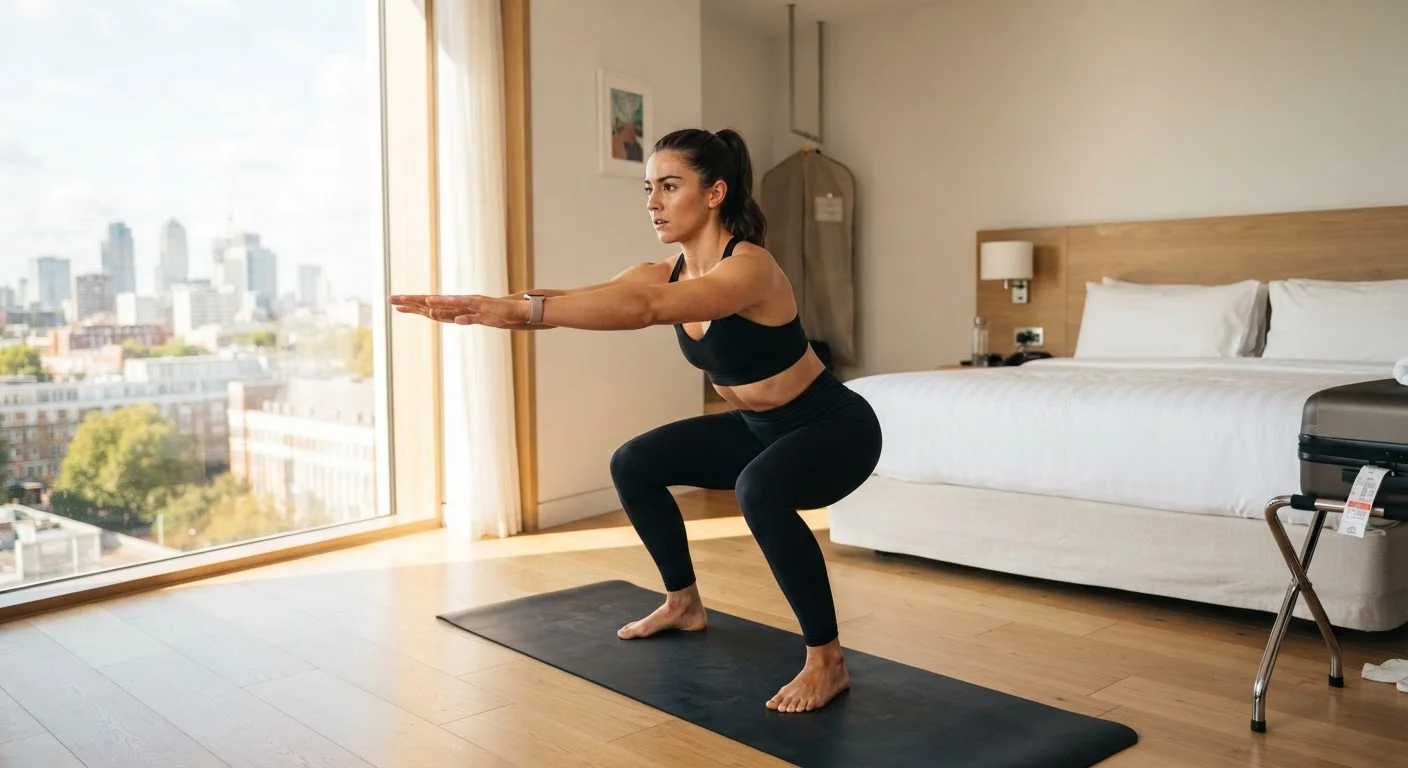
A 15–25 minute bodyweight or resistance-band circuit done in a hotel room has several concrete advantages for travelers:
- Low barrier to entry. No commute to a gym, no equipment dependency, no scheduling conflict with early flights or late meetings.
- Metabolic and cardiovascular maintenance. High-intensity interval formats and compound bodyweight movements — squats, push-up variations, lunges, hip hinges — can keep your aerobic capacity and muscular endurance from significantly declining over a short trip.
- Mental health benefit. Even brief movement sessions reduce cortisol and support mood regulation, which matters considerably when travel-related stress, jet lag, and disrupted sleep are already stacking up.
- Flexibility. You can complete a meaningful session before breakfast, between meetings, or after a long travel day.
The honest limitation: short workouts cannot fully replicate training volume. Progressive overload — the gradual increase in resistance that drives strength and muscle adaptation — is difficult to achieve in a 20-minute bodyweight session. If you're mid-program on a structured strength plan, brief sessions will maintain more than they build.
For practical ideas beyond the hotel fitness center, explore exercise options that go beyond the hotel gym.
| Short Workouts (15–25 min) | Full Sessions (45–60 min) | |
|---|---|---|
| Equipment needed | None or minimal (bodyweight, bands) | Gym or more varied equipment preferred |
| Fitness maintenance | Effective for most travelers | Effective and can build on progress |
| Strength/hypertrophy gains | Limited without resistance | Achievable with proper load |
| Scheduling flexibility | Very high — fits almost any itinerary | Requires dedicated time block |
| Mental health benefit | Meaningful, even at short duration | Significant, especially with exercise variety |
| Best trip length | Any trip, especially short | Extended stays (7+ days) |
Full Sessions on the Road: When They're Worth Pursuing
A complete 45–60 minute workout — whether at a hotel gym, a local fitness facility, an outdoor park, or using resistance equipment — provides training stimulus that short sessions cannot fully match. For travelers with access to even basic equipment, full sessions are worthwhile when:
- You have a structured program with specific volume requirements (sets, reps, load).
- Your trip extends beyond a week, making maintenance-only training a meaningful regression risk.
- You're using travel as an opportunity for active recovery through longer, low-intensity movement like hiking or swimming.
The practical challenge is logistics. Gym access varies enormously by destination, hotel gyms are often limited or inconsistently equipped, and finding a local facility takes time you may not have. Urban fitness strategies for travelers offer a useful middle ground — parks, staircases, and open public spaces can support a genuine full session without requiring a gym membership.
Plan Your Workout Options Before You Arrive
Spending five minutes before a trip to identify nearby parks, running routes, or fitness facilities removes a significant decision-making burden mid-travel. Many cities have free outdoor fitness areas or public tracks that work well for a full session. Apps that map local running routes or outdoor gyms can make this research quick and useful.
Travelers pursuing structured training goals benefit from planning their workout options before arriving — checking what's available in the area rather than hoping the hotel gym will be sufficient.
Building a Practical Travel Fitness Strategy
The most effective approach for most active adults isn't a binary choice — it's a flexible hierarchy. On days with constrained time or limited access, a short, focused session wins over nothing. On days with more latitude, a fuller session compounds your progress meaningfully.
A few principles that hold up across both formats:
- Prioritize compound movements. Whether you have 15 minutes or 60, exercises that work multiple muscle groups simultaneously — squats, deadlifts, rows, push-ups — deliver the most return per minute of effort.
- Match intensity to duration. Shorter sessions demand higher effort density. If you're working with 20 minutes, the pace and challenge need to compensate for the reduced volume.
- Use your environment. Bodyweight exercises and resistance bands are both effective travel tools — understanding the tradeoffs between them helps you pack and plan smarter.
- Don't neglect incidental movement. Walking between destinations, taking stairs, and exploring on foot all contribute to your overall activity level. These aren't substitutes for structured exercise, but they meaningfully support it. For broader strategies, see healthy travel habits that keep you active on the road.
This article is for general informational purposes only and does not constitute medical or fitness advice. Consult a qualified healthcare or fitness professional before making significant changes to your exercise routine, particularly if you have an existing health condition.