

Key Takeaways
Why the City Is a Better Gym Than You Think
Most travelers who struggle to maintain fitness on the road share one assumption: that exercise requires a dedicated facility. In practice, cities are dense with functional training environments — inclined streets, park benches, open plazas, pedestrian staircases — that are available around the clock and cost nothing to access.
The key shift is perceptual. Rather than looking for a gym to replicate what you do at home, you start reading the urban landscape as a training resource. This approach is well-supported by exercise science: bodyweight resistance, cardiovascular effort, and functional movement patterns can all be achieved without a barbell or a treadmill. Research consistently shows that consistent moderate activity — regardless of venue — supports cardiovascular health, muscular endurance, and mental well-being.
Whether you're on a two-day business trip or a three-week itinerary, the strategies below give you a repeatable framework for staying active. For a broader look at sustaining fitness habits on the road, see the complete guide to fitness while traveling.
Use Staircases for Interval Training
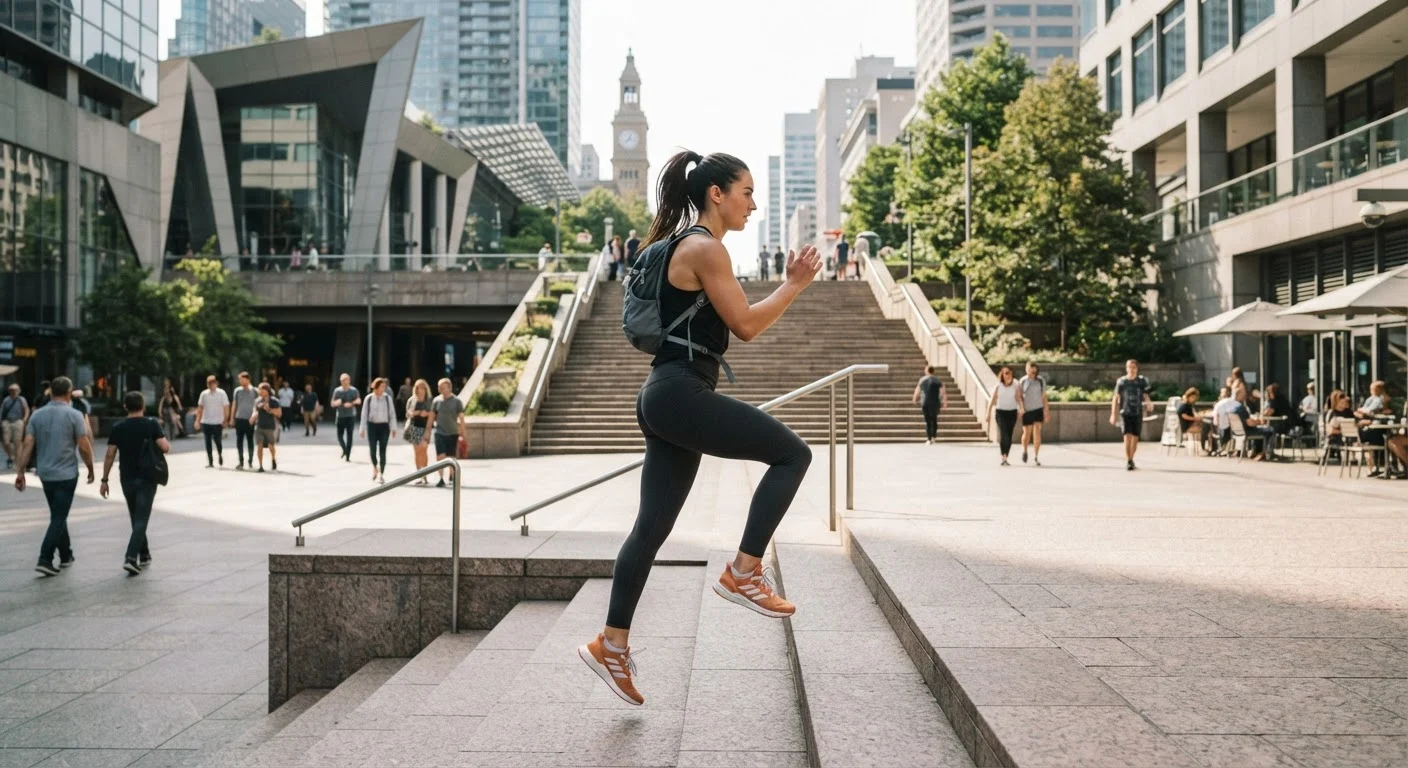
Public staircases — at transit stations, monuments, parks, or open plazas — are among the most underused training tools in any city. Stair climbing engages the glutes, hamstrings, and calves at a higher intensity than flat-ground walking and elevates heart rate quickly, making it effective for cardiovascular conditioning and lower-body strength in a short window.
A simple protocol: climb at a brisk pace, descend slowly for active recovery, and repeat for 10–20 minutes. You can increase difficulty by taking two steps at a time or adding calf raises at the top of each flight. No equipment, no membership — just a set of stairs and a timer.
Stair climbing elevates heart rate and builds lower-body strength in under 20 minutes.
Turn Park Benches Into Resistance Equipment
A sturdy park bench is a versatile piece of functional equipment. It supports incline push-ups, tricep dips, step-ups, Bulgarian split squats, and seated core work. These movements collectively address the major upper-body and lower-body muscle groups that a conventional gym session would target.
When selecting a bench, check that it's stable and fixed to the ground. Perform a firm press test before loading it with bodyweight. Most city parks in major urban areas have at least one suitable bench within a short walk of central accommodation.
A park bench supports push-ups, dips, step-ups, and split squats — a full session without a gym.
Run as Sightseeing, Not Separate Exercise
Running a city's main boulevards, waterfronts, or historic districts at an easy aerobic pace is one of the most efficient ways to combine tourism and training. A 30–45-minute run at conversational pace covers meaningful ground, provides genuine cardiovascular benefit, and orients you to a neighborhood in a way that no map app replicates.
Plan a loose route the night before using satellite view to identify pedestrian-friendly paths, riverside promenades, or park loops. Many cities have well-documented running routes shared by local running communities — a quick search before you travel can surface options suited to your fitness level and time available.
An easy 30-minute city run delivers aerobic benefit while orientating you to a new neighborhood.
Use Building Lobbies and Covered Walkways in Bad Weather
Weather is the most common reason urban training plans collapse. Covered public spaces — wide hotel corridors at quiet hours, covered pedestrian walkways, large interior atriums — can serve as improvised movement venues when outdoor conditions are unsuitable. Hallway walking lunges, wall-supported exercises, and core sequences require only a few square metres.
This is not about intense sessions; it's about preserving the habit on days when conditions work against you. Even 15 minutes of structured movement maintains momentum and, according to exercise adherence research, habit consistency matters more than session intensity for long-term fitness outcomes.
Preserving the habit on bad-weather days matters more than the intensity of any single session.
Treat Walking with Intent as a Training Mode
Not all urban movement needs to be classified as a workout to contribute meaningfully to your fitness. Intentional walking — brisk pace, upright posture, varied terrain — accumulates significant cardiovascular and metabolic benefit across a travel day. Research on non-exercise activity thermogenesis (NEAT) shows that incidental movement throughout the day contributes substantially to overall energy expenditure and cardiovascular health.
Practical applications: choose stairs over escalators, walk between destinations that would otherwise be a short taxi ride, and opt for elevated or hilly routes when possible. For more on building this kind of activity into your daily structure, the daily movement hub offers additional strategies.
Brisk, intentional walking on varied terrain accumulates meaningful cardiovascular benefit across a travel day.
Scout Outdoor Fitness Installations
Many cities — particularly in Europe, Asia, and Latin America — have invested in outdoor fitness installations in public parks: pull-up bars, parallel bars, balance beams, and resistance stations. These are free, open to the public, and often well-maintained. They support more structured strength work than improvised bench exercises and can anchor a more complete training session.
Before you travel, search the destination city's name alongside terms like "outdoor gym" or "calisthenics park" to identify available facilities. Apps that map outdoor workout stations have become more comprehensive in recent years and are worth checking for major urban destinations. For a full inventory of options beyond hotel fitness rooms, see why hotel gyms aren't your only option.
Free outdoor fitness installations in city parks can anchor a structured strength session with no membership needed.
Making Urban Training a Habit, Not a Hack
Urban fitness works best when it's woven into how you already move through a city rather than treated as a separate task. Scout your training spots the evening before — a quick map search for parks, waterfronts, or pedestrian areas takes minutes and removes morning decision fatigue. Pair your workout with something you'd do anyway: an early run through a neighborhood you want to explore, or a staircase session at a landmark you're visiting.
Scout Your Training Spots the Night Before
Spend five minutes before bed using a map application to identify a nearby park, pedestrian staircase, or open plaza within walking distance of your accommodation. Knowing exactly where you're going removes the morning friction that most often causes travel fitness routines to break down. Pair this with laying out your workout clothes the night before to reduce the number of decisions you need to make before you start moving.
If you want to go deeper on structuring movement into days that don't allow for dedicated sessions, the guide on building a movement-rich day without a gym offers practical habit-stacking strategies that translate well to travel. And if you're weighing whether brief urban sessions are worth the effort, short workouts vs. full sessions provides an honest comparison of both approaches.
This article is for general informational purposes only and is not a substitute for personalised advice from a qualified fitness or healthcare professional. Consult a professional before starting a new exercise routine, particularly if you have any existing health conditions.