

Key Takeaways
Location-Independent Exercise
Location-independent exercise refers to any physical activity that doesn't depend on access to a gym, specific equipment, or a fixed training facility. It encompasses bodyweight training, outdoor movement, and creative use of everyday environments. For travelers, this mindset shifts the question from 'where's the gym?' to 'what can I do with what's here?'
Research on exercise adherence consistently shows that flexibility in workout format — rather than rigid gym dependence — is a stronger predictor of long-term consistency.
The Hotel Gym Problem
Anyone who travels regularly has encountered the hotel gym reality: a windowless room with two treadmills, a set of fixed dumbbells that top out at 30 pounds, and a cable machine that's been out of order since 2019. Even when the equipment works, the hours may not — many hotel gyms lock before dawn and after 10 p.m., cutting off the windows that frequent travelers most depend on.
This isn't a knock on hotels. Fitness centers are an amenity, not a core service, and most properties aren't designing them for serious athletes. The real issue is the mental dependency that many active adults develop around gym access — the feeling that without a proper facility, the workout simply can't happen.
Travel can disrupt or expand your fitness practice, depending entirely on how flexible your approach is. Expanding that flexibility starts with recognizing how many alternatives exist beyond the fitness center door.
Your Room Is Already a Training Space
A standard hotel room — even a modest one — offers enough floor space for a complete bodyweight session. Push-up variations, squat patterns, hip hinges, core work, and unilateral leg exercises can collectively address most major muscle groups. The limiting factor is rarely space; it's programming knowledge and willingness to adapt.
Structured circuits using five to eight exercises, performed for time or reps, can sustain cardiovascular output and muscular stimulus without a single piece of equipment. For travelers carrying resistance bands, the options expand further — rows, pull-aparts, banded squats, and hip abduction exercises fill gaps that pure bodyweight can't easily address.
Pack Light, Train Smarter
A looped resistance band weighs under two ounces and fits in any bag. Combined with bodyweight movements, it can replicate the core function of a full cable machine setup. If you're checking luggage, a set of three bands at different resistance levels covers almost every travel training scenario without adding meaningful weight.
The home workout framework applies directly here: the principles that make equipment-free training effective at home translate almost perfectly to a hotel room environment.
The City as Your Gym
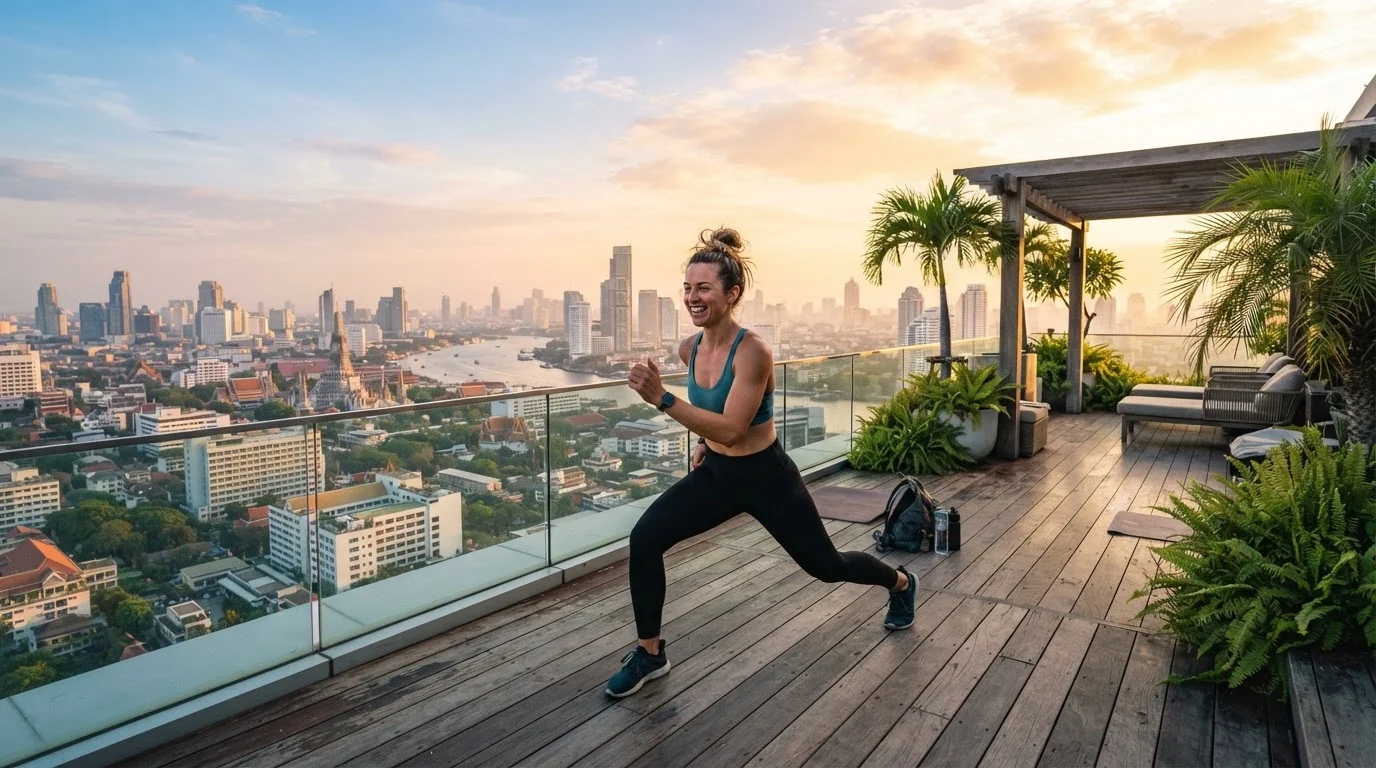
Every urban destination contains infrastructure that doubles as fitness equipment. Staircases in hotels, office buildings, and public spaces provide genuine cardiovascular and lower-body conditioning. Park benches support dips, step-ups, and incline push-ups. Open grass allows sprints, agility work, or yoga flows. Pedestrian paths become running routes.
Urban environments are richer training grounds than most travelers realize. Morning runs double as neighborhood exploration. Staircase repeats in a multi-level parking structure take under 20 minutes but deliver a meaningful training stimulus. The mental reframe — from 'I need a gym' to 'I need to move' — is where consistency begins.
For those who prefer structure, many cities have outdoor fitness stations in public parks, free to use and often underutilized by visitors. Checking local parks and recreation department websites before arrival can surface these options quickly.
Community and Day-Pass Options
When a proper gym session is genuinely important — whether for heavy lifting, swimming, or a specific class format — travelers have more access than they may realize. Municipal recreation centers, university athletic facilities, and independently operated gyms in most mid-size and large cities offer day passes or short-term visitor memberships. These are often significantly less expensive than resort-style hotel gym upgrades.
Swimming pools deserve special mention. Many hotels without fitness centers have pools, and lap swimming is a highly effective full-body workout that's easy to sustain without equipment or coaching. Community pools near your accommodation are another option worth investigating.
Adapting to local infrastructure is a skill that becomes easier the more deliberately you practice it. Before each trip, a five-minute search for 'day pass gym' or 'public pool' plus your destination can open up meaningful options.
“The gym is a tool, not the destination. When you understand that movement is what matters — not the machine — you stop being hostage to your zip code.”
— Kelly Starrett, Physical therapist and mobility researcher, author of works on human movement and performance
Consistency Over Perfection
The most important shift for active travelers isn't finding a better gym — it's releasing the expectation that every workout must match what you do at home. A 25-minute bodyweight circuit in a hotel room, a 3-mile run through an unfamiliar neighborhood, or a staircase session before a morning meeting all count. They maintain the habit, preserve conditioning, and often deliver experiences that a gym session never would.
Shorter sessions can be surprisingly effective when intensity and focus replace duration. The trade-offs of gym-free training are real but manageable — and for a trip of a few days to a few weeks, the maintenance goal is well within reach through flexible, location-independent movement.
This article is for general informational purposes only and does not constitute medical or fitness advice. Consult a qualified healthcare or fitness professional before beginning any new exercise program, particularly if you have existing health conditions.